London Daily

Focus on the big picture.
Wednesday, Jul 01, 2026

Covid: Planned redundancies at lowest level since 2015

Covid: Planned redundancies at lowest level since 2015

Employers are planning the lowest number of job cuts for over six years, as the economy reopens after the pandemic.

Redundancy figures for June from the Insolvency Service saw 15,661 positions put at risk in Great Britain.

Last June saw nearly ten times that number, the worst on record.

The reduction in expected redundancies comes despite the imminent end of the furlough scheme which was designed to protect jobs during the pandemic.

Employers planning 20 or more redundancies have to file a form called HR1 notifying government at the start of the process.

This data gives an early indication of moves in the labour market, months before they show up in the official unemployment figures.

Proposed redundancies have been on a downward trend since September, despite two lockdowns being imposed across most of the UK during that period. June saw the lowest monthly total since February 2015.
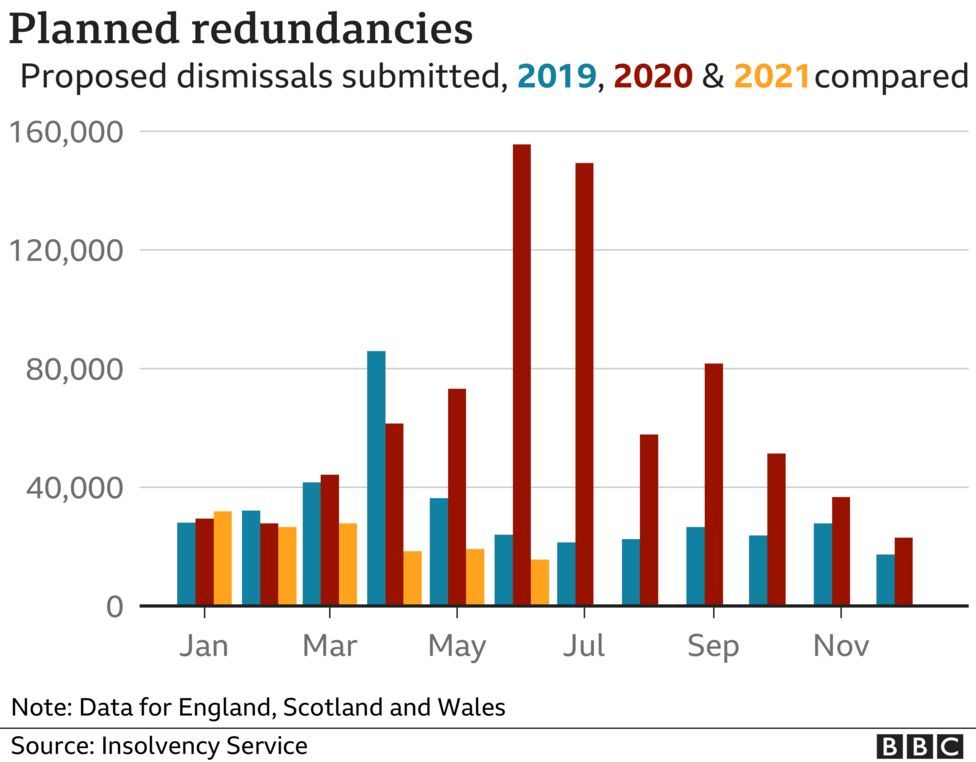

Redundancy figures from the Office for National Statistics have shown a similar trend, a few months later.

"The data suggest that there is no spike in redundancies coming in July or August," says Xiaowei Xu, senior research economist at the Institute for Fiscal Studies. "The labour market is in a much better position than anyone expected at the start of the pandemic, and it shows how well the furlough scheme has worked,"

The latest numbers are the lowest since the Insolvency Service tightened up reporting guidelines, according to Tony Wilson of the Institute for Employment Studies.

Before that, it was more common for firms to fail to file the necessary paperwork when planning redundancies, leading to artificially lower figures, he says.

The number of HR1 forms filed has also been falling this year, with 179 forms filed by 151 different employers.
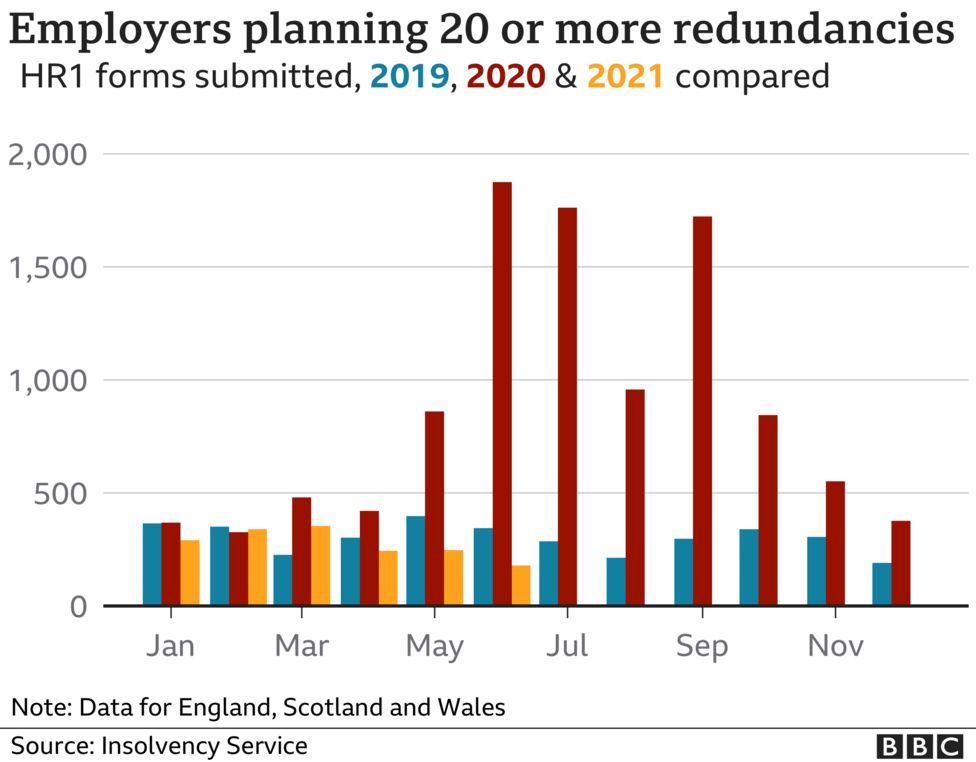

That's the lowest number of forms since 2014, despite the winding down of the furlough scheme, where the government has supported jobs in the pandemic by paying wages when employers cannot.

No rise despite end of furlough


From July, employers will have to pay 10% of employees' wages, on top of pension contributions and employer's National Insurance. That rises to 20% in August, until the scheme finishes completely at the end of September.

"Anyone who has been on furlough this year has already cost their employers money - so their employers must be keen to keep them on. It's not surprising that they are not being made redundant in large numbers," says Ms Xu.

A total of 11.6 million jobs have been furloughed during the pandemic, though only 2.4 million were still on furlough at the end of May.


The success of the furlough scheme and the vaccine programme have lead many economists to cut their forecasts of how many jobs would be lost in the pandemic.

"By the time the furlough scheme ends on 30 September, the economy is likely to be strong enough to support a level of employment not far off where it is now. In fact, there is evidence that firms are finding it increasingly difficult to hire workers, especially in industries such as transport and manufacturing," says Ruth Gregory, senior UK economist at Capital Economics.

"I think it's likely that many firms have already made and communicated their plans and that with the easing of restrictions happening on schedule next week, we just won't see any significant increase in redundancy notifications over the next few months," says Mr Wilson.

Until recently, HR1 data were not routinely published, except for in Northern Ireland.

Last year the BBC began requesting these figures through the Freedom of Information Act, revealing the extraordinary increase in redundancy plans through the spring and summer of 2020.

This year, the Insolvency Service has started to publish these figures every month on its website.

The data only covers firms proposing 20 or more job cuts, so smaller firms are not picked up by these figures. Employers sometimes notify more redundancies than they eventually make.

The figures are not classified as Official Statistics, which are subject to rigorous quality control procedures.

Data for Northern Ireland is published by the Northern Ireland Statistics and Research Agency as part of its monthly Labour Market Report.


As furlough support reduces we hear from a worker who has been in and out of work over 15 months.


Newsletter

Related Articles

0:00
0:00
Close
Global Billionaire Numbers Rise 13 Percent Amid Artificial Intelligence Stock Boom
Body of Fifteen-Year-Old Boy Recovered from Manchester Reservoir
Major Rail Disruption in UK After Cows Stray Onto Intercity Tracks
UK Launches National Campaign to Reduce Water Consumption After Heatwave
Foreign Secretary David Lammy Raises Case of UK Woman Death with US Authorities
Shetland Islands Council Approves Subsea Tunnel Plans Linking Major Islands
Telegraph Media Group Takeover by German-Led Consortium Completed
Resident Doctors in England Accept Government Pay and Conditions Deal
Andy Burnham Sets Out Ten-Year Economic Vision Amid Labour Leadership Debate
Asylum Seekers in UK Face £10,000 Contribution Requirement Under New Law
UK Government Moves to Break Apple and Google App Store Dominance
New UK Steel Tariffs and Import Quotas Aim to Shield Domestic Industry
Damning Report Exposes Failures in Maternity and Neonatal Care Across England
Government Data Reveals Five Billion Pound Shortfall in UK Defence Budget
Prime Minister Keir Starmer Unveils Three Hundred Billion Pound Defence Investment Plan
UK Crime and Policing Act 2026 Comes into Force with New Justice System Reforms
UK Prime Minister Hosts NATO Secretary General Mark Rutte for Security Talks at Downing Street
UK Tightens Oversight of Emissions Trading Scheme Through New Ministerial Directions
UK Issues Statement at UN Security Council on Violence in the West Bank
UK Environment Agency Clears Illegal Waste Site in West Yorkshire After Court Action
UK Resident Sentenced for Fraudulently Claiming £30,000 in Covid Business Loans
UK Launches Taskforce to Help Young People Claim Dormant Child Trust Fund Savings
UK Gambling Commission Fines Betfred Operator Petfre Gibraltar £900,000 Over Social Responsibility Failures
UK Appoints Lord Collins as Global Envoy for LGBT+ Rights
UK Expands Detention Capacity to Support Removal of Foreign Criminals and Failed Asylum Seekers
UK Resident Doctors End Strike Action After Accepting Government Pay Deal
UK Tightens Sentencing for Domestic Killings with 25-Year Starting Point for Murder of Partners
UK to Build at Least Six New Royal Navy Warships Under Expanded Defence Programme
UK Government Unveils £5 Billion Defence Investment Plan Focused on Drones and Autonomous Warfare Systems
UK Economy Records 0.6% First Quarter Growth as Services and Manufacturing Drive Steady Expansion
Welsh Government Unveils New Agricultural Support Plan Focused on Sustainability and Rural Growth
UK Teacher Recruitment Shortfalls Continue in Science and STEM Subjects
Police Scotland Expands Cybercrime Investigations Amid Rising Digital Fraud
UK Universities Warn of Risk to International Student Numbers Amid Visa Changes
UK Defence Ministry Pivots Toward Greater Domestic Military Procurement
UK Launches National Rail Review After Repeated Service Disruptions
Northern Ireland Assembly Debates Long-Term Funding Settlement for Public Services
UK Accelerates Approval of North Sea Offshore Wind Projects to Expand Energy Capacity
UK Retail Sales Fall as Households Cut Discretionary Spending in June
UK Expands Border Intelligence Cooperation with France and Belgium to Target Smuggling Networks
Scottish Government Faces Pressure Over Delays in Major Infrastructure and Transport Projects
UK Launches Multi-Billion-Pound Artificial Intelligence Infrastructure Investment Fund
National Health Service Warns of Continued Emergency Department Strain Across England
Bank of England Signals Interest Rate Hold as Wage Growth Keeps Inflation Elevated
UK Sets Emergency Fiscal Strategy as Inflation Pressures and Weak Manufacturing Growth Persist
UK Launches New Measures to Improve Safety Standards in Night-Time Venues
UK Tightens Import Rules for Low-Value Parcels to Support Domestic Retailers
UK Launches £85 Million Obesity Care Programme Targeting Early Intervention Projects
UK Commits Up to $26 Million to Ebola Response in Democratic Republic of Congo
Security Industry Authority Flags Safety Failures in Night-Time Economy Inspections
×