London Daily

Focus on the big picture.
Sunday, Mar 29, 2026

Covid has 'cut life expectancy in England and Wales by a year'

Covid has 'cut life expectancy in England and Wales by a year'

Exclusive: Life expectancy has regressed to 2010 levels, say scientists, with poor hardest hit

The Covid-19 pandemic has cut life expectancy in England and Wales by roughly a year, scientists have estimated, reversing gains made since 2010.

A study, conducted by Oxford researchers, found that life expectancy at birth (LEB) had fallen by 0.9 and 1.2 years for females and males relative to 2019 levels respectively.

Life expectancy in England and Wales had been steadily improving for 50 years before stagnating in the past decade.

“If you look at life expectancy indicators in high-income countries over the 20th century, it has really been a story of an upward trend,” said Ridhi Kashyap, an associate professor of social demography at the University of Oxford, one of the authors of the study.

“What we’re seeing now is a big interruption of the kind of magnitude that we haven’t seen in a really long time … it has been a real shock.”

LEB is defined as how long, on average, a newborn can expect to live, if mortality patterns at the time of its birth sustain in the future.

The Oxford analysis was based on the researchers’ calculation of excess mortality – the number of deaths above what would be expected in a normal year based on the 10-year average from 2010-19 – and encompassed all deaths, including those from Covid-19.

They looked at data from the week beginning 2 March, in which the first death attributable to Covid-19 was registered in England and Wales, to the week ending 20 November and found that 57,419 extra deaths occurred, a roughly 15% increase compared with the expected level in 2020.

Covid-19 in the UK
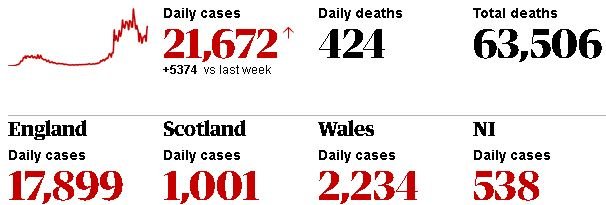
UK data as published 11 December, 2020, national data as published 11 December, 2020. Note: This is the latest available from PHE. UK total is not always the sum of totals for individual countries. Low daily deaths at weekends is often a result of delayed reporting. Weekly change shows new daily cases compared to 7 days ago.


Life expectancy was 83.5 for females and 79.9 for males in 2019. For 2020, those numbers have fallen to 82.6 and 78.7 respectively, the researchers found, noting that this too was likely to be an underestimation given that there were small lags in the registration of deaths.

“To put this into perspective, male and female life expectancy regressed to the levels of 2010,” they wrote in their analysis, which is under peer review.

By way of comparison, in 2015 – a particularly difficult flu year – life expectancy fell across virtually all of Europe. In the UK, deaths associated with flu were estimated at about 28,000, and life expectancy fell by 0.2 years versus the preceding year.

“These potentially scarring effects … I think will have implications for how soon we are able to get back to the trajectory of progress that we had seen in life expectancy,” Kashyap said.

Data compiled by the Office for National Statistics showed England had the highest levels of excess deaths in Europe in the first wave of the pandemic.

Dr Veena Raleigh, a senior fellow at the King’s Fund thinktank, said Covid-19 had a disproportionate impact on the poorest communities – meaning areas with the lowest life expectancy had been hit the hardest. She predicted the gap would widen when official data for 2020 became available.

Patrick Heuveline, a professor of sociology at the University of California, Los Angeles, who recently produced a still-to-be peer-reviewed paper on the sharp fall in life expectancy in the US, conducted a similar analysis for the UK at the request of the Guardian.

Unlike the Oxford team, which based its life expectancy calculation on excess mortality data, Heuveline relied on reported deaths tallied by Johns Hopkins University, which as of 8 December were about 61,500 for the UK.

For the UK to record a one-year fall in life expectancy in 2020, the threshold is 62,500, which he estimated would be reached in days.

Newsletter

Related Articles

0:00
0:00
Close
Thousands Rally in London to Oppose Rise of Far-Right Movements
Hong Kong Official Rejects Allegations of Surveillance Orders Targeting UK-Based Dissidents
PayPal Expands Cryptocurrency Services to Allow UK Users to Buy and Sell Bitcoin
UK Minister Challenges Reform Party’s ‘Pro-Family’ Agenda as Debate Intensifies
Concerns Grow Over Meningitis Risk Among UK Students Amid Warning Signs of New Outbreaks
Japanese Grand Prix 2026: Schedule, UK Start Times and Full Broadcast Details
Electric Vehicles Seen as Strategic Solution to UK Fuel Reserve Concerns
Rise of Lone-Actor Threats and Online Radicalisation Drives New Wave of Antisemitic Attacks in the UK
Canada Advances Plan to Ban Cryptocurrency Donations in Election Campaigns
UK Faces Looming Medicine Shortages as Iran Conflict Threatens Supply Chains
Deadly Meningitis Outbreak in the U.K. Highlights Urgent Need for Vaccination
Fresh Claims Emerge Over Harry and Meghan’s Australia Visit as Insider Speaks Out
NATO Assessment Indicates UK Defence Spending Has Fallen Below Alliance Average
FTSE 100 Slips as Middle East Tensions Weigh on Investor Sentiment
UK Economy Begins to Feel Early Impact of Iran Conflict as Policy Challenges Intensify
Russian National Jailed in UK After Assault Case Linked to Barron Trump’s Alert
Energy Price Surge Accelerates Shift Away from Fossil Fuels in UK Homes
UK Museums House More Than 260,000 Human Remains, New Report Reveals
Surging UK Gilt Yields Reflect Inflation Pressures and Fiscal Uncertainty
UK Issues Updated Guidance on Children’s Screen Time with Focus on Balance and Wellbeing
UK Migration Figures Show Shifting Trends Across Asylum, Visas and Channel Crossings
UK Watchdog Launches Probe into Five Firms Over Alleged Fake Reviews and Ratings
Jaguar Land Rover Halts Production at UK Plant Amid Supplier Disruption
UK Police Reverse Position, Confirm Arrests Will Resume for Palestine Action Protests
UK Small Businesses Face Europe’s Steepest Cost Pressures, New Survey Reveals
US Envoy Urges UK to Proceed with King’s Visit Amid Diplomatic Sensitivities
FTSE 100 Drops Over One Percent as Middle East Tensions Weigh on Markets
UK CO2 Plant Set to Reopen as Authorities Move to Safeguard Supplies Amid Middle East Tensions
Trump Urges Stronger Defence Investment as He Questions Allied Naval Capabilities
New COVID Variant Detected in UK Raises Concerns Over Vaccine Effectiveness
FTSE Russell Moves to Standardise Free-Float Rules for UK and International Listings
HBO Max Launches in UK and Ireland, Marking Major Step in Global Streaming Expansion
UK Signals Readiness to Seize Russian ‘Shadow Fleet’ Vessels in Escalation of Sanctions Enforcement
Escalating Middle East Conflict Seen as Major Threat to UK Economic Stability
Early Challenges Mark Prince Harry and Meghan’s Australia Visit
UK Government Rejects Cover-Up Claims After Theft of Former PM Aide’s Phone
Cyprus Opens Strategic Talks with UK Over Sovereign Base Areas
UK Faces Risk of Sharp Inflation Surge Despite Stable Pre-Crisis Figures
UK Police Arrest Two Over Suspected Antisemitic Arson as Iran Link Investigated
UK Inflation Holds at Three Percent Ahead of Oil Price Shock from Iran Conflict
UK Fuel Prices Face Upward Pressure as Global Oil Trends Raise Cost Outlook
Girlguiding UK Sets September Deadline for Membership Policy Change Affecting Trans Participants
Germany and UK Accelerate Wind Power Expansion to Strengthen Energy Security
UK Moves to Ban Cryptocurrency Donations to Political Parties Over Foreign Influence Concerns
UK and Turkey Finalise Major Air Defence Agreement Worth Billions
Apple Introduces Mandatory Age Verification for iPhone Users in the UK
Diverging Views Emerge Over Meghan Markle’s Planned Australia Appearance
Trump Signals Frustration with UK Leadership Amid Diverging Approaches to Iran Conflict
UK Government Takes Control of Hunterston B as Landmark Nuclear Decommissioning Begins
UK Public Inflation Expectations Jump Sharply in March, Raising Pressure on Bank of England
×