London Daily

Focus on the big picture.
Monday, Sep 21, 2026

Covid: Deaths below average for first time since summer

Covid: Deaths below average for first time since summer

Deaths in the UK have fallen below the five-year average for the first time since the summer.

Experts say it means the winter wave of Covid deaths has ended and lockdown and the vaccine rollout have saved lives.

In the week up to 12 March, 14% of all deaths involved Covid, compared with 44% at the 22 January peak, Office for National Statistics (ONS) figures show.

In January, Covid deaths drove overall mortality in the UK 40% higher than the average seen between 2015 and 2019.

There have been more than 145,000 deaths involving Covid in the UK since the first lockdown, a year ago.

Warmer weather


During the first wave of the virus, tens of thousands of Covid deaths meant many more people were dying overall than during the same months in previous years.

The first lockdown brought cases down - but it took longer for this to translate to a fall in deaths.

Following this lockdown, and in the warmer weather from late June until the beginning of August, deaths dipped back below the five-year average.

But after the first week of August, they again began to rise above levels expected for the time of year.
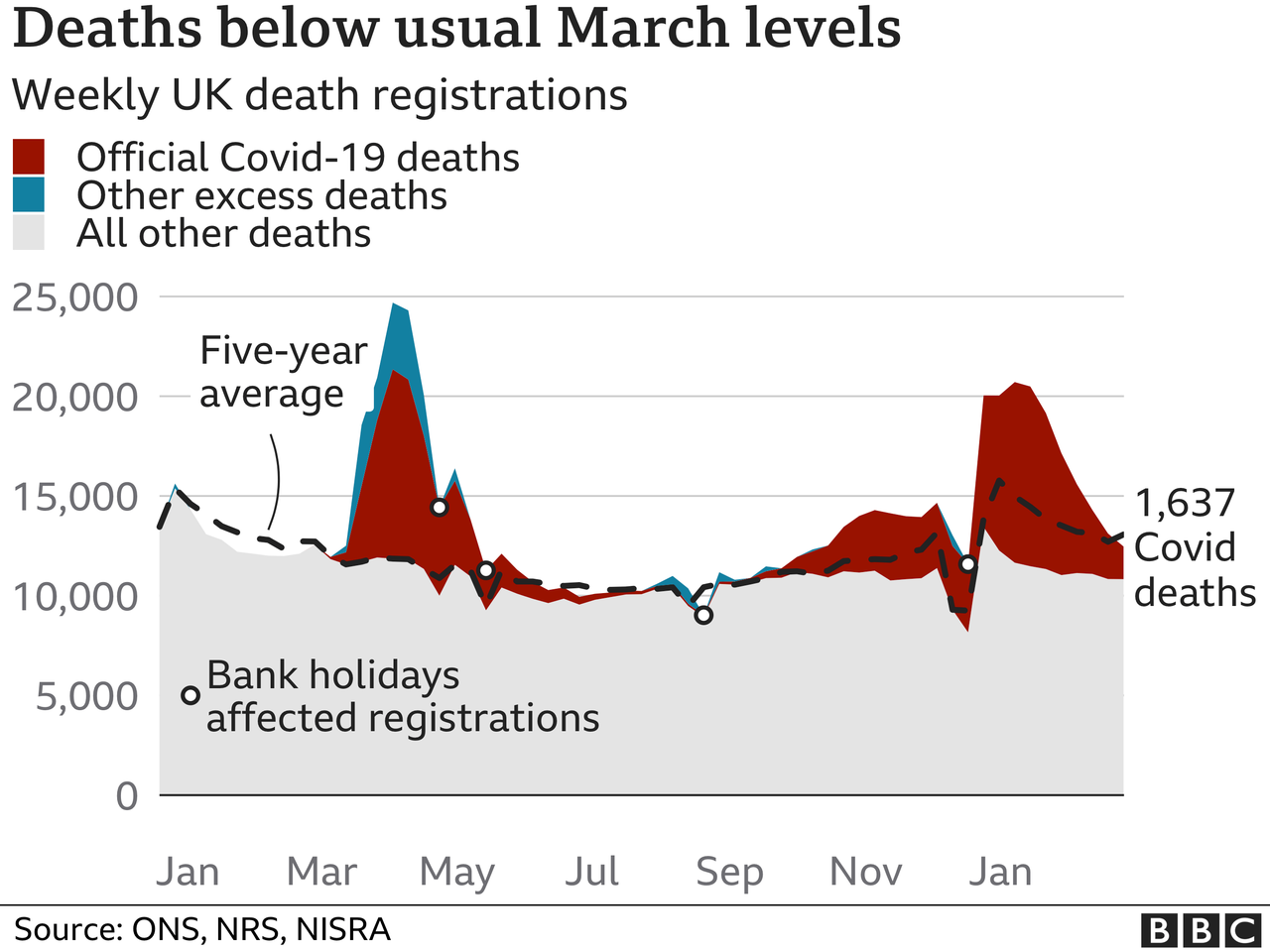

And they remained above expected levels every week since - with the exception of the week ending 4 September, which was skewed by delays in reporting because of the August Bank Holiday - until the second week in March, which saw them fall 5% below the average.

This time we have a tool we did not have previously, though, in the form of vaccines.

Prof Neil Ferguson, director of the Medical Research Council Centre for Global Infectious Disease Analysis, at Imperial College London, said: "The new ONS data on deaths is encouraging in suggesting the second devastating wave of the pandemic is behind us.

"But calling epidemics 'waves' can be misleading in implying a phenomenon which has reached a natural end - that is not the case here.

"The rapid decline in deaths we have thankfully seen is entirely because of the lockdown and the rapid rollout of vaccines.

"So while I'm optimistic that this we will be able to return to something more like normal in the next few months, we need to remain vigilant and cautious in the pace with which social distancing is relaxed - particularly given the threat still posed by new variants of the virus."


Newsletter

Related Articles

0:00
0:00
Close
British Museum Faces Questions Over Peter Thiel’s Private Bayeux Tapestry Viewing
Earl Spencer Memoir Excerpts Renew Public Debate Over Diana’s Death
Liberal Democrats Gather in Brighton for Autumn Conference
Mothercare Shares Plunge as Middle East Store Closures Threaten Long-Term Solvency
Kent Police Treat Folkestone Hotel Fire as Suspicious
Caribbean Governments Advance Reparations Campaign Seeking Engagement With Britain
Scottish Labour Leader Backs Rosebank and Jackdaw North Sea Projects
FCA Urges Young Adults to Trace £1.5 Billion in Unclaimed Child Trust Funds
UK Competition Regulator Opens Inquiry Into McCormick-Unilever Foods Deal
Public Inquiry Into Tees, Esk and Wear Valleys Mental Health Failings Set to Begin
Nigel Farage Looks to US Immigration Enforcement Model for UK Border Policy
Chiltern Railways Moves Into Public Ownership
Security Review Raises Concerns Over Sensitive UK Police Data Stored on Microsoft Cloud
Burnham Government Warns of Difficult Autumn Budget as Fiscal Headroom Narrows
Bank of England Holds Rates at 3.75% as Inflation Rises to 3.1%
Ed Sheeran Tour Faces Backlash After Macklemore Is Removed Over Pro-Palestinian Remarks
Vandalism of Traffic Cameras Intensifies Across Parts of England
Nearly 300 Evacuated as Fire Hits Grand Burstin Hotel in Folkestone
King Charles Warns AI Executives About Risks From Uncontrolled Technology
Church of England Apologises for Role in Historical Forced Adoption Practices
UK Debate Over Online Speech Intensifies After Arrest Figures Draw Scrutiny
Oxfordshire Village Holds Symbolic Independence Vote Over Asylum Accommodation Plan
Nigel Farage and Richard Tice Sue National Crime Agency Over Alleged Banking Data Leaks
Apple Introduces Stricter Age Checks for UK Accounts
BBC Cash Reserves Fall 66% to £125 Million as Broadcaster Restructures
McLaren Announces £500 Million UK Investment and Plans 1,000 Jobs
Green Party Wins Historic Gorton and Denton By-Election as Labour Falls to Third
Burnham Government Prepares October Budget Under Growing Fiscal Pressure
UK Energy Suppliers Pull Fixed-Price Deals as Wholesale Markets Turn More Volatile
Bank of England Holds Rates at 3.75% as Middle East Energy Shock Raises Inflation Risks
Addison Lee Founder Loses £20 Million UK Tax Tribunal Case
BrewDog Creditors Face Losses on About £190 Million of Debt
Harrods Seeks to Recover Abuse Compensation Costs From Mohamed Al Fayed’s Estate
Ed Davey Targets Reform UK as Liberal Democrat Conference Opens
Great Britain Retail Sales Rise 0.5% in August
NHS England Approves Life-Extending Treatment for Incurable Breast Cancer
Proposals to Limit NHS ADHD Diagnoses Draw Criticism From Patient Groups
Resolution Foundation Warns of Housing Cost Crunch for Low-Income UK Families
BBC Cash Reserves Fall to Decade Low as Annual Deficit Reaches £121 Million
Millisecond Software Error Triggered Major UK Air Traffic Control Disruption
Twenty Women Underwent Unnecessary Mastectomies During NHS Cancer Care
Sensitive UK Police Data Found Vulnerable to Access by Foreign Actors
British Steel Faces Renewed Pressure for a Long-Term Financial Plan
MPs Urge Government to End Thames Water Restructuring Talks With U.S. Hedge Funds
Andy Burnham Warns of Difficult UK Budget Choices as Inflation Returns to 3.1%
England Tightens School Food Standards With Restrictions on Deep-Fried and High-Sugar Foods
Oxfordshire Village Votes Symbolically to Leave UK Over Proposed Asylum Centre
Michael Marra Elected Leader of Scottish Labour
BBC Cash Reserves Fall Sharply as Financial Pressures Mount
George Osborne Calls for UK to Rejoin EU Customs Union
×