

Covid-19: More than 30m people in UK receive first jab
Asked about the concerns over supply, Culture Secretary Oliver Dowden said "we always knew there would be ups and downs" but the timetable was on track.
Data shows more than 3.5m adults have now received their second dose.
Meanwhile, the first Moderna jabs are due to arrive in the UK by late April.
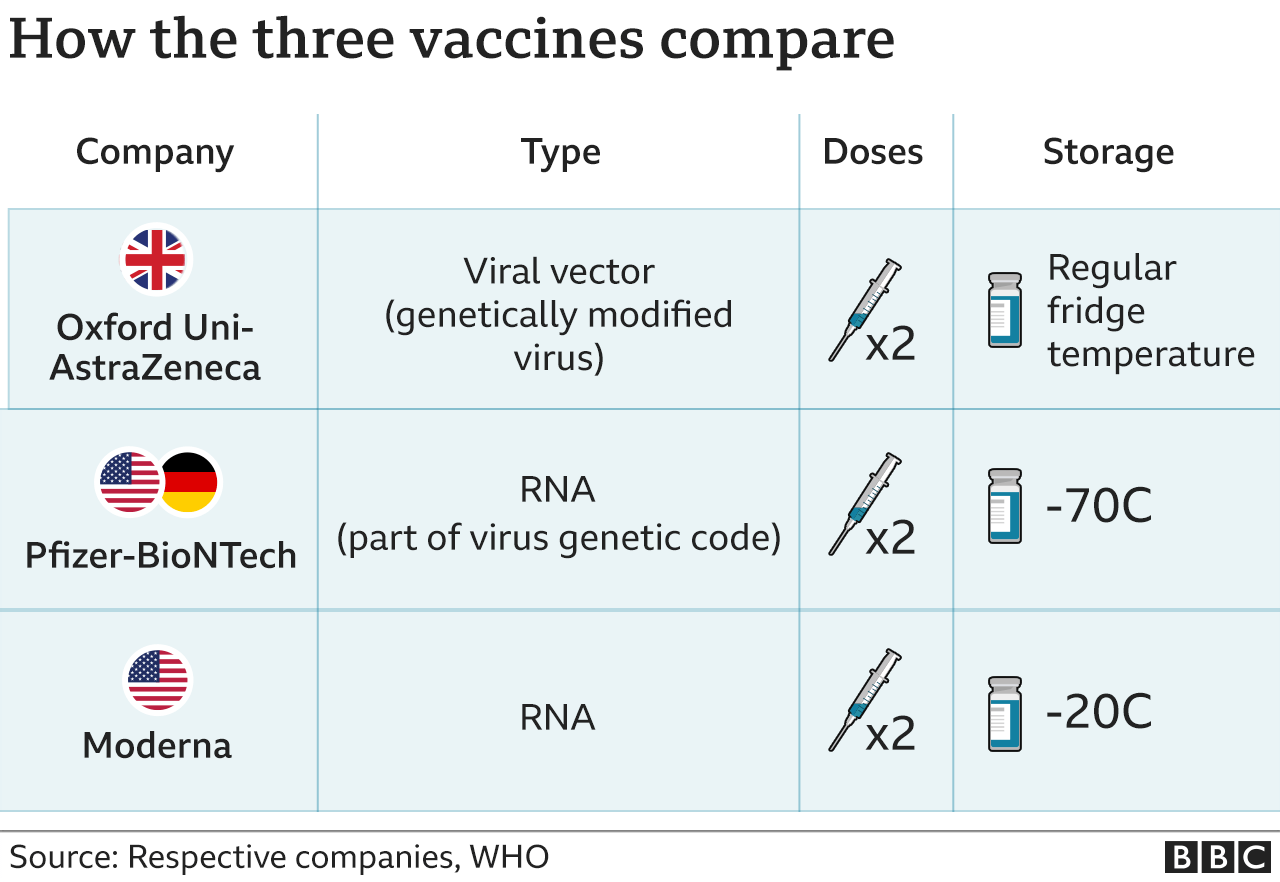
It is the third vaccine of seven that the UK has put in an order for - and the UK is lined up to receive 17 million doses. Like the Pfizer-BioNTech and Oxford-AstraZeneca jabs which are already in use, the Moderna jab is given in two doses several weeks apart.
The latest government figures show 423,852 UK adults received a first dose of either the Pfizer or the Oxford vaccine on Saturday, taking the overall number to 30,151,287 - with 233,964 having their second dose, bringing that total to 3,527,481.
Another 19 deaths of people within 28 days of a positive Covid test were recorded on Sunday, compared to 33 on the same day last week, along with a further 3,862 cases.
Vaccine supply issues have continued to make the rollout bumpy.
Earlier this month, the NHS warned of a significant reduction in jabs available in England in April, and there has been a delay to Oxford-AstraZeneca shipments from India. There are also tensions from the EU over the supply of jabs.
Meanwhile, Northern Ireland's First Minister Arlene Foster has said she hopes the UK will give vaccine doses to the Republic of Ireland, in a bid to help stop the spread of infection in Northern Ireland. She said the idea was "very practical" and she would speak to Boris Johnson about it again.
'Slow-down'
Speaking to the BBC's Andrew Marr Show on Sunday, Mr Dowden said: "We're on track both with the rollout of the vaccine and the roadmap.
"You will have seen the ups and downs - we were surging ahead a couple of weeks ago, there's been a bit of a slow-down now.
"But that doesn't undermine our confidence that we will be able to deliver for that crucial group, the over-50s, by the middle of April and then for the rest of the adult population by the end of July."
Asked whether there will be enough supply for everyone to get their second dose, Mr Dowden said: "That is absolutely essential and in all our planning throughout this, we have borne in mind that we have to get that second top-up and so we're confident we will be able to deliver it."
He also said the government was confident that vaccination centres could meet the 12-week deadline on second doses without resorting to mixing of vaccines - giving a Oxford jab to someone who had Pfizer first time round or vice versa.
Prof Adam Finn, from the Joint Committee on Vaccination and Immunisation, said the Moderna vaccine was an "extra string to our bow" but shipments would be more limited than of the other two vaccines currently in use.
He said it "adds a further line of supply to enable the vaccine programme to move forward into the under-50s" but with Moderna primarily directing their supplies towards the US, it is not a "game-changer".
Are the vaccinators on track with second doses?
* As of Friday, more than 3.2 million people have now had their second dose
* To work out whether the NHS has so far been giving doses within the 12 week-timeframe, we can go back and look at when 3.2 million people had their first dose - that was achieved by 15 January
* So all those 3.2 million people needed to have their second dose by 9 April; that's still 12 days away, which suggests the programme is meeting its targets, even accounting for small changes in the order of people being recalled for second doses
* However, the rate at which first vaccines were given accelerated sharply from mid-January - so it will become more challenging in the coming weeks to deliver the same number of second jabs
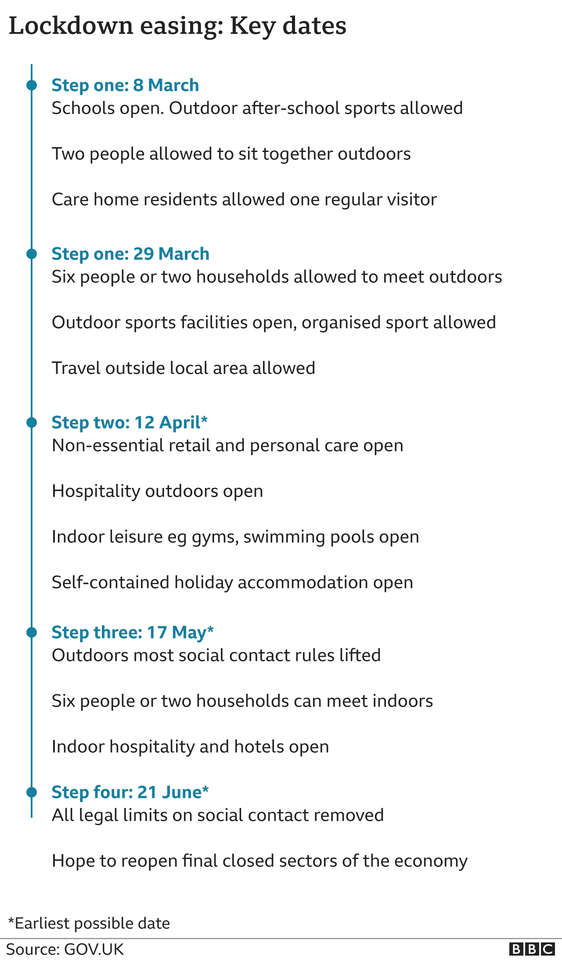
Mr Dowden also said people "still need to abide by the rules after Monday", which is when lockdown rules are next eased in England.
From Monday, six people or two households are allowed to gather together outside and the "stay at home" guidance will be lifted, which coincides with forecasts of warm and sunny weather in some areas.
In Wales, the "stay local" rule was lifted on Saturday and people were allowed to meet in groups of six outside.
Some experts have expressed hesitancy at the planned relaxation of rules.
Prof Mark Woolhouse, who sits on a group that feeds into the government's Scientific Advisory Group for Emergencies (Sage), said with the vaccine rollout performing at its current rate the UK "can get quite close to a full release", but he was "a little bit nervous" about the full relaxation planned for 21 June at the earliest.
Mr Dowden defended the plan, saying it was "cautious" - and the five week gaps between each stage means the government has "four weeks to see the effect of the spread from the easing and then a week to prepare the rules".
But some have been critical of the pace. Sir Richard Sykes, chairman of the scientific body the Royal Institution, said the UK has "gone from being cavalier to crippling caution" when it comes to handling Covid.
He told BBC Radio 4's Broadcasting House programme: "If we are not now well prepared to put up with anything that's thrown at us, then it's God help all of us because that's the best we can do at this point in time."
It comes as a group of charities called for the UK to share its vaccines with poorer countries.