

Covid-19: Lockdown needs to be stricter, scientists warn
Prof Robert West said the current rules were "still allowing a lot of activity which is spreading the virus".
Prof Susan Michie also said the spread of the new more infectious variant meant the restrictions were "too lax".
The government said it had adapted its approach and taken "swift action" to try and stop the spread of the virus.
The warnings come after ministers launched a new campaign urging people to act like they have the virus.
Meanwhile, Buckingham Palace has said the Queen, 94, and the Duke of Edinburgh, 99, received Covid-19 vaccinations on Saturday.
Under the national lockdown, people in England must stay at home and can only go out for essential reasons. Similar measures are in place across much of Scotland, Wales and Northern Ireland.
Prof West, a participant in the Scientific Pandemic Influenza Group on Behaviours (SPI-B), which advises the government's Scientific Advisory Group for Emergencies (Sage), said the new variant of Covid is around 50% more infectious compared to the virus that infected people last March.
"That means that if we were to achieve the same result as we got in March we would have to have a stricter lockdown, and it's not stricter," he said
The professor of health psychology at University College London, also told the BBC more children were going to school, compared to the first lockdown and he said schools were "a very important seed of community infection".
More people are in schools, after the Department for Education has widened the categories of vulnerable and key worker pupils allowed to attend, with attendance rates surging to 50% in some places.
Prof Michie, who is also a member of Sage, agreed the current lockdown was "too lax".
"When you look at the data, it shows that almost 90% of people are overwhelmingly adhering to the rules - despite the fact that we're also seeing more people out and about," she told BBC Radio 4's Today programme.
She said in comparison to the first lockdown last spring more people were allowed to go out to work and children's nurseries were open, making public transport busier.
The number of people travelling by public transport in London has decreased since the latest national lockdown began, with tube journeys now at 18% of the pre-pandemic demand and bus journeys at 30%, according to figures from Transport for London.
However, during the first lockdown passenger numbers fell below 10% at some points.
Prof Michie, a professor of health psychology at University College London, added that the winter season posed extra challenges because the virus survives longer in the cold and people spend more time indoors, where the virus can spread more easily.
Combined with the more transmissible new variant, she said "we should have a stricter rather than less strict lockdown than we had back in March".
Scientists believe the new variant spreads between 50 and 70% faster compared to previous forms of the virus.
Dr Adam Kucharski, another scientist advising the government and an associate professor of infectious disease epidemiology at the London School of Hygiene and Tropical Medicine, said that because the new variant was more transmissible "each interaction we have has become riskier than it was before".
He said that even if people reduced their contacts to levels seen last spring, it would not have the same effect on virus transmission.
Prof Kevin Fenton, London regional director for Public Health England, said there were "things we could do better" to reduce the number of infections, including greater compliance with mask wearing and social distancing when shopping and using public transport.
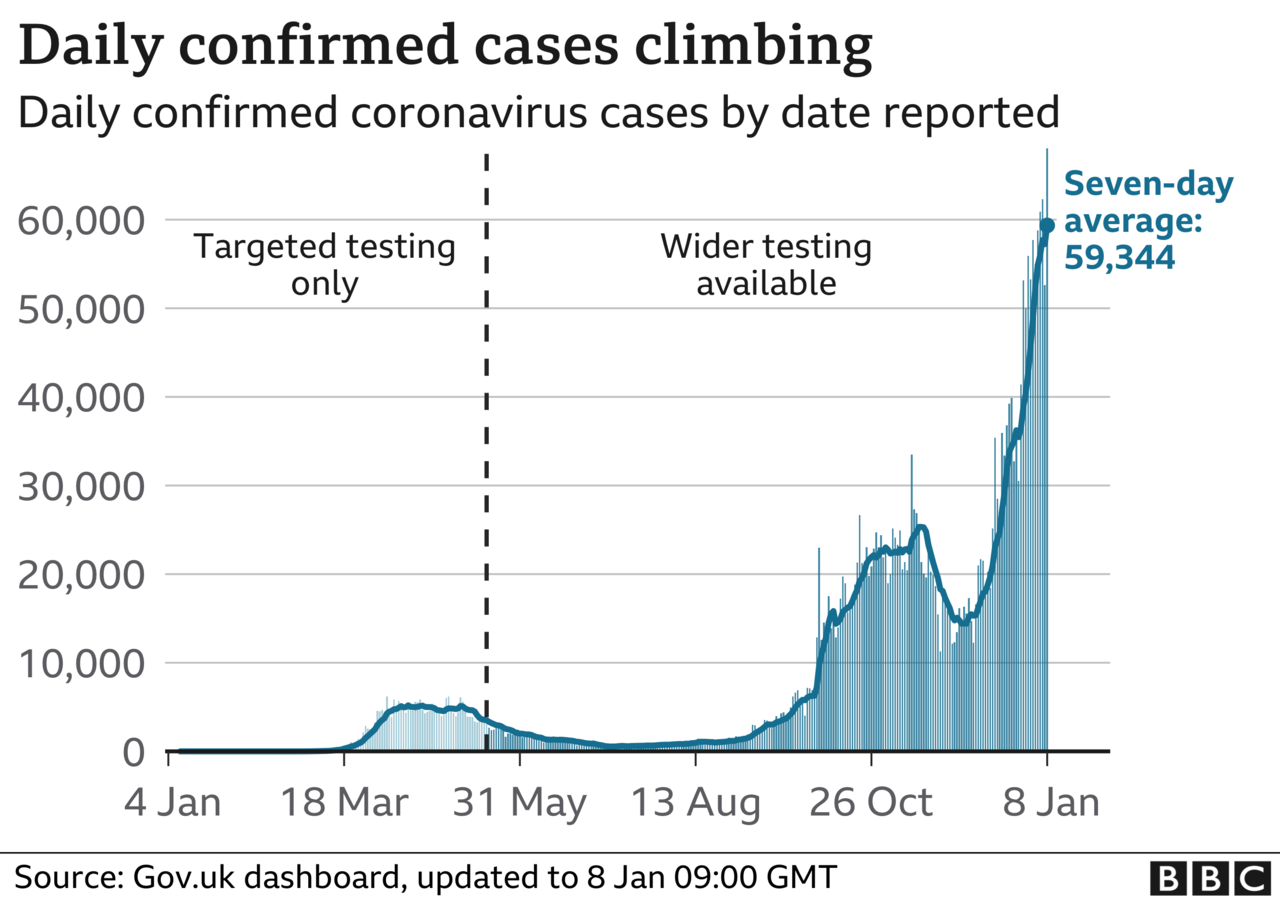
On Friday 1,325 deaths within 28 days of a positive Covid test were recorded in the UK - the highest daily figure yet - along with 68,053 new cases.
As cases and deaths soar, the government has launched an advertising campaign, which will be shared across television, radio, newspapers and on social media, urging people to stay at home and not to get complacent.
Government sources say there is also likely to be more focus from police on enforcing rather than explaining rules.
Prime Minister Boris Johnson says hospitals are "under more pressure than at any other time since the start of the pandemic", with infection rates increasing at an "alarming rate" across the country and the NHS under "severe strain".
It comes after London's mayor Sadiq Khan said the spread of coronavirus was "out of control" as he declared a "major incident" in the capital on Friday.
Dr Simon Walsh, an emergency care doctor in London, told BBC Breakfast the "unprecedented" numbers of patients requiring intensive care treatment meant staff were spread "more and more thinly".
Hospitals in other parts of the UK are also under pressure.
Dr Justin Varney, director of public health in Birmingham, said he was "very worried" about the situation in the city, where hospital bosses have warned they do not have enough intensive care nurses to deal with the growing case load.
He warned that the NHS had still not seen the impact of the rise in cases following the relaxation of restrictions over Christmas and added: "It is going to get a lot, lot worse unless we really get this under control".
A government spokesperson said: "Our priority from the outset has been to protect the NHS to save lives and we have taken advice from scientific and medical experts throughout. As new evidence has emerged, we have adapted our approach and taken swift action to try and stop the spread of the virus."