

Could Liz Truss’ visit to Taiwan start a culture war in the Tory Party?
Guess who’s back – back again?
The Liz Truss bandwagon or blunderbuss, depending on your view of the short-lived but eventful ex PM has set a cat among the Tory pigeons - and unleashed a mighty foreign policy row as she sets off today on a one-woman mission to shire up independent Taiwan in the face of a looming threat from its Chinese neighbour (and a gathering storm about her “instagram diplomacy” at home).
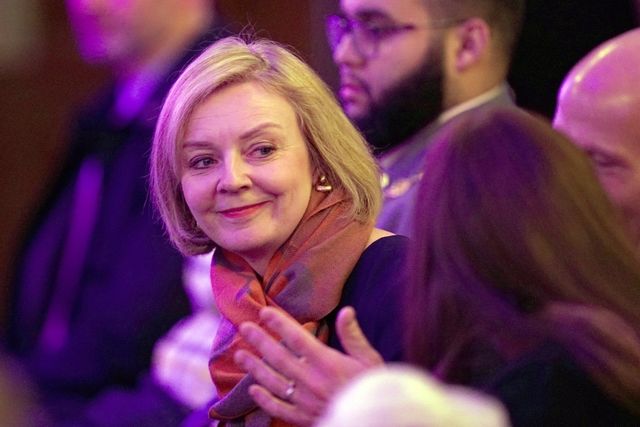 Former prime minister Liz Truss
At the invitation of the foreign ministry in Taiwan, an island which has enjoyed practical autonomy from China since 1950s, but which an increasingly belligerent Beijing regards as a province, Truss raised the stakes by describing Taiwan’s stand off with its giant neighbour as “the most consequential struggle of our time”, adding that Britain must “increase defence co-operation with the island” to fend off further aggression from China.
The timing could hardly be more sensitive: the stand off between Beijing and Taiwan is a flashpoint with potential to divide the Western alliance at a dangerous time.
Speaking to POLITICO at the Copenhagen Democracy Summit before her visit, Truss also took aim at the French leader Emmanuel Macron (who claimed that Europe should not become ‘America’s followers’ in squaring up too assertively to Beijing). But her target at home was clearly the cautious approach of her successor Rishi Sunak and the Foreign Office. “Fundamentally we send mixed messages, if we continue with the same level of trade and investment with China.” Europe, she insisted should urgently take “more collective action”.
At the start of her five day visit Truss went on to tell reporters: “It’s absolutely clear that President Xi [Jinping of China] has the ambition to take Taiwan.”
“Now, we don’t know exactly when that could take place, we also don’t know how, and it’s my view that the preference of President Xi and the Chinese Communist Party would be to do it in a way that doesn’t involve using force, but I certainly think they would be prepared to use force if necessary.”
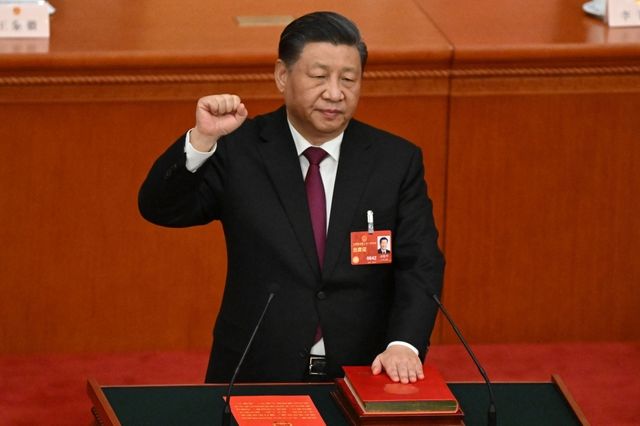 President Xi Jinping
China’s state media has takes a dim, shrill view – while finding the visit important enough to condemn. Truss, according to a Beijing’s Global Times headline was a “washed up politician” seeking to make “political capital” out of the visit and duly lectured that Taiwan is not an “internet celebrity check-in spot.” Critics among Sunak loyalists have followed suit.
Alicia Kearns, chair of the Foreign Affairs Select Committee unleashed a ferocious attack on Truss’s “Instagram diplomacy” – a swipe at Truss’s tendency to post pictures of herself in prestigious international settings as she vied for the Tory top job. Kearns is an increasingly frequent media performer for the government, trusted by Number 10, so her assault on Truss’s “performative not substantive” visit looked like a licensed strike at a newly ex-PM getting in the way of the government’s approach to China.
 Conservative MP Alicia Kearns
It was, Kearns added for good measure, akin to the Nancy Pelosi’s visit last year when the feisty Democrat speaker of the US House of Representatives embarked on a visit to the territory to the ire of the State Department. Truss’s team shot back that as the mere “MP for Rutland” (i.e. without a ministerial position) , Kearns could be ignored. Or at least snubbed.
For Truss and many other “China hawks” in the Conservative ranks, Taiwan embodied the tendency of the government to dither on important issues, with no clear sense of where the UK’s centre of gravity should be in dealings with China. Sunak’s approach has been to continue forging ties with Japan and other strategic competitors to China through membership of the Trans-Pacific Partnership and the boosting of the UK’s role in AUKUS, a trans-national pact to build nuclear-pow3rd submarines which so excited Sunak when he flew to the US to seal the deal that he was, according to one witness, “Literally bouncing up and down on his heels with excitement” as he announced the deepending of the partnership to Tory MPs.
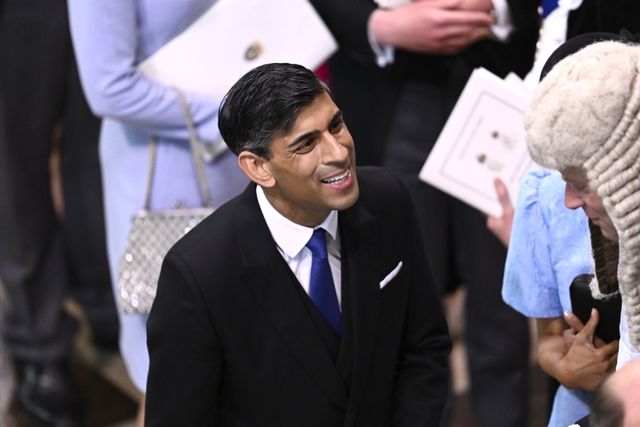 Prime Minister Rishi Sunak
Publicly, however Sunak and the Foreign Office dial down confrontational talk with Beijing, “Speak softly and carry a big stick,” was the Churchillian description of this kind of approach. Internal foes range from Tom Tugendhat on the left of the party, a foreign policy voice who (before he was becalmed with a junior ministerial role) advocated for a more muscular five point plan coalescing security and commercial concerns. On the Right of the party, prominent figures like Iain Duncan Smith, Liam Fox and Truss herself increasingly equate the “great fudge of China” as one MP puts it, with criticism of Sunak’s tendency to duck noisy arguments. Add to that an urban liberal default mode that if Truss is in favour of something, it must be wrong and the battle lines are set to grow wider in the rhetorical wars over China.
It’s not hard to heap contempt on a woman known for her accident-prone “fire and forget” interventions. A disastrous 44 day premiership with its failed shock treatment recipe for the UK economy and mishandling which roiled the money markets, consolidated a reputation for recklessness. A tendency to fiery rhetoric (and opposition to the Sunak camp which is partly ideological and partly the result of an ill-tempered leadership contest last summer which ended up in neither speaking to the other) makes the visit difficult for the government to handle. Formally, it cannot object to Truss supporting a democracy under threat while committing extensive blood and treasure to to the defence of Ukraine.
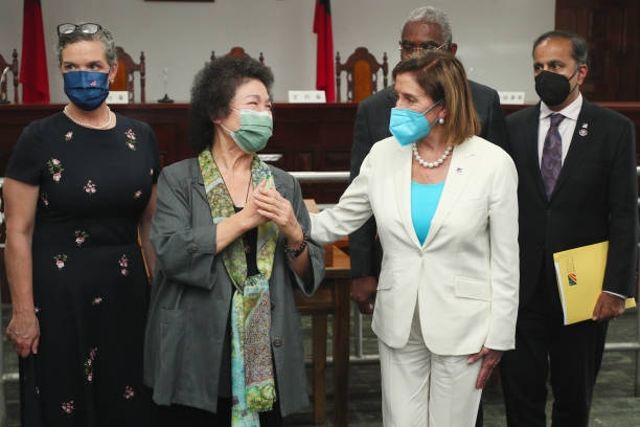
Nancy Pelosi meets with the President of Taiwan
Truss’ backers include Geoffrey Hosking a well-heeled hedgefunder Brexiteer who had donated a reported £50, 000 to Truss to support a range of her causes , from radical pro-growth policies growth to Taiwan, which has become a new “poster child” among dissatisfied Conservatives for a number of related reasons.
For strong Brexiteers like Hosking, it is a vital plank in a Global Britain aspiration, intended to replace reliance on the EU with trade links across the democracies - a cause which also has fans among US Conservatives as trade tensions with China congeal and Republicans look to challenge Joe Biden’s record.
The Taiwan cause also involves a penumbra of advocates and communications groups with a mix of commercial and ideological interests. Patrick Robertson, an eclectic and often controversial PR guru, is also a strong supporter of Taiwan’s independence. His communication company “World PR” has strong links to the Brexit camp, as an ally of the late Sir Jimmy Goldsmith’s Referendum Party in the 1990s. Robertson runs a “Global Britain” campaign, with senior Brexiteers and often works with the former defence secretary (and Leave advocate) Liam Fox. Its website boasts that World PR “has the knowledge and expertise to help companies, governments and organisations navigate the post-Brexit landscape and achieve their objectives” - including links to a motley crew of countries around the Russian and Chinese periphery.
"Nothing is gained by Truss turning up right now. It simply encourages Beijing to divide and rule"
For Truss, a campaigning stance on Taiwan is a route back to international prominence; the subject of how assertive to be on China divides opinion across the parties and provides Truss with a new launchpad.
All in all it looks like an ideological argument brewing in the eventuality of an election defeat next year.
Who’s right? By general agreement outside the purely mercantile wing of diplomacy (which has been shown to have its own perils in the example of too great a leeway given to Russian financial interests by the West over the last couple of decades ), was short sighted in dismissing the risks of business engagement with China. Subsequently, a decision was taken to block Huaewei’s access to the UK’s 5 G network – the powerful telecoms and mobile phone company has close links to the all-powerful Chiense surveillance state. The government’s cyber security advice now advises extreme caution in dealing with Chinese-backed apps. The Government has banned the Tik Tok app on Government electronic devises – and a similar block is being implemented in the EU’s institutions.
In terms of messaging however, the British government has ended up in an ‘in between” position. It invited Hang Zhe, the figure behind the brutal crackdown on the Hong Kong protests to King Charles’s coronation (or rather invited President Xi and was fobbed off with a controversial representative in what looked like a snub). A welcome to Hong Kongers fleeing repression (Nathan Law is the most high-profile Opposition figure to have ended up in London, along with many young and prosperous Hong Kongers at London and other leading universities).
Commercially too, equivocation and stop-start relationships with China have been the hallmark of the last decade – and London has born the brunt of an erratic relationship with Beijing’s commercial might. The ”golden era” of Cameron and Osborne’s attempts to woo Chinese investors was also supported by Boris Johnson as mayor. The Albert Docks marquee project in the East was intended to rival Canary Wharf, via a deal with the Chinese company ABP (the company’s chairman told me after 2016 that China was not too bothered about Brexit - “we think in decades, not years here”). The long term soon turned into the short term, as the US- China relationship entered the big chill and globalisation faltered. Last month, the undeveloped site (its interim use has been as a set for films requiring a desolate urban backdrop) was sold off at a knockdown price to David Maxwell, a British investor.
Truss clearly is risking blowback from China and complicating the diplomatic outlook for the government at a tricky time in international affairs. On the other hand, those criticising her errand as merely foolhardy grandstanding might factor in that she is invited by Taiwan’s foreign ministry, which takes the view that it needs any symbolic western help it can get. Labour too will face a decisive moment if elected on how robust to be in dealings with China at a time when fence-sitting is not a comfortable posture for G7 countries who wish to influence global events.
Setting off for her latest battlefront, Truss tweeted in defiance of critics urging restraint that she “wished she had been able to accept sooner” and that “we must do all we can” to support an independent Taiwan.
Blessing or curse, one recently departed British PM has found a cause – to the chagrin of a Number 10 successor left picking up her pieces.