

Coronation: How popular is the monarchy under King Charles?
But is public opinion about the monarchy changing too? Recent visits by King Charles have seen anti-monarchy protesters making their presence noisily felt, alongside those showing support for the new reign.
Those anti-monarchists have acknowledged that they would have been reluctant to carry out such protests when the late queen was alive, because of the risk of antagonising the public. But now it seems the gloves are off.
To gauge the public mood ahead of the coronation, Panorama commissioned a new YouGov opinion poll. The results suggest broad support for keeping the monarchy, with 58% preferring it to an elected head of state - which was supported by 26%.
But, below these headline figures the poll points to attitude shifts under way - with some clear popularity challenges for the new king at the start of his reign.
In particular, the monarchy seems to have a problem appealing to young people.
While over-65s were the most likely to be supportive of the monarchy at 78%, 18-24 year olds were the least likely. Only 32% backed the monarchy. This younger group was more likely, at 38%, to prefer an elected head of state, although the remaining 30% didn't know.

Indifference could be an issue as much as opposition, with 78% of the younger age group saying they were "not interested" in the Royal Family.
So what are the difficult issues facing the new reign?
The wealth of the Royal Family, at a time of cost-of-living pressures, is one factor that seems to sharply divide the age groups.
As a headline figure, 54% of people in this online survey of 4,592 UK adults say the monarchy represents good value - compared with 32% who think it represents bad value.
But the younger group polled - those aged 18-24 - were more likely, at 40%, to think the monarchy is bad value for money, while 36% thought the opposite.
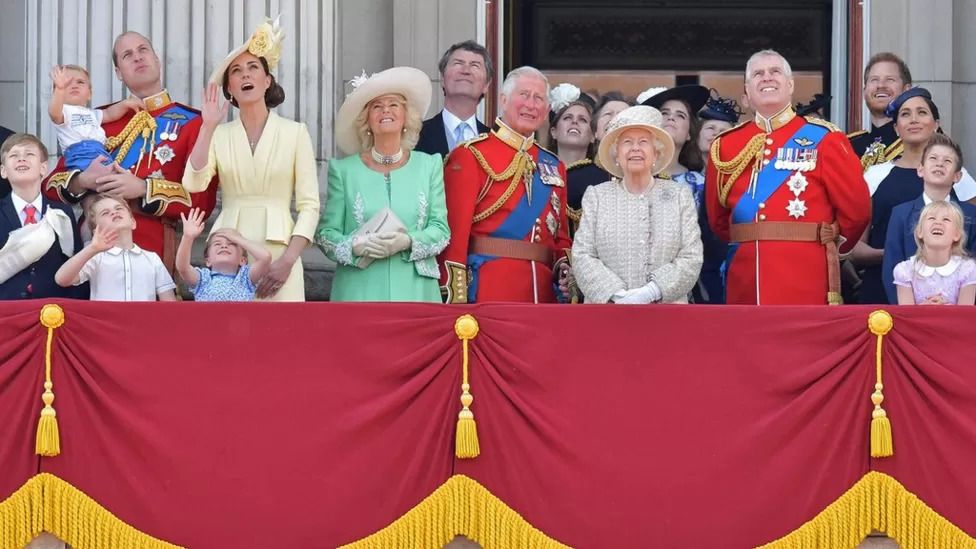 The Royal Family appeared on the balcony of Buckingham Palace to watch an RAF flypast - marking the Queen's birthday in 2019
"The number of palaces is absurd. Frankly, you need one palace for state occasions, Buckingham Palace, and perhaps one other for when they want to retire to the country," says former Lib Dem minister and critic of royal funding, Norman Baker.
He also highlights what he claims is an overuse of helicopters and private jets when the King is "lecturing people about climate change".
Such accusations are rejected by Lord Nicholas Soames, a friend of the King's for many years, who says using a helicopter would only be for a "very good purpose" on public duties.
"This is not done as a sort of jaunt," he says.
Constitutional expert Sir Vernon Bogdanor also doesn't accept the financial criticism.
"I think the Royal Family give, on the whole, very good value for money. And the only people who receive money are those who undertake public duties."
But there are public sensitivities about spending, as highlighted in another YouGov poll last week, which found a majority of people did not believe that the government should pay for the coronation.
How much the coronation will cost, in terms of public spending, won't be revealed by the government until after the event.
There have also been recent newspaper investigations into royal funding which have questioned the boundaries of private and public funding for the royals - including the status of the duchies of Lancaster and Cornwall, estates which each generate more than £20m in profits for the royals.
According to Mr Baker, these holdings of land and property should be seen as "public assets" and "the money that they raise in terms of profit should go to the taxpayer to fund public services", instead of being "diverted into royal coffers".
In response Buckingham Palace says the Duchy of Cornwall funds the public, private and charitable activities of the heir to the throne - while the Duchy of Lancaster helps fund the sovereign so they are not otherwise a "burden on the state".
Prof Anna Whitelock, a historian at City University who explores the place of the monarchy in modern Britain, questions why a new monarch does not have to pay inheritance tax on the death of a previous sovereign.
But the Palace points out that decisions about funding and taxation are decided by the government, not by the Royal Family themselves.
Nonetheless, questions over the opacity of royal finances seem likely to continue and the scale of uncertainty is suggested by the size of the different conclusions from two separate recent newspaper investigations into the King's wealth - one saying he was worth £600m and another £1.8bn.
Questions over money might feed into doubts about how well the royals can empathise with the experiences of the public.
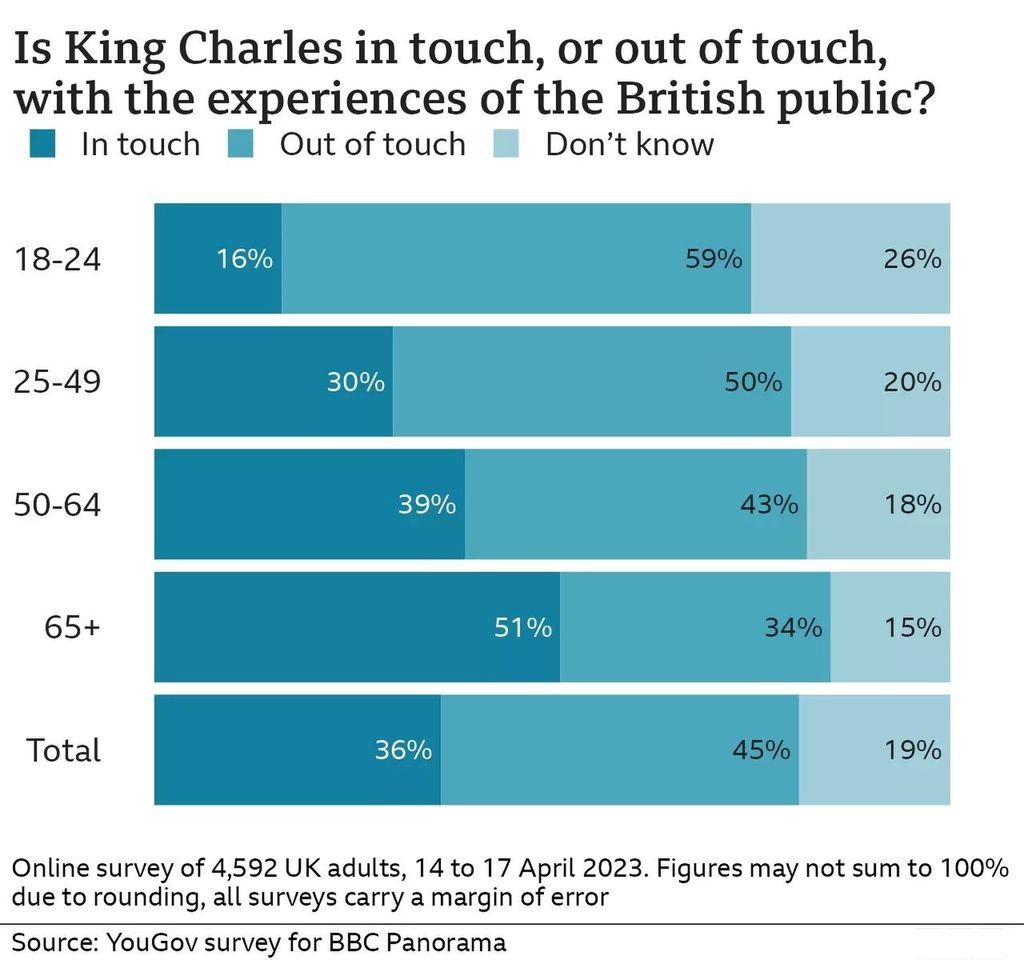
The polling of UK adults for Panorama - carried out between 14 and 17 April - suggests more people believe the King is "out of touch" by 45% to 36%.
But the King has had decades of working through his charities to support disadvantaged families - and Dame Martina Milburn, former chief executive of the Prince's Trust, praised his ability to communicate with a wide range of people. "I've literally been with him in prisons, in youth offending institutes, in job centres - and he can make that connection, it is quite extraordinary," she says.
Although Graham Smith, chief executive of the anti-monarchy group Republic, suggests polling reflects an often under-reported level of opposition to the monarchy. "Across the country there are millions of people who want the monarchy abolished," he says.
Another intense area of sensitivity for the Royal Family has been perceptions of their attitudes towards race.
From the fallout with Meghan, Duchess of Sussex, to the high-profile row over the treatment of black charity founder Ngozi Fulani at a Buckingham Palace reception - it has been a thorny subject.
The scale of the challenge is suggested in the YouGov polling which found people from ethnic minority backgrounds were less likely to support the monarchy. Of that group, 40% wanted an elected head of state rather than a monarchy. Similarly, people from ethnic minority backgrounds were more likely to think the royals have a "problem with race and diversity", with 49% saying they thought the royals did have a problem - while the overall percentage, regardless of background, was 32%.
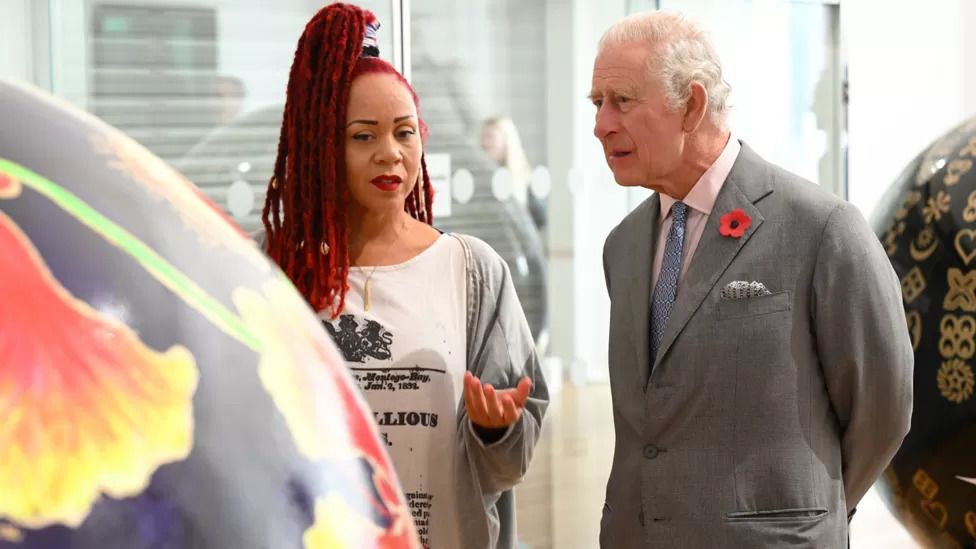 In November, King Charles attended an art exhibition in Leeds which explored the UK's role in slavery
Lord Soames strongly rejects any suggestions of racism. "There's not a racist drop of blood in the King," he says.
Buckingham Palace says the King and the Royal Household treat all matters of race and diversity with great seriousness - pointing to the "swift and robust" response to the Ngozi Fulani row as evidence. It says it has also carried out a review of its diversity and inclusion policies.
But this is also an issue affecting relations outside the UK, including the Commonwealth, where questions are being raised about the legacy of colonialism and slavery.
In a speech to Commonwealth leaders in Rwanda last year, the then Prince Charles spoke of the "depths of his personal sorrow" at the suffering caused by the slave trade.
In another speech - during last autumn's visit of the South African president, Cyril Ramaphosa - the King said: "We must acknowledge the wrongs which have shaped our past if we are to unlock the power of our common future."
But Sir Hilary Beckles - a historian in Barbados and chairman of the Caricom Reparations Commission - says more action is needed because, at present, the relationship between the monarchy and the Caribbean is "tense".
"That tension can easily be alleviated by the King pursuing a reparatory justice path that begins with language of apology, and then evolves into practical, everyday activity that will help to promote Caribbean economic development," he says.
Buckingham Palace says Historic Royal Palaces - a charity which looks after six sites including the Tower of London and Kensington Palace - is a partner in an independent research project exploring the links between the British monarchy and the slave trade. King Charles takes the issue profoundly seriously, it says.
The polling for Panorama might raise questions about a moment of change for the monarchy.
But it's also something of a picture of continuity. The overall findings show broad support for the monarchy, alongside a sizeable minority of sceptics.
Many polls over the years have found something similar, with rises and falls alongside the changing headlines.
The popularity of the royals seemed to reach a high point around 2011-2012, the era of Prince William and Kate's wedding and the Queen's Diamond Jubilee.
There has been a downward drift in the following years and the rows surrounding Prince Harry's book, Spare, earlier this year saw the approval ratings for the royals take a hit - but that doesn't necessarily mean they won't recover.
It will also depend on how much young people maintain their current trend of a rising lack of enthusiasm for the monarchy. The long-running British Social Attitudes survey has previously found that people's views tend to become more sympathetic to the monarchy as they get older.
The new reign will be watching carefully and hoping that pattern continues.