

Cocaine-smuggling submarine reveals Europe's drug crisis
It's 20 metres (65 ft) long, built out of fibreglass and - remarkably - homemade.
After clambering on top, I lift up the wonky manhole cover and descend into the hull where three men survived for 27 long days and nights, as they voyaged across the Atlantic Ocean just under the surface of the crashing waves.
It's cramped, claustrophobic and incredibly primitive.
The sunlight tries to creep in from faint cracks in the walls. There is a steering wheel, a couple of basic dials and a rusted key still wedged in the ignition.
You can understand why one prospective skipper took one look at the vessel and concluded it was a death trap.
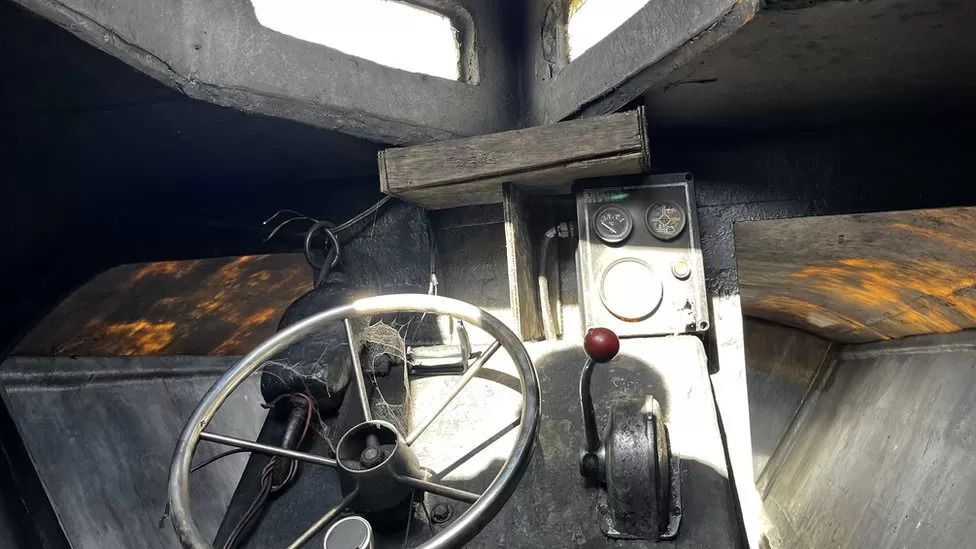 Three men and $150m worth of cocaine crossed the Atlantic in the tiny submersible
The heat and noise would have been intense as the engine in the back of the sub burned through the 20,000 litres of fuel stored onboard.
The crew of two Ecuadorean cousins and a former Spanish boxer set out from the Brazilian rainforest and first travelled along the Amazon river.
They had energy bars, cans of sardines and plastic bags they used for toilet facilities.
That was about all they had. Apart, of course, from three tonnes of cocaine worth more than $150m (£121m).
But this was not a lucrative, covert mission neatly accomplished.
The sub's journey in late 2019 had been tracked by law enforcement agencies, including the UK's National Crime Agency (NCA).
After scuttling their vessel near the coast of Galicia, having run into problems, the men were arrested and jailed.
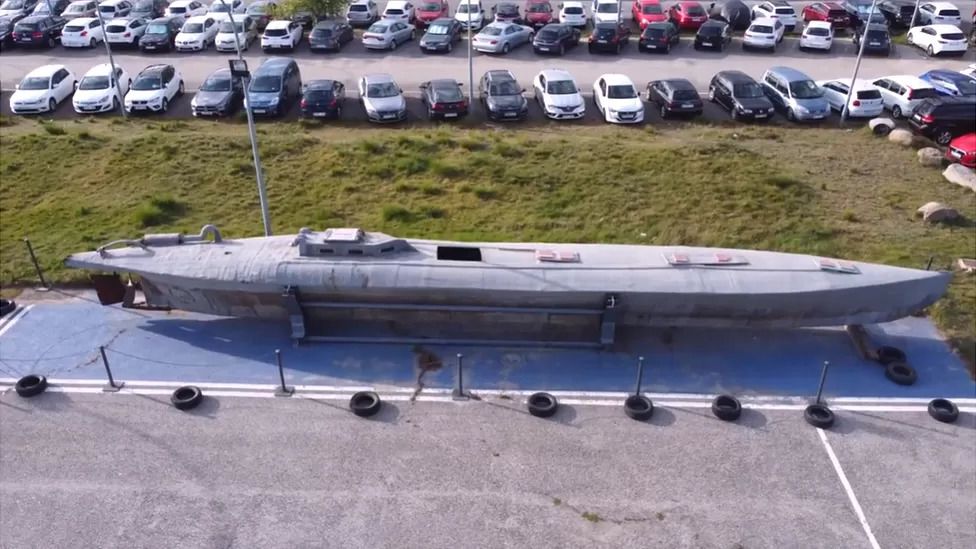 The homemade submarine now sits in a car park in central Spain
This piece of history in the fight against international drug trafficking is now a trophy in the car park of the Spanish police academy in Ávila.
However, it's not a rotting relic of a bygone battle: it's a symbol of a secretly growing phenomenon.
Just last month, another sub was discovered off the Spanish coast - again in the Galicia region.
"For more than 20 years traffickers have been using submarines to reach Africa and Europe, but these two are the first we've seized," explains Antonio Martinez Duarte, Chief Commissioner of the Narco Brigade in the Spanish National Police.
"They are very hard to detect," he admits.
In fact, it's thought hundreds of homemade submarines have been launched towards Europe, which is the biggest cocaine market after the US, and one that's growing rapidly after a Covid pandemic slump.
It's even said that in the middle of the Atlantic, around the Canary Islands and the Azores, there lies a mass graveyard of cocaine submarines, deliberately sunk after their cargo had been successfully unloaded.
Each covert mission would have been a huge triumph for the teams of mechanics quietly constructing their vessels in the depths of the South American jungle, mostly in Guyana and Suriname.
Here though, in Spain today, as part of the global trafficking war, it's the police trumpeting a big victory at their headquarters in Madrid.
"This is a very important operation," says Chief Commissioner Duarte. "It's the first time in Europe that we found as much as one and a half tonnes of base cocaine paste."
In fact, officers say it was the biggest lab turning raw coca paste into cocaine that they've found on the continent. But it's not just the size of the haul which is significant.
"This operation also confirms the links between Colombian and Mexican criminals that have joined Spanish gangs working in Spain," Chief Commissioner Duarte says.
Clearly proud of their work, the police have transported the contents of the lab into a press conference room to show local journalists.
The stench of the raw coca paste - like that of vinegar - hangs in the air.
The drugs-making process has been replicated, with barrels of chemicals, a microwave, a hydraulic press and scales - reflecting the journey from paste to final product.
On a table at the far end of the room are dozens of brown parcels, each the size of a house brick, emblazoned with a Superman logo - the symbol chosen by the traffickers who no doubt felt a sense of invincibility.
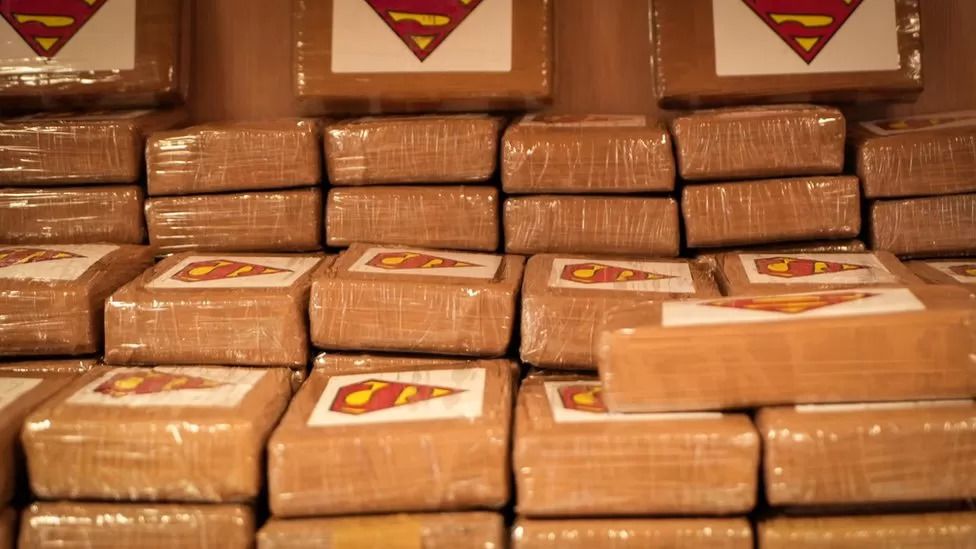 The bricks of cocaine were stamped with the Superman logo
An officer leans over and whispers that importers pay €27-32,000 ($30-35,000; £24-28,000) for each parcel. They then at least double their money when they sell it on the streets.
The only limit on their profits is to what extent they dilute their drug with cutting agents, ranging from anaesthesia (which mimic physical sensations associated with cocaine, such as numbing of the mouth) to cheaper options like caffeine and glucose. But there are also other options, including de-worming medicine, normally used by vets.
This lab dismantled in the city of Pontevedra in the Galicia region was capable of producing 200 kilos a day with a purity of 95%, according to the police.
Along with the submarines, the lab is a glimpse into a narco-world which is expanding rapidly.
The United Nations drug agency says cocaine production increased by a third between 2020 and 2021, which was a record high and the biggest year-to-year increase since 2016.
One place they're witnessing first hand the surge in supply of the drug is at the port of Antwerp in Belgium.

