London Daily

Focus on the big picture.
Sunday, Jun 28, 2026

Climate change: New Zealand's plan to tax cow and sheep burps

Climate change: New Zealand's plan to tax cow and sheep burps

New Zealand has unveiled a plan to tax sheep and cattle burps in a bid to tackle one of the country's biggest sources of greenhouse gases.

It would make it the first nation to charge farmers for the methane emissions from the animals they keep.

New Zealand is home to just over five million people, along with around 10 million cattle and 26 million sheep.

Almost half the country's total greenhouse gas emissions come from agriculture, mainly methane.

However, agricultural emissions have previously not been included in New Zealand's emissions trading scheme, which has been criticised by those calling for the government to do more to stop global warming.

"There is no question that we need to cut the amount of methane we are putting into the atmosphere, and an effective emissions pricing system for agriculture will play a key part in how we achieve that," New Zealand's climate change minister James Shaw said.

Under the proposal farmers will have to pay for their gas emissions from 2025.

The plan also includes incentives for farmers who reduce emissions through feed additives, while planting trees on farms could be used to offset emissions.

Andrew Hoggard - who is a dairy farmer and the national president of Federated Farmers of New Zealand - told the BBC that he broadly approved of the proposals.

"We've been working with the government and other organisations on this for years to get an approach that won't shut down farming in New Zealand, so we've signed off on a lot of stuff we're happy with."

"But you know, like all of these types of agreements with many parties involved, there's always going to be a couple of dead rats you have to swallow," he added.

Mr Hoggard also highlighted that the fine details of the plan's rollout have not yet been agreed.

"There are still the nuts and bolts to be hammered out, like who actually implements the scheme, so there's still stuff to work through with the government."

The money raised from the scheme will be invested in research, development and advisory services for farmers, the country's environment ministry said.

Last month, New Zealand's finance minister committed NZ$2.9bn (£1.5bn; $1.9bn) for initiatives to tackle climate change, which would be funded by an emissions trading system that taxed polluters.

Meanwhile on Thursday, investors managing $14tn of assets urged the United Nations to create a global plan to make the agriculture sector sustainable.

In a letter to the UN's Food and Agriculture Organisation's director-general - which was first reported by the Reuters news agency - the FAIRR Initiative said the agency was best-placed to take the lead on creating a road-map to curb one of the biggest sources of climate damaging emissions.

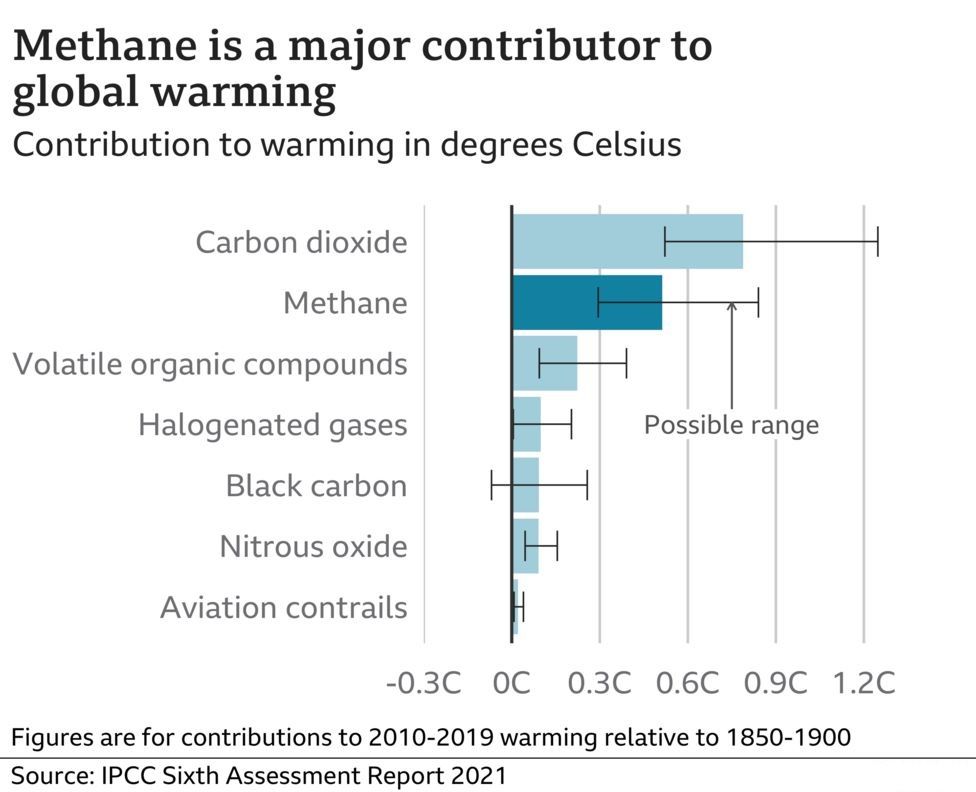
Methane is the second most common greenhouse gas after carbon dioxide (CO2).

It is one of the most potent and responsible for a third of current warming from human activities. Individual methane molecules have a more powerful warming effect on the atmosphere than single CO2 molecules.

At last year's COP26 environmental conference in Glasgow the US and the EU agreed to cut emissions of the gas by 30% by 2030. More than 100 countries, including New Zealand, have also signed up to the initiative.


How is methane emitted?


Around 40% of CH4 comes from natural sources such as wetlands but the bigger share now comes from a range of human activities, ranging from agriculture, such as cattle and rice production, to rubbish dumps.

One of the biggest sources is from the production, transport and use of natural gas and since 2008 there has been a big spike in methane emissions, which researchers believe is linked to the boom in fracking for gas in parts of the US.

In 2019, methane in the atmosphere reached record levels, around two-and-a-half times above what they were in the pre-industrial era.

What worries scientists is that methane has real muscle when it comes to heating the planet. Over a 100-year period it is 28-34 times as warming as CO2.

Over a 20-year period it is around 84 times as powerful per unit of mass as carbon dioxide.

However, there is much more CO2 than methane in the atmosphere and individual molecules of it can remain there for hundreds of years.

Newsletter

Related Articles

0:00
0:00
Close
UK Government Confirms Further Medicine Price Concessions for Community Pharmacies in June
British Chambers of Commerce Calls for Public Procurement Reform to Boost Regional Growth
Thousands Mark Armed Forces Day Across the United Kingdom With National Parades and Flypasts
Man Arrested in Ealing on Suspicion of Attempted Murder After Vehicle Ramming Incident Injures Five
Cambridge South Station Opens With £250 Million Investment to Strengthen Life Sciences Corridor
UK Heat-Health Alerts Extended Across England as High Temperatures Persist
Thames Water and Energy Operators Warn of Peak Demand Risks During UK Heatwave
Government Conference Highlights Push for Evidence-Led Policy Across UK Public Sector
Insolvency Service Reports Improved Confidence in UK Insolvency System
Security Industry Authority Finds Widespread Safety Failures in UK Night-Time Economy
Nigel Farage Expands Anti-WHO Campaign Into United States With New Lobbying Structure
Home Secretary Seema Mahmood Unveils New Safe Routes Plan for Asylum Seekers
UK Government Warns of Peak Electricity and Water Pressure Amid Ongoing Heatwave
New Nuclear Plant in Wales Named Gwyndod Power Station as Energy Strategy Advances
UK Announces First Major Hydropower Projects in Four Decades to Expand Renewable Capacity
Thirteen Men Charged in Major UK Sexual Abuse Case as Investigation Continues
UK Launches Cross-Sector Climate Security Taskforce Linking Environment and National Security
UN Secretary-General António Guterres Calls for Urgent Global Methane Emissions Cuts in London
World Bank Approves $1 Billion UK-Backed Financing Package for Ukraine Recovery
UK Pledges Emergency Aid and Rescue Team Deployment to Earthquake-Hit Venezuela
Bank of England Holds Interest Rates at 3.75 Percent for Fourth Straight Meeting
Record-Breaking Heatwave Puts Strain on UK Health Services and Energy Networks
London Ambulance Service Sees Record Emergency Demand as Heatwave Intensifies
British Chambers of Commerce Warns of Prolonged Weak Investment Climate Through 2027
Bank of England Holds Interest Rates as Inflation Risks Persist
UK Construction Sector Faces One Percent Contraction Amid Cost and Investment Pressures
Former DUP Leader Sir Jeffrey Donaldson Convicted of Sexual Offences
Church of England Appoints Dr Linsay Cunningham to Lead Faith and Public Life Division
UK Armed Forces Day Marked Nationwide With Events From Aberdeen to the Scilly Isles
Rising Tensions in Edinburgh Prompt Joint Warning From Scottish Local Government Leaders
UK Construction Sector Forecast to Contract One Percent in 2026 on Cost Pressures
UK Parliament Backs 87 Percent Emissions Cut as Government Deepens Electrification Drive
British Chambers of Commerce Forecast Weak UK Growth as Investment and Demand Slow
Bank of England Holds Interest Rates at 3.75 Percent Amid Energy and Inflation Uncertainty
London Ambulance Service Reports Record Surge in Life-Threatening Emergency Calls During Heatwave
UK Parliament Approves Legally Binding 87 Percent Emissions Cut Target by 2040
United Kingdom Records Third Consecutive Day of Record June Heat as Europe Faces Worsening Heatwave
Robert Jenrick Defends £5 Million Donation to Nigel Farage Amid Political Scrutiny
Plymouth Museum The Box Wins 2026 Art Fund Museum of the Year Award
UK Government Faces Backlash Over Plans to Use Former Military Sites for Asylum Accommodation
Labour Party Faces Pressure Over Cabinet Stability as Senior Figures Clash on Policy Direction
Heathrow Airport Forecasts Passenger Decline in 2026 as Costs and Climate Disruption Mount
UK Energy Regulator Approves Expansion of Long-Duration Storage to Boost Power System Resilience
Crown Estate Reports Third Consecutive Year of £1 Billion Profit as Debate Over Royal Finances Intensifies
Teenager Charged With Murder in Wales Following Death of 14-Year-Old Boy
Nottingham University Hospitals Maternity Failures Trigger Calls for Public Inquiry Into Patient Safety
EasyJet Rejects £4.9 Billion Takeover Offer From Castlelake but Keeps Door Open for Further Talks
Record Heatwave Triggers UK Transport and Infrastructure Strain as Heathrow Revises Passenger Forecast Downward
Ofgem Approves Sixteen Long-Duration Energy Storage Projects to Strengthen UK Grid Stability
Labour Government Faces Internal Tensions Over Cabinet Decisions and Net Zero Policy Direction
×