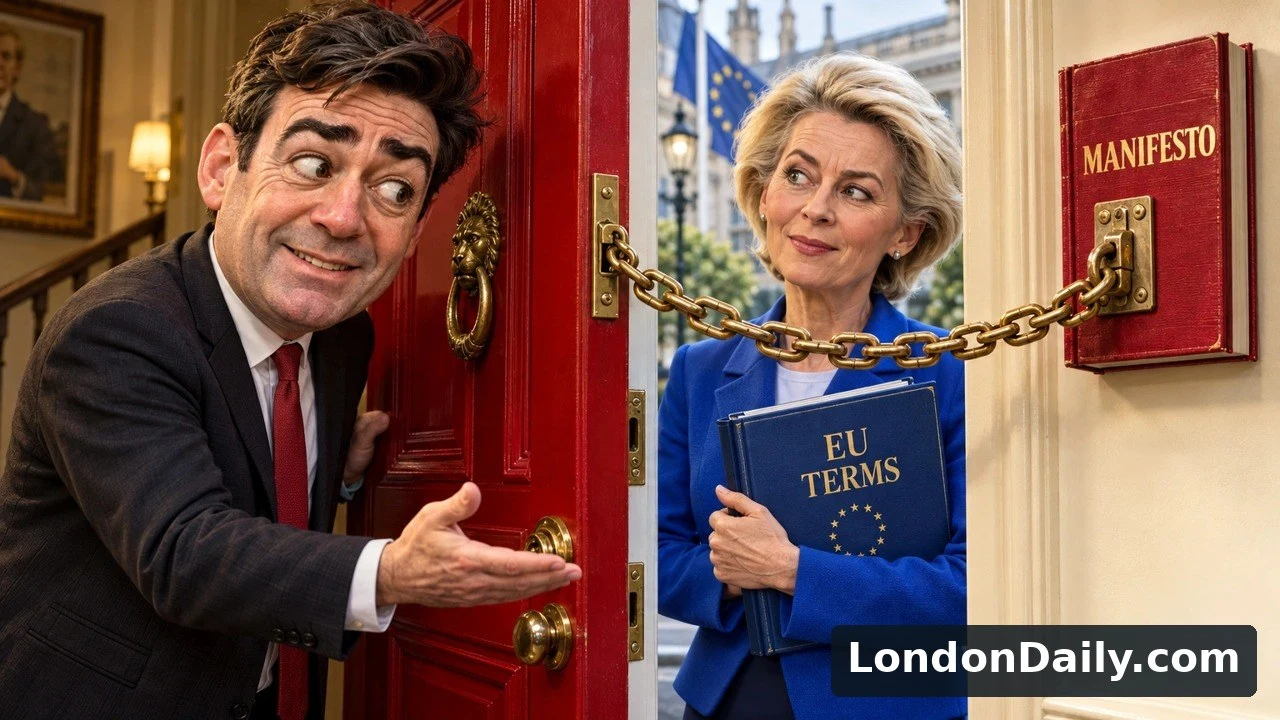
Prime Minister Andy Burnham has told EU leaders he is ready to discuss Britain rejoining the bloc over the next year, opening a longer-term debate alongside a reset agreement covering youth mobility, food standards and the carbon market.
At Friday’s press conference, Burnham proposed informal discussions before the next UK-EU summit, with full membership expected among the options. He maintained Labour’s manifesto commitment not to rejoin the EU, its single market or a customs union before the next general election, but did not retreat from his previously expressed wish for membership during his lifetime.
“Incremental steps, as you say, only take us so far,” he said. He linked closer relations to his forthcoming 10-year plan, due next month, to reindustrialise Britain and reduce inequality. Changes since 2016, Russia’s war in Ukraine and Vladimir Putin’s threats to Europe also informed his case. The British people would “be the boss” of any final decision, he said.
European Council president Antonio Costa welcomed the closest possible relationship, while insisting on the single market’s indivisible four freedoms and a balance of rights and obligations. European Commission president Ursula von der Leyen supported wider discussions but also saw scope for further incremental improvements.
Burnham repeatedly cited support approaching three-quarters for closer ties. A European Council on Foreign Relations poll found around 75 per cent favoured a closer relationship, two-thirds would accept freedom of movement and most thought Brexit had harmed their interests. Support for closer ties does not, by itself, establish support for membership.
The reset, announced by Downing Street at around 10.15am on Friday, provides up to 100,000 visas for young Europeans. Its reciprocal youth scheme would allow under-30s to live, work and study in Britain and the EU for up to three years. The cap exceeds the 45,000 sought by Burnham’s predecessor, Sir Keir Starmer.
Implementation could be delayed by tuition fees. Talks continued late on Thursday; Burnham reportedly offered fees of around £12,000 annually for European students, while a group of EU countries demanded equal treatment at the domestic rate of £9,970.
The agreement also leaves Britain following many EU food and drink rules, while concerns that the energy arrangements could increase household bills remain unresolved. Challenged over whether Parliament would merely copy European legislation, Burnham argued that British experts would regain a place in implementation discussions.
Chief Whip Anneliese Midgley has arranged for MPs to consider the agreement next week, with the tuition-fee dispute still unsettled.








Join the conversation