

Britain's royals have denied being a racist family. Archived papers reveal recent racist past
The implication was clear: That there was concern at the heart of the monarchy over how a baby who may look different from the rest of the family because of his biracial mother would fit in.
The fallout was huge. But reactions were largely split between people who saw it as a sign of institutional racism in the monarchy and those who thought the couple had made the whole thing up. After all, there was no hard evidence to back up the claim.
This time, there are papers.
Britain's Guardian newspaper this week unearthed documents, buried in the UK national archives, which revealed that the Queen's courtiers had banned ethnic minority immigrants and foreigners from holding clerical positions at Buckingham Palace until at least the late 1960s.
According to the report, the Queen's chief financial manager told civil servants in 1968 that "it was not, in fact, the practice to appoint coloured immigrants or foreigners" to clerical roles, but they were allowed to be hired as domestic servants.
The palace has not clarified when the policy ended, only telling CNN in a statement that "claims based on a second-hand account of conversations from over 50 years ago should not be used to draw or infer conclusions about modern day events or operations."
The investigation also revealed that decades ago, the palace used a parliamentary procedure known as "Queen's consent" to obtain an exemption from UK legislation aimed at preventing discrimination in the workplace -- including the hiring of people based on their ethnicity. The Queen is still exempt from those laws today, the Guardian reported.
"The Royal Household and the Sovereign comply with the provisions of the Equality Act, in principle and in practise," the palace told CNN in its statement.
"This is reflected in the diversity, inclusion and dignity at work policies, procedures and practises within the Royal Household."
What is missing from these statements is any apology for past racist policies, or insight into the steps the royal family plans to take to right those wrongs.
This silence from the Queen's inner circle will not come as a surprise to anyone familiar with the behavior of the palace. Queen Elizabeth is a very traditional monarch who rarely make public statements. She is of a generation that believed remaining silent on almost all issues was the best way of preserving the dignity of the crown.
This strategy has largely served the monarch well during her 69-year stint on the throne, though its success is in part a result of the Queen enjoying enormous popularity among the British public, many of whom accept that she is a woman of a different generation and don't expect her to change.
But the palace reaction will be disappointing to the growing chorus of people calling for change, at a time of racial reckoning in the UK and across the globe.
And for the younger generations of royals, the Queen's decades of silence could make their lives harder when the time comes for the crown to be passed on.
Some of the younger royals have spent the past decade-plus being public figures, speaking out on issues such as mental health, climate change and equality.
This has largely been supported by younger British citizens who have not grown up in the same deferential culture as their parents and grandparents.
Now, it will be more difficult for younger royals to square their public image of enlightenment with the failure, as of now, to condemn their family's institutionally racist hiring policy in the past. It will be particularly hard for Prince William, second in line, who said publicly in response to Harry and Meghan's racism allegations that the royals were "very much not a racist family."
All of this matters because of the unwritten contract that exists between the monarchy and its subjects.
The royal family can only be guaranteed of its existence if the public supports it. In the Oprah Winfrey interview, Harry revealed how "scared" members of his family are "of the tabloids turning on them." While the prince might have overestimated the influence that newspapers have over the public, his view of the importance of public relations to his family is correct.
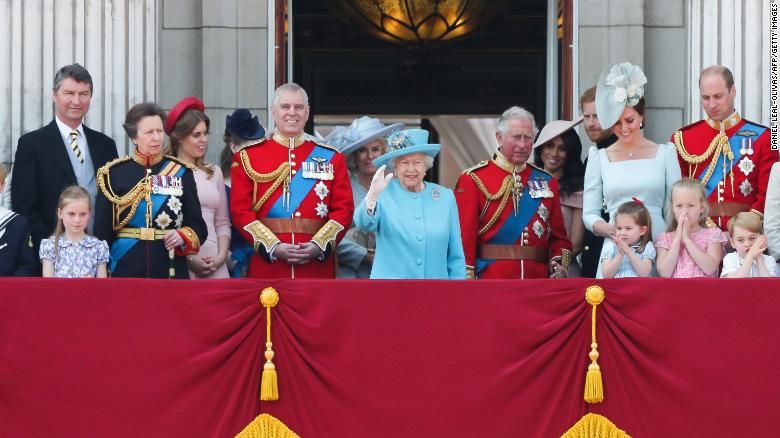 Members of the royal family wave to the public from the balcony of Buckingham Palace
The point at which this all becomes dangerous for the royals is when the public demands greater transparency and accountability, but the palace digs its heels in.
"That is why public opinion plays such a big role," said Catherine Haddon, constitutional expert at the think tank Institute for Government. "With increasing loss of deference in society and increasing pressure for greater transparency, it is hard for the monarchy to stick to the old ways of doing things."
Unlike the claims of racism and neglect made by Harry and Meghan, these employment practices are provable. They do not paint the current monarch in a favorable light, and it's also worth noting that these policies existed during the lifetime of the first in line to the throne, Prince Charles, who is supposedly a more modern royal that his mother.
Worse for the monarchy, there is a chance it could give those on the fence about the Sussexes' contemporary allegation pause for thought: if current senior royals were able to turn a blind eye to racist policies once, is it really implausible they would make racist comments about the color of a baby's skin?
Kehinde Andrews, professor of Black studies at Birmingham City University, is not optimistic the story will shift public thinking around the monarchy in any serious way.
"These debates are not about rational thinking or evidence. People will probably put it into the context of it being historical and of its time," Andrews told CNN. "The royal family has a terrible record on race, but no incident has radically changed thinking before, so why would it now?"
Andrews' analysis will probably be accurate in the short term: it's very unlikely that Brits are going to turn on their Queen any time soon. But the combination of hard evidence of racism at the heart of the monarchy and a younger generation that finds such behavior inexcusable will make the monarch's style of silent leadership impossible for her descendants who will one day sit on her throne.