London Daily

Focus on the big picture.
Saturday, Jul 04, 2026

Boris reveals three things that need to happen before lockdown lifts

Boris reveals three things that need to happen before lockdown lifts

The prime minister has outlined three things which need to happen in order for the coronavirus lockdown to start to ease.

Boris Johnson told a Downing Street press conference today that the Government must be confident the new vaccine programme is working and that there are no changes which affect calculations, such as a new variation of the virus.

He also said the rate of infection needs to be ‘not still so high’.

It comes as the PM revealed the mutant UK variant of Covid-19 is more deadly than the original strain of the virus.

‘We’ve been informed today that in addition to spreading more quickly, it also now appears that there is some evidence that the new variant – that was first identified in London and the south east – may be associated with a higher degree of mortality,’ he said.

‘It is largely the impact of this new variant that means the NHS is under such intense pressure with another 40,261 positive cases since yesterday, we have 38,562 Covid patients now in hospital – that’s 78% higher than the first peak in April.’

Another 1,401 people were reported to have died with the virus today.

Both Mr Johnson and his scientific advisors – Professor Chris Whitty and Sir Patrick Vallance – agreed a lot more still needs to happen for the Government to consider lifting lockdown.
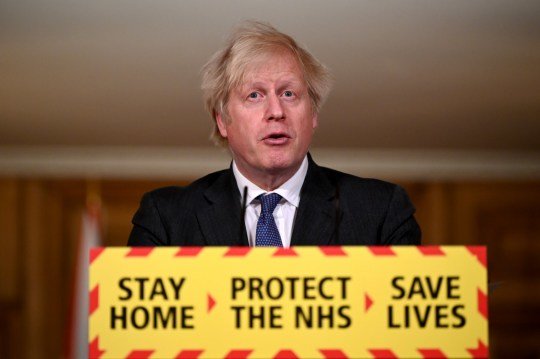


Prime minister Boris Johnson speaking at the Downing Street press conference this afternoon


‘We think this is the right package of measures to deal with the new variant and we don’t want to change and what we want is to see people obeying them and that’s the crucial thing,’ the prime minister said.

He added: ‘We are seeing some signs of flattening in the data in some areas – particularly in London and the South East where numbers of infections are coming down – that’s very encouraging.’

But he warned the rates are ‘still very high’.

‘We really can’t begin to consider unlocking until we’re confident that the vaccination programme is working, until we’re confident that we don’t have new variants, or changes in our medical understanding of the virus that might affect our calculations,’ he explained.

‘But I think the most important thing is that we’ve got to be in a position where the rate of infection is not still so high, and it’s very high right now – so for unlocking just to lead to another big rebound, and I think that would be the wrong thing and the wrong way to approach it.’

He said it’s ‘not just about’ rolling out the vaccine, but Mr Johnson however was positive about progress of the mass vaccination programme.

The PM added although the ‘target remains very stretching indeed’ the Government remains on track to ‘offer a first dose to everyone in the top four priority groups by the middle of February’.

‘I want to thank all of you who have come forward to get your jabs because by doing that you are protecting yourselves, your communities and of course our NHS,’ he said.

‘I say to everyone when that letter arrives, please don’t hesitate to book that appointment and get this life-saving protection because this is the best and fastest way for us all to defeat this virus and get our lives back to normal.’


Newsletter

Related Articles

0:00
0:00
Close
UK Government Consults International Partners on Maritime Trade Security and Energy Market Stability
Rare Revolutionary-Era Documents Discovered by UK Archives and Undergoing Authentication
UK Consumer Confidence Remains Deep in Negative Territory as Household Spending Stays Cautious
Transport for London Warns of Severe Disruption as Major Events Converge in Central London
NHS and Social Care Sectors Face Ongoing Recruitment Shortages Amid Persistent Workforce Gaps
Rising Energy Costs Drive Price Pressures Across UK Retail and Service Sectors
Competition and Markets Authority Expands Review of Artificial Intelligence Impact on UK Media Markets
UK Parliamentary Committees Intensify Scrutiny of National Security and Industrial Policy Legislation
Bank of England Faces Persistent Inflation Pressure as Rate Cut Expectations Fade
UK Public Finances Under Pressure as Borrowing Exceeds Forecast and Debt Nears 95% of GDP
Major Police Deployment Across Central London as Mass Demonstrations and Pride Parade Converge
Large-Scale Police Dispersal Powers Activated in Liverpool Ahead of Anti-Immigration Protests and Counter-Demonstrations
Luxury bags take over the World Cup: style, status symbol, or just showing off?
National Productivity Institute Highlights Weak Business Investment Outside Southern England
UK High Court Orders Reassessment of Environmental Impact in Major Highway Project
UK Cyber Security Centre Warns of Rising Threat From State-Sponsored Digital Espionage
UK Education Secretary Launches National Reform of Apprenticeships and Vocational Training
Financial Conduct Authority Tightens Climate Risk Disclosure Requirements for Listed Firms
Rail Union Suspends Planned Strike Action to Enter Formal Negotiations With Operators
Northern Ireland Businesses Seek Clarity Over Post-Brexit Trade Rules
Welsh Government Launches Regional Growth Plan Targeting Transport and Digital Infrastructure
North Sea Wind Sector Attracts £5 Billion Investment Amid Expansion of Offshore Capacity
Scotland and UK Governments Establish New Framework for Coordinated Investment in Energy and Infrastructure
UK Government Launches Major Immigration and Border Policy Overhaul Review
Bank of England Signals Interest Rates to Remain Elevated Despite Easing Inflation Pressures
National Health Service Warns of Severe Winter Capacity Strain Across Hospital Trusts
Chancellor Orders Urgent Treasury Review Amid Concerns Over Structural Public Finance Gap
Prime Minister Unveils Sweeping Legislative Programme Focused on Housing, Health Service Reform and State Energy Plan
UK Parliamentary Committee Launches Inquiry Into Falling Primary School Rolls and Public Service Impact
UK House of Lords Debates Electoral Commission Powers and Political Finance Reform
UK Parliament Considers Expanding Carbon Rules to International Aviation and Shipping Emissions
UK Traffic Commissioner Revokes Hampshire Haulage Operator Licence Over Regulatory Failures
UK Parliament Examines Risks in Public Contracts Awarded to Technology Firm Palantir
UK Competition Watchdog Moves Toward More Flexible Merger Rules to Support Efficiency and Growth
UK Government Seeks Approval for £1.15 Trillion Public Spending Plan Amid Scrutiny Over Department Budgets
UK Parliament Debates Sweeping National Security and Steel Industry Nationalisation Bills
UK Government Issues Formal Apology for Historic Forced Adoption Practices and Announces £4 Million Support Scheme
UK DEFENCE AND TECHNOLOGY STRATEGY TILTS TOWARD SOVEREIGN CAPABILITY AND INDUSTRIAL INVESTMENT
UK ECONOMIC POLICY OUTLOOK SHAPED BY LEADERSHIP TRANSITION AND FISCAL SIGNALS
STERLING STRENGTHENS AMID SHIFTING MONETARY OUTLOOK AND GLOBAL LABOUR MARKET SIGNALS
UK HPV VACCINATION PROGRAM NEARLY ELIMINATES CERVICAL CANCER DEATH RISK IN YOUNG WOMEN
UK EXPANDS PRISON SAFETY REVIEW AS GOVERNMENT SEEKS WIDER SYSTEM REFORM
UK DRIVES DIGITAL ASSETS STRATEGY WITH NEW STABLECOIN REGULATORY MODEL
UK TO EXPAND AI INFRASTRUCTURE THROUGH NEW EUROPEAN TECHNOLOGY PARTNERSHIP
UK LAUNCHES £15 BILLION DEFENCE TECH SHIFT TOWARD ADVANCED MILITARY SYSTEMS
CIVIL SERVICE FACES SHIFT IN POWER STRUCTURE AS REGIONAL GOVERNANCE PLANS EXPAND
WHITEHALL CONSIDERS MAJOR DECENTRALISATION PLAN WITH SECOND GOVERNMENT HUB IN MANCHESTER
UK TARGETS SERVICES EXPORT GROWTH IN TRADE TALKS WITH CHINA AMID GEOPOLITICAL TENSIONS
POLICE WATCHDOG PROBES OFFICERS OVER HANDCUFFING OF DYING TEENAGER IN HAMPSHIRE CASE
UK REGULATORS UNVEIL DUAL OVERSIGHT FRAMEWORK FOR STABLECOINS AND DIGITAL ASSETS
×