

Boris Johnson wins no-confidence vote despite unexpectedly large rebellion
Boris Johnson was clinging to his premiership on Monday night after 148 of his MPs voted to oust him from Downing Street in a ballot that exposed potentially fatal rifts within his party.
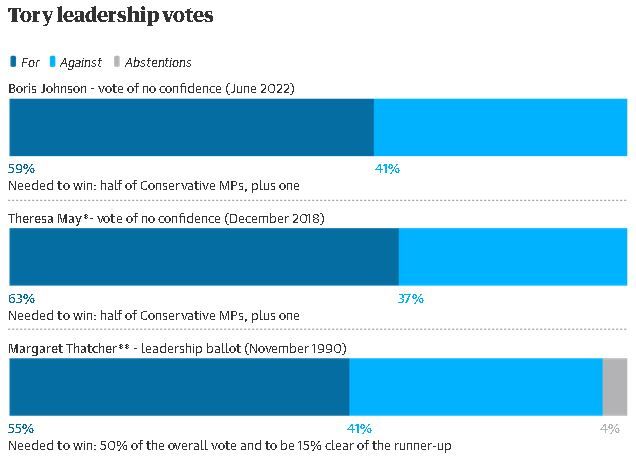
The prime minister won the support of 211 MPs but 41% of his party voted to get rid of him, with many citing his lack of repentance over the Partygate scandal and the public’s loss of trust in his leadership. It was the worst verdict on a sitting prime minister by their own party in recent times.
Although Johnson and his allies claimed the vote as a victory, many Conservative MPs including some of his supporters believe the attempted coup is the beginning of the end for his three-year premiership.
With so many of his party having voted against him, the prime minister has effectively lost his majority support in parliament, with the risk that his government is paralysed.
Johnson is theoretically safe from another leadership challenge for a year under the rules of the 1922 Committee – but Theresa May was forced to leave office just six months after a winning a confidence ballot, having been terminally damaged despite winning by 200 votes to 117.
The proportion of MPs who voted against Johnson is even greater than the votes against May in 2018 and Margaret Thatcher in 1990. Thatcher resigned a week later.
Speaking after the result, Johnson insisted it was an “extremely good, positive, conclusive, decisive result” that would allow him to “move on to unite and focus on delivery”. He also claimed he had “won a far greater mandate” from colleagues than he did in his 2019 leadership election, although critics cast doubt on that claim. Johnson also declined to rule out calling a snap election, although he said he was “not interested” in that idea.
Nadhim Zahawi claimed Johnson had “won handsomely” and he hoped the result would “draw a line under all the speculation from the media and Twitterati”, leading to a “united party”.
The education secretary also claimed that Volodymyr Zelenskiy, the Ukrainian president, would be “punching the air” at the result.
James Cleverly, the Foreign Office minister, called it a “comfortable” and “clear” win for Johnson, while the MP for Lichfield, Michael Fabricant, said the result was a “lot better” than he had feared.
However, rebel MPs said Johnson should quit for the good of the party and the country. Sir Roger Gale, one of Johnson’s leading critics, said a “prime minister of honour” should realise he had lost the support of a sizeable number of his MPs. He suggested rebels would continue to oppose Johnson remaining as prime minister.
The scale of the rebellion means some government ministers and aides must have voted against Johnson in the secret ballot, while remaining publicly supportive.
One former cabinet minister said he believed Johnson could soon face other attempts to oust him if the Tories lose in two byelections on 23 June, or the prime minister is found by a parliamentary inquiry to have misled the House of Commons. “The role of the chief whip will be key,” he said. “It would be his role to tell the prime minister he has lost his cabinet.”
Keir Starmer, the Labour leader, said the Conservative party “believes the British public now have no right to expect honest politicians”, while Ed Davey, the Liberal Democrat leader, said Tory MPs have “narrowly voted to keep a lawbreaker and liar in No 10”.
The confidence vote was triggered early on Monday morning after more than 54 Tory MPs – 15% of the total – submitted no-confidence letters to Graham Brady, chair of the 1922 Committee that represents backbenchers.
Johnson had embarked on a last-minute bid to win over colleagues but a number of Tory MPs said they were surprised by the lack of effort put into the operation.
The rebels started the day thinking Johnson was certain to win the vote convincingly but became increasingly emboldened after the resignation of John Penrose as No 10’s anti-corruption tsar and a critical statement from Jeremy Hunt, a possible leadership contender.
“Anyone who believes our country is stronger, fairer and more prosperous when led by Conservatives should reflect that the consequence of not changing will be to hand the country to others who do not share those values. Today’s decision is change or lose. I will be voting for change,” Hunt said.
Announcing he would quit, Penrose called on Johnson to stand down too, accusing the prime minister of failing to address the “broader and very serious criticisms” contained in Sue Gray’s report into Downing Street parties.
He said the only fair conclusion to draw from Gray’s report was “that you have breached a fundamental principle of the ministerial code – a clear resigning matter”.
Jesse Norman, a former Treasury minister, also published a coruscating letter saying Johnson had “presided over a culture of casual law-breaking at 10 Downing Street in relation to Covid”. For Johnson to describe himself as vindicated by last month’s Gray report was “grotesque”, he said, adding that breaching the Northern Ireland protocol would be “foolhardy and almost certainly illegal”, while the policy of deporting asylum seekers to Rwanda policy was “ugly”.
A string of Scottish Tory MPs, including leader Douglas Ross and John Lamont, who resigned as a ministerial aide, also said they voted against Johnson.
Some MPs hardened their resolve against the prime minister after he gave a defiant speech to the 1922 Committee late on Monday afternoon, suggesting he would take the same decision again in relation to holding leaving dos in No 10 during lockdown.
He also blamed the “media-driven focus on the leadership of the Conservative party” and tried to turn the debate on to Brexit by claiming a vote against him would lead to a “hellish groundhog day” about rejoining the EU single market.
“Let us refuse to dance to the tune of the media, let us refuse to gratify our opponents by turning in on ourselves,” he said. “Let’s show this country that we understand that this is a moment to unite and serve. If we can do that then believe you me, whatever they may say about me I will lead you to victory again and the winners will be the people of this country.”
After the meeting, a Tory source briefing in support of the prime minister also played down the significance of the Partygate furore that has enraged the public. “Is there anyone here who hasn’t got pissed in their lives? Is there anyone here who doesn’t like a glass of wine to decompress?” they said.
But one of the first MPs to leave the meeting, arch Brexiter Steve Baker, took a very different view. He told reporters that it was “a very, very sad day” but he felt he had no choice but to vote against the prime minister.
“For me, although this is an incredibly difficult moment, I can’t move past the requirement to have at the very top of government a culture of compliance with laws,” he said. “I told the prime minister that if he broke the law he’d have to go, he clearly broke the law, he has clearly acquiesced in the law being broken, and so I must keep my word.”