London Daily

Focus on the big picture.
Wednesday, Jul 15, 2026

Biggest boom in City bonuses for years risks driving up inequality, says IFS

Biggest boom in City bonuses for years risks driving up inequality, says IFS

Think tank says pay and bonus deals have risen by about twice as much as other UK sectors

Inequality in Britain risks being driven up by the biggest boom in City bonuses and pay since the 2008 financial crisis, the country’s leading economics thinktank has warned.

The Institute for Fiscal Studies (IFS) said the return of bumper finance industry payouts meant the top 1% highest-paid workers were beginning to pull further away from the rest of the UK workforce despite the cost of living crisis hitting the country at large.

Suggesting that City bankers would be better insulated than most from the soaring cost of living, the thinktank said pay and bonus deals in the Square Mile had shot up in recent months and had risen by about twice as much as other sectors in the past two years.

According to the report, the mean monthly pay packet in the finance sector in February was 31% higher than in December 2019 in cash terms, compared with 14% across all sectors. Pay growth was driven by high earners, reflected in the higher mean figure. However, median pay in the finance industry was also significantly higher than for the economy at large.
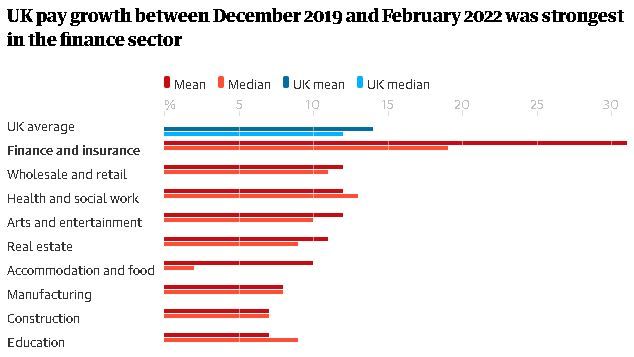

The IFS said City bankers, fund managers and other finance workers accounted for almost a third of all employees in the top 1% income bracket, meaning that a bumper period for this group would lift them further ahead of everyone else.

The IFS said this was in contrast with the trend from 2016 to 2020, when low earners saw the strongest pay growth.

Average annual pay growth, including bonuses, has increased in recent months as unemployment falls despite the end of furlough, reaching 5.4% in February. However, wage growth has failed to keep pace with soaring inflation driven by the rising cost of fuel and surging energy bills, exacerbated by Russia’s war in Ukraine. Inflation hit 7% in March and is expected to peak close to 10% later this year.

However, the average figures mask a growing divide between different sectors of the workforce, highlighting how the cost of living emergency is likely to hit some people harder than others. Private sector staff have seen the strongest annual growth in pay, and earnings in the public sector have fallen furthest behind inflation.

Xiaowei Xu, a senior research economist at the IFS, said: “Earnings inequality had been falling for some years before the pandemic hit, with low-paid workers seeing the strongest pay growth. The recent surge in pay among financial sector employees – particularly among top earners in the sector – has led to a reversal of this trend.

“This appears to be the first time since the financial crisis that finance sector earnings have taken off like this and it remains to be seen whether this is a one-off spike or a new trend.”

A spokesperson for UK Finance, the trade group for the financial services industry, said: “The banking and finance sector is a major source of employment around the country. It provides a range of high-skilled jobs and is one of the most important sources of tax revenue for the government.”

Newsletter

Related Articles

0:00
0:00
Close
Beer Industry Warns UK Rules Could Limit Growth of Alcohol-Free Market
Home Office Faces Legal Challenges Over Asylum Seeker Accommodation Closures
UK Heatwaves Linked to More Than Two Thousand Seven Hundred Deaths as Climate Debate Intensifies
Home Secretary Faces Pressure Over Political Security After Ann Widdecombe Murder Investigation
United Kingdom Opens Trade Consultation With Indonesia, Philippines, United Arab Emirates and Uruguay
Robert Jenrick Joins Reform UK After Leaving Conservative Party Leadership Role
Counter-Terrorism Police Take Over Investigation into Murder of Former MP Ann Widdecombe
Andy Burnham Secures Strong Labour Backing in Race to Succeed Keir Starmer
Global Markets Slide as Middle East Conflict Escalation Sends Oil Prices Higher
UK Prime Minister Keir Starmer Offers Condolences Following Death of Qatar’s Father Amir
UK Regional Innovation Policy Focuses on Research Clusters Across Scotland, Wales, and Northern England
UK Corporate Transparency Rules Set to Become More Strict Under Modern Slavery Reform Plans
UK Civil Service Estate Strategy Shifts Government Activity Away From London
UK Strengthens National Security Powers Through New Threat Designations
Greater Manchester Police Conduct Drink and Drug Driving Operations After Football Events
UK Government Advances Darlington Economic Campus With Construction Milestone
UK Authorities Increase Football-Related Security Operations After Tournament Fixtures
UK Invests Fifty-One Million Pounds in National Cryogenics Facility and Regional Innovation Hubs
UK Moves Toward Tougher Modern Slavery Reporting Rules With Corporate Penalties
UK Government Reports Forty-Three Million Pounds in Savings From Office Estate Reform
UK Government Expands Civil Service Regional Strategy With Manchester and Darlington Campus Projects
UK Designates Iran’s Islamic Revolutionary Guard Corps as National Security Threat
United Kingdom Financial Markets Monitor Business Response to Economic Policy Changes
Scottish Renewable Energy Expansion Highlights Need for Faster Grid Development
Wales and Regions Strengthen Focus on Economic Development Through Tourism and Investment
Retail Industry Warns High Street Businesses Remain Under Pressure
Police Chiefs Highlight Growing Challenges Managing Protests and Public Order
Agriculture Leaders Seek Clarity on Post-Brexit Farming Support and Environmental Rules
Transport Unions Warn of Further Industrial Action Over Pay and Working Conditions
Welsh Tourism Sector Reports Strong Growth Driven by Domestic and International Visitors
National Infrastructure Review Gains Support as Leaders Seek Faster Project Delivery
Financial Markets Assess Impact of United Kingdom Corporate Tax Policy Changes
Northern Ireland Assembly Debates Cross-Border Trade and Infrastructure Cooperation Plans
Government Opens Consultations on Housing Reform and Planning System Changes
Scottish Government Faces Pressure to Accelerate Offshore Wind and Grid Expansion
National Energy System Operator Warns Grid Investment Is Needed for Future Electricity Demand Growth
United Kingdom Research Council Invests in Artificial Intelligence and Biotechnology Innovation Hubs
United Kingdom Expands Oversight of Skilled Worker Visa Sponsors Amid Migration Debate
Cross-Party MPs Call for National Infrastructure Strategy Review to Accelerate Economic Growth
Prime Minister Announces One Billion Pound NHS Funding Package Ahead of Winter Pressures
Bank of England Signals Cautious Approach to Interest Rates as Inflation Remains Above Forecasts
World Cup Visitors Turn American Big-Box Stores Into Souvenir Stops
Netflix Weighs Always-On Channels, Bundles and Short-Form Video
Passenger Is Pulled Partly Outside Ryanair Jet After Window Fails Mid-Flight
Innovation-led growth strategy
Public service reform pressure
Defence and industrial security
Labour leadership transition and economic reset
Northern England Pushes for Greater Influence in Britain’s Future Economic Model
UK Technology Strategy Focuses on Life Sciences, Digital Innovation and Research Investment
×