London Daily

Focus on the big picture.
Thursday, May 14, 2026

Berlin warms to France’s ‘Buy European’ plans as global trade rules erode

Berlin warms to France’s ‘Buy European’ plans as global trade rules erode

Germany fears losing industrial champions because of unfair competition from state-backed US and Chinese rivals.

Threatened by a new U.S. subsidy package that could hammer EU industry, Germany is rowing back on its long-standing objections to schemes like France's "Buy European Act" that would set provisions on buying goods locally.

Berlin's increasing sympathy for the French approach is a stark sign that Germany fears the traditional trade order is melting, as Washington follows China's lead with massive state support for industry. As one of the EU's more commercially liberal nations, Germany has generally opposed French proposals for interventionist industrial strategy, reckoning such measures would break free-trade taboos.

The calculus is now changing, however, ahead of a gathering of EU trade ministers in Brussels on Friday and a meeting between German Chancellor Olaf Scholz and French Prime Minister Elisabeth Borne in Berlin.

America's Inflation Reduction Act, which grants $369 billion worth of subsidies and tax breaks to U.S. green businesses, will be high on the agenda of both meetings. EU countries fear that the U.S. law will suck investment out of Europe, and are fuming about discriminatory provisions that encourage consumers to "Buy American" when it comes to purchasing an electric vehicle.

With the time for peace talks with the U.S. running out amid little hope of an agreement, German officials are now open talking about not only funneling billions of state subsidies into key green technologies like batteries, wind power or hydrogen, but also creating controversial requirements that would, at least to a certain extent, privilege European production.

German Economy Minister Robert Habeck said Thursday that the EU needed a "strong answer" to the U.S. law, telling German daily Handelsblatt that this would involve faster approvals of state aid decisions by the European Commission, more subsidies and also "procurement of local products."

The latter point is crucial, as it edges toward a "Buy European Act" that French President Emmanuel Macron has been calling for, which would give preferences to the use of European components in crucial industries, similar to those the U.S. law offers to American products. However, it's likely to antagonize other trading partners as they would be disadvantaged.

While such local content provisions might help the EU to avoid an exodus of key industries and ensure that the bloc stays in the race to produce next-generation green technologies, including electric vehicles, they are seen as a sacrilege in the international trading system.
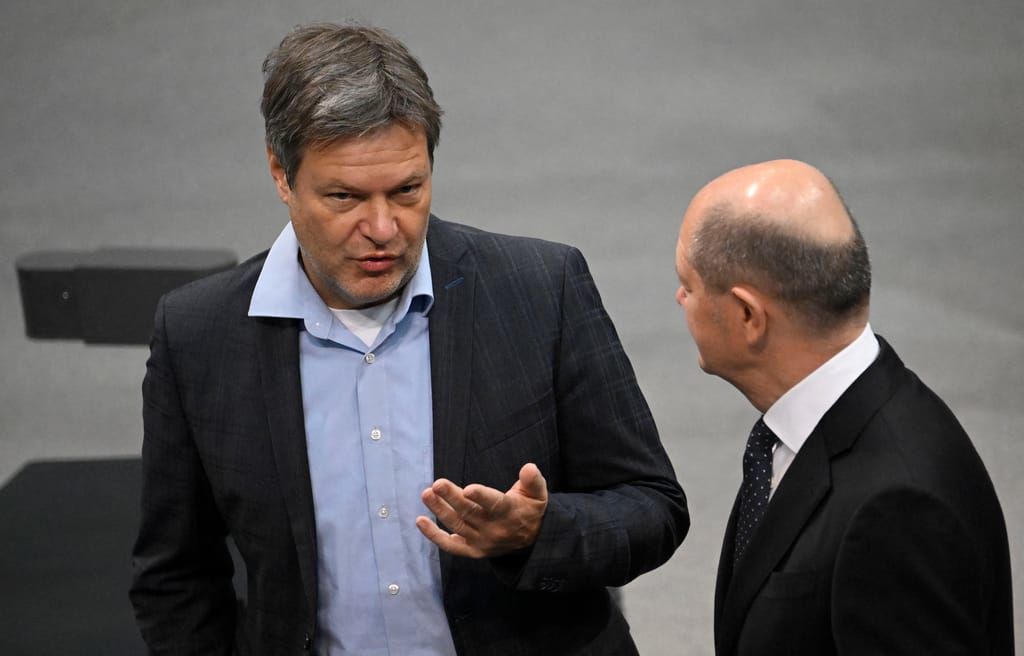

German Economy Minister Robert Habeck and Chancellor Olf Scholz, pictured November 23 2022

"The question of local content is very tricky, because it’s by definition very much against the core of World Trade Organization (WTO) rules, which is no discrimination against foreign companies," said Elvire Fabry, a senior research fellow at the Institut Jacques Delors.

Fabry warned that the EU "risks crossing the Rubicon" and losing its credibility as a custodian of global trading rules, on which the EU depends much more than the U.S. because of its high share of foreign trade.

Speaking at an economics summit in Berlin on Wednesday, Habeck accepted that the EU's actions should remain in line with multilateral trading rules "if possible," but also warned that, faced with unfair trading practices by the U.S. and China, it was not enough to just "criticize and complain."

Habeck said that local content requirements had long been "unfamiliar" to the EU, but stressed that Europe had already taken such a path in the field of microchip production.

He suggested that such a measure might qualify for an exemption under global trading rules as long as the EU can prove that it's not about creating "national" advantages but instead about "the strategic need for sovereignty, also in the area of energy policy."

Newsletter

Related Articles

0:00
0:00
Close
The Great Western Exit: Why Best Citizens Are Fleeing the Rich World [PODCAST]
The New Robber Barons of Intelligence: Are AI Bosses More Powerful Than Rockefeller?
The End of the Old Order [Podcast]
Britain’s Democracy Is Now a Costume
The AI Gold Rush Is Coming for America’s Last Open Spaces [Podcast]
The Pentagon’s AI Squeeze: Eight Tech Giants Get In, Anthropic Gets Shut Out [Podcast]
The War Map: Professor Jiang’s Dark Theory of Iran, Trump, China, Russia, Israel, and the Coming Global Shock [Podcast]
Labour Is No Longer a National Party [Podcast]
AI Isn’t Stealing Your Job. It’s Dismantling It Piece by Piece.
Lawyers vs Engineers: Why China Builds While America Litigates [Podcast]
Churchill’s Glass: The Drunk, the Doctor, and the Myth Britain Refuses to Sober Up From
Apple issues an unusual warning: this is how your iPhone can be hacked without you doing anything
Kennedy’s Quiet War on Antidepressants Sparks Alarm Across America’s Medical Establishment
The Met Gala Meets the Age of Billionaire Backlash
Russian Oligarch’s Superyacht Crosses Hormuz via Iran-Controlled Route
Gunfire Disrupts White House Correspondents’ Dinner as Trump Is Evacuated
A Leak, a King, and a Fracturing Alliance
Inside the Gates Foundation Turmoil: Layoffs, Scrutiny, and the Cost of Reputational Risk
UK Biobank Breach Exposes Health Data of 500,000, Listed for Sale on Chinese Platform
KPMG Cuts Around 10% of US Audit Partners After Failed Exit Push
French Police Probe Suspected Weather-Data Tampering After Unusual Polymarket Bets on Paris Temperatures
CATL Unveils Revolutionary EV Battery Tech: 1000 km Range and 7-Minute Charging Ahead of Beijing Auto Show
Crypto Scammers Capitalize on Maritime Chaos Near the Strait of Hormuz: A Rising Threat to Shipping Companies
Changi Airport: How Singapore Engineered the World’s Most Efficient Travel Experience
Power Dynamics: Apple’s Leadership Shakeup, Geopolitical Risks in the Strait of Hormuz, and Europe's Energy Strategy Amidst Global Challenges
Apple's Leadership Transition: Can New CEO John Ternus Navigate AI Challenges and Geopolitical Pressures?
Italy’s €100K Tax Gambit: Europe’s Soft Power Tax Haven
News Roundup
Microsoft lost 2.5 millions users (French government) to Linux
Privacy Problems in Microsoft Windows OS
News roundup
Péter András Magyar and the Strategic Reset of Hungary
Hungary After the Landslide — A Strategic Reset in Europe
Meghan Markle Plans Exclusive Women-Focused Retreat During Australia Visit
Starmer and Trump Hold Strategic Talks on Securing Strait of Hormuz Amid Rising Tensions
Unofficial Australia Visit by Prince Harry and Meghan Expected to Stir Tensions with Royal Circles
Pipeline Attack Cuts Significant Share of Saudi Arabia’s Oil Export Capacity
UK Stocks Rise on Ceasefire Momentum and Renewed Focus on Diplomacy
UK to Hold Further Strategic Talks on Strait of Hormuz Security
Starmer Voices Frustration as Global Tensions Drive Up UK Energy Costs
UK Students Voice Concern Over Proposal for Automatic Military Draft Registration
Rising Volatility Drives Uncertainty in UK Fuel and Petrol Prices
UK Moves to Deploy ‘Skyhammer’ Anti-Drone System to Strengthen Airspace Defense
New Analysis Explores UK Budget Mechanics in ‘Behind the Blue’ Feature
Man Arrested After Four Die in Channel Crossing Tragedy
UK Tightens Immigration Framework with New Sponsor Rules and Fee Increases
UK Foreign Secretary Highlights Impact of Intensified Strikes in Lebanon
UK Urges Inclusion of Lebanon in US-Iran Ceasefire Framework
UK Stocks Ease as Ceasefire Doubts in Middle East Weigh on Investor Confidence
UK Reassesses Cloud Strategy Amid Criticism Over Limited Support Measures
×