

Are school uniforms too expensive for some families?
It comes after the Welsh government announced a one-off £100 payment to families already eligible for help.
The Child Poverty Action Group wants more families to receive funding. Only looked-after children or those getting free school meals currently qualify.
The Welsh government said it recognised the pressure many families were under.
One former school governor warned the impact can be like period poverty - with children missing school as a result of not being able to afford the right uniform.
What are the pressures on families?
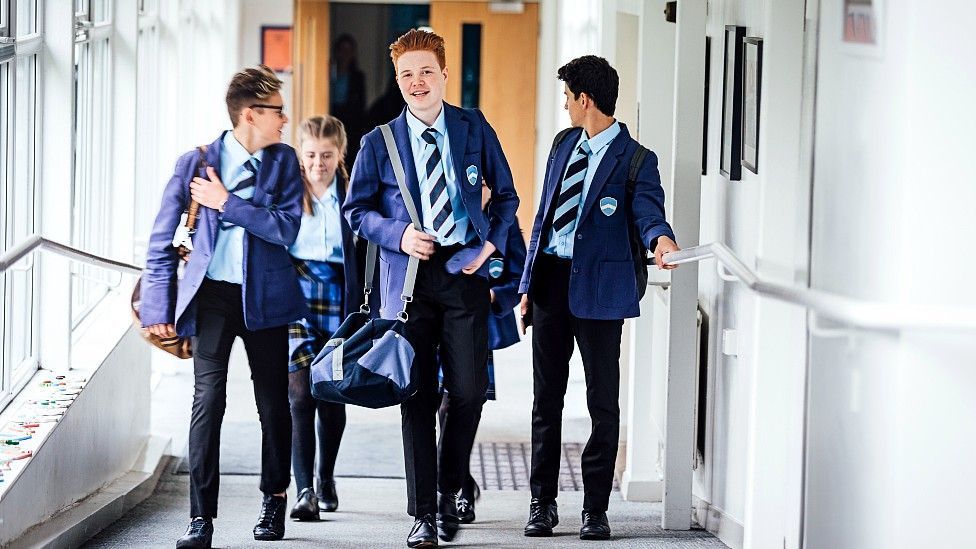 Items like blazers can put financial pressure on parents, an ex-head teacher says
The cost of living is rising rapidly. A combination of Brexit, the pandemic and now the war in Ukraine has seen prices for fuel and food soaring.
With energy bills alone due to rise by an average of £693 per year, more families on tight budgets are having to make hard choices.
Research by the Children's Society from 2020 showed the average spent on school uniform per year was £337 for each secondary child and £315 for primary.
The costs were three times what parents thought was acceptable.
The Child Poverty Action Group's research found differing uniform policies across Wales had an impact on affordability, particularly as many schools had just one specified retailer for branded items.
Kate Anstey from CPAG welcomed the additional £100 grant but said it was not enough to "plug the gaps", adding 55,000 children in poverty in Wales lived with families earning just above the eligibility limit for free school meals and therefore missed out on the pupil development grant and this extra payment.
"In the short term, the existing grant must be increased to reflect the actual school costs that parents face and eligibility must be extended," she said.
"But the bigger picture is that we need system-wide change to remove school costs - because no child should be shut out from school activities on account of family income."
All in a name?
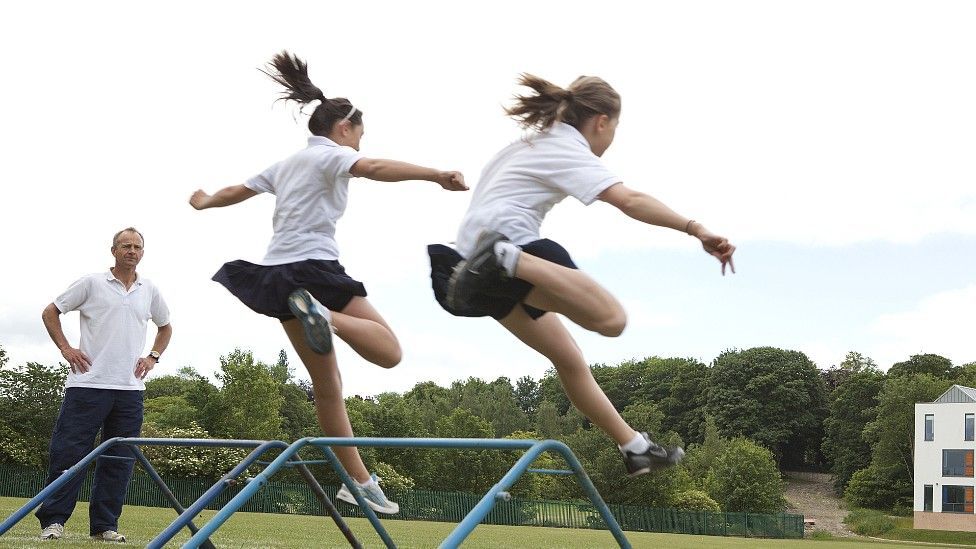 Should children need school branded kit to do PE?
Eligible families can currently claim £125 (£200 for those starting secondary in Year 7) to help pay for uniform. The extra £100 announced by the Welsh government was billed as helping with additional costs such as PE kit and other necessary items.
If you go to a state school, you would assume the cheapest pair of shorts and t-shirt you can lay your hands would suffice for PE. The price could be single figures for a canny shopper.
Add on a tracksuit for winter, and trainers of course, but surely these are items every child would already have in their wardrobe? So why the need for more help with PE kit in particular?
The answer often lies in one word: Logo.
In many schools, branded PE kits bearing the school's colour scheme and logo have become compulsory for children, not just for matches against other schools but even during ordinary PE lessons.
Parents already face having to pay for branded regular school uniform. These items are often many times more expensive than a similar item without a logo.
As an example, a pack of two polo shirts from Asda costs between £2.50 and £4 depending on age, while a single branded polo can cost between three and five times that amount, making it six to 10 times more expensive than plain ones per unit.
A branded school rugby shirt can cost in the region of £20-25, double what a plain one sells for.
One mother, who has two secondary school-age children at Ysgol Bro Morgannwg in the Vale of Glamorgan, said the uniform policy there was very strict.
"Our youngest child is in so many sports teams they have to have three of everything," she said.
"Only the correct logoed uniform can be worn for everything. The only thing I've been able to buy without the logo is the socks.
"I do feel there could be more relaxed rules for general PE lessons with more formal kit for fixtures."
While the mother, who did not wish to be named, agrees with uniform in principle "to stop kids from sticking out for any reason [such as] branded or non-branded clothes", she felt their former primary school had the right approach.
"Grey skirt, shorts or trousers with a blouse, shirt or polo and a bottle green cardigan or jumper. Logoed items were available but not insisted on - this gave far more options of where uniform could be bought from.
"Everything at Bro Morgannwg has to be logoed and this makes it much more restrictive and expensive," she said.
She would be keen to see schools do more to promote the passing on of second hand uniform and for councils and the government to have firm policies in place to ensure a range of suppliers to suit all budgets. "If this means dropping the logos then so be it," she added.
A spokesperson for the Vale of Glamorgan council said uniforms could give a sense of belonging and remove negative attention from what children wore, adding each school in the county set its own policy but financial support was available to all eligible parents.
How can schools help?
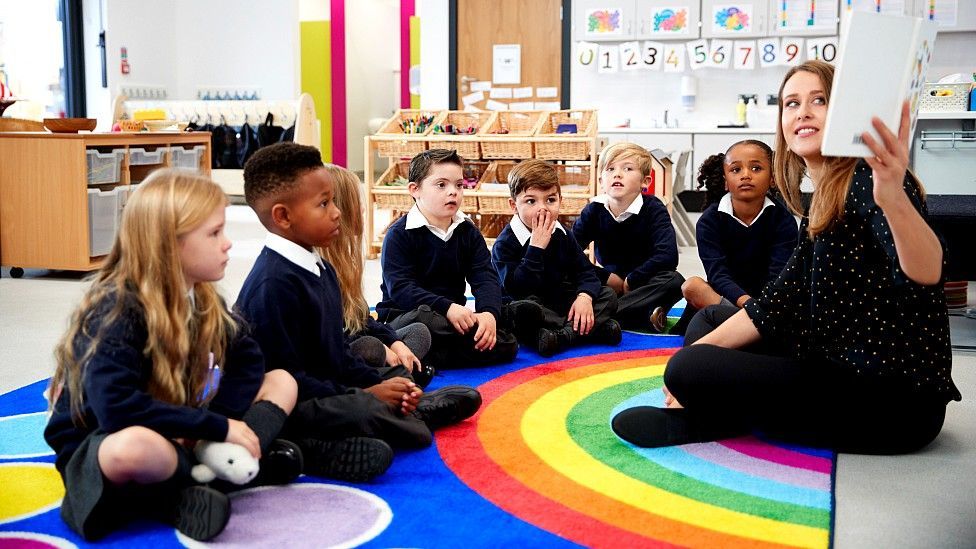 Primary school uniform is often simpler and more high-street items can be used
George Davies, a retired secondary school headteacher in Pembrokeshire, did all he could to keep uniform affordable while in post and said he did not understand why schools included items like blazers, for example.
He told BBC Wales: "I insisted on a simple uniform and could never understand putting families under financial pressure by having to buy expensive items from specified retailers.
"I hope this is something you understand could reduce costs dramatically and reduce pressures on families especially those who don't quite qualify for free school meals. I fully endorse the purchase of uniform from a range of suppliers."
But this is not the norm, particularly at secondary level, which is when the costs can really start to mount.
As an example, a simple branded sports T-shirt for PE can start at about £8.50 at some schools, such as St Joseph's High School in Wrexham, but rise to £15 or more at other schools.
One mother, whose daughter is due to start at secondary school in Swansea this year, said a strict uniform list made no mention of any second-hand stock options or of school badges being available to sew on to high-street items.
"There are only two outlets to purchase uniform from so this limits choice and costs," she said.
"Many Year 6 parents, not on free school meals, find the costs a huge concern when they should be excited about this new chapter.
"I think the grant would not even be needed if uniform was more reasonable, but if grants are available, they should be for all students."
 Former Bryncelynog school governor Lynne Williams says uniform needs to be "very accessible"
Former school governor Lynne Williams has strong feelings about equality of access to school.
She told BBC Wales her work with the Salem Chapel foodbank in Tonteg, Pontypridd, which has provided community support in many areas apart from food during the pandemic, had made her very aware of the difficulties facing some families with regard to the cost of living.
"There was a case where the child was really upset because family didn't have the right item of clothing for school," she said.
"It prevents people from accessing education because it's like period poverty - when kids don't go because they have got their period and don't have sanitary protection.
"The Welsh government has done something about that [by providing free pads and tampons in schools]. But it's a similar thing if you are sent home because you don't have the right item of clothing on.
"My feelings are that a badge on a uniform does not improve learning but is divisive, elitist and wasteful."
She said other countries managed without uniforms, and while agreeing it could make mornings easier for parents it "should be very, very accessible, no particular colour, no badges".
'Transition to secondary makes the difference'
 Moving from primary to secondary has a bit impact on parents' budgets, says Parentkind's Kerry-Jane Packman
Parent-teacher association charity Parentkind conducts an annual parent survey to gauge opinions on various topics relating to school.
"We ask a number of questions around what are they concerned about with the cost of school and consistently over the past seven years it has been around school uniforms and the increasing costs," said Kerry-Jane Packman, executive director of programmes, membership and charitable services.
The surveys found primary uniform tended to be less of an issue, because primaries often accept just coloured tops without school branding, but the situation at secondary schools was very different.
"It's that transition from primary to secondary which really does make the difference," she said.
"PE kit is another additional cost. I've heard of schools where there's a branded rugby kit, there's a branded athletics kit, there's a branded netball kit.
"If your child is particularly sporty and they are members of all these teams, then that becomes even more expensive.
"[Parents] are in this difficult position where the cost of school uniform is getting higher, PE kit adds to that cost, but if you don't do it, your child is being singled out and then is not seen as part of that school community.
"It's a very difficult balance."
'Ask parents about costs'
She believes one way forward is for schools to have more consultation with parents around the costs of uniform at the site.
"With PE kits especially, ask parents whether they think it is necessary that their child has several PE kits, if there's different ways of doing it."
A spokeswoman said the Welsh government had been the first in the UK to introduce statutory guidance on uniform to keep costs to a minimum.
"The Pupil Development Grant Access scheme, which is additional support for families, is the most generous scheme of its type in the UK and we were pleased to recently expand it so that every school year group will be able to benefit."
Primary school families would also soon benefit from universal free school meals in a policy jointly agreed by Labour and Plaid Cymru.
She added: "We will also continue to look at what further we can do to support pupils and their families."