

Analysis: UK and France reheat one of the world's oldest rivalries at a risky time for both
French President Emmanuel Macron was never going to be at UNGA in person. It was, however, impossible to detach his non-attendance -- even in virtual form -- from the spat that broke out following the submarine deal between Australia, the UK and US (AUKUS), which subsequently saw the Australian government ditch a multi-billion-dollar agreement with France.
French officials have been, justifiably, furious. Three of its supposed allies struck a deal behind its back with one reneging on a contract agreed years ago. For a man who has spent his presidency presenting himself as Europe's most serious leader both internally and on the world stage, it was a major embarrassment.
Conversely, for Boris Johnson, the man who led the Brexit campaign and has been accused of making his country insular and a global insignificance, this was a hat-trick. Standing shoulder-to-shoulder with US President Joe Biden; agreeing a deal with two nations on opposite sides of the world; poking France in the eye in the process.
It's the final point that best explains both the hostile rhetoric that has come out of France and goading language from British over the past week.
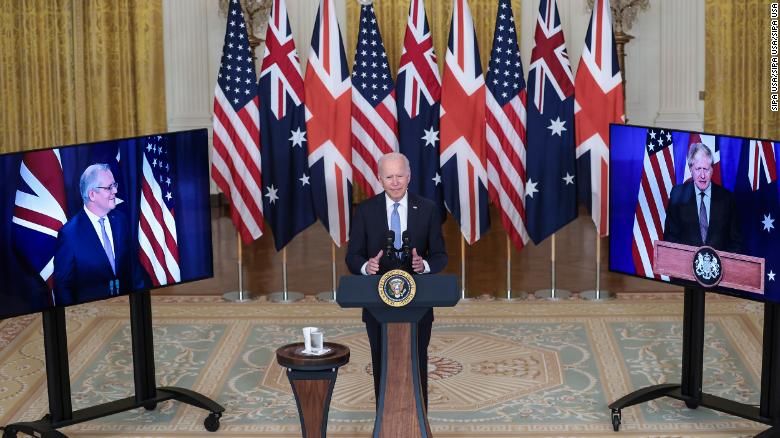 US President Joe Biden delivers remarks about the AUKUS security
initiative on September 15, 2021 at the White House, joined virtually by
Prime Minister Scott Morrison of Australia and UK Prime Minister Boris
Johnson.
US President Joe Biden delivers remarks about the AUKUS security
initiative on September 15, 2021 at the White House, joined virtually by
Prime Minister Scott Morrison of Australia and UK Prime Minister Boris
Johnson.
When France withdrew its ambassadors from Washington DC and Canberra, it elected not to do the same in Britain, which was seen as a snub, of sorts.
France's Europe minister called the UK a "junior partner" that had accepted its "vacillation" by the US.
Johnson responded to the hostility by saying, tellingly in broken French, that some people need to get a grip and give him a break.
"I just think it's time for some of our dearest friends around the world to 'prenez un grip' about all this, 'donnez-moi un break'," he said to reporters during his US trip.
As childish as all this seems, it could be consequential.
France and the UK have long been neighbors who love to hate one another.
"Politics is often as simple as: People like being on one side of a rivalry and love it when they get one over their rival," says Rob Ford, professor of politics at the University of Manchester.
The past week must have been incredibly difficult for Macron to swallow. Not only did the AUKUS deal undermine France's claim to be Europe's most serious geopolitical player, but Johnson went on to score a series of wins in America -- a meeting in the White House; global leaders supporting his climate goals; an end to the US travel ban. All the while, Macron was absent and scorned.
Ford points out that this plays into a particular strength of Johnson's: using undiplomatic language -- "get a grip" -- that is likely to cause offense while amusing his domestic audience.
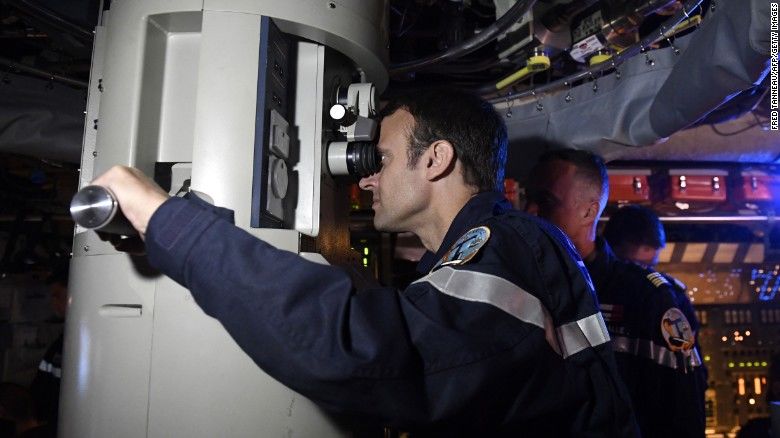 French President Emmanuel Macron looks through the periscope of
submarine "Le Terrible" during a July 4, 2017 visit aboard the vessel.
French President Emmanuel Macron looks through the periscope of
submarine "Le Terrible" during a July 4, 2017 visit aboard the vessel.
But why would he, or any world leader, want to even risk causing such offense? Bluntly, engaging in a bitter spat politically suits Macron and Johnson rather well right now.
First, Macron.
Aurelien Mondon, senior lecturer at the University of Bath, explains that this is a "good opportunity for him to appear statesmanlike" while France is "only a few months away from the presidential election. This sets him apart from many other candidates who have very little experience in such matters."
It also helps Macron underscore one of his key objectives: bringing the European Union together on matters such as defense, something that would have been impossible had the UK not voted to leave.
"It's no secret that Macron wants to build up an EU pillar within NATO and the EU to have greater defense capabilities," says Emmanuelle Schon Quinlivan, lecturer in European politics at the University of Cork. "He's now able to use the AUKUS row to say the EU cannot rely on the US or the UK."
She also points out that during the Brexit negotiation process, it was Macron who consistently took the hardest line with the UK and was at times the biggest risk to a Brexit deal.
Which brings us to Johnson.
"He is a leader who is arguably at his best when he is fighting an enemy," says Ford. "Post-Brexit, the incentive to play up minor conflicts with France is greater because it can no longer punish us inside the structures of the EU."
However, Ford points out that this could go wrong "if Macron looks for revenge and wants to make Johnson look stupid."
The most obvious area where he could seek to punish Johnson is by pushing the EU to take legal action over the UK's failure to implement the Northern Ireland Protocol in full.
"If France presses the EU to take Britain to court and Britain retaliates by triggering Article 16 of the protocol -- allowing the UK to take unilateral action -- it would represent a serious escalation in tension," says Anand Menon, professor of European politics at King's College London.
How likely are things to get out of hand?
There is limited good faith between Paris and London right now.
And a poor relationship affects lots of important issues between neighbors.
The UK government has been working with France to stem the flow of irregular migrants traveling across the English Channel.
Julian King, Britain's former ambassador to France, says that without the French incentivized to "enthusiastically patrol those beaches," crossing the Channel becomes "much easier for those wanting to smuggle people into the UK." This would be a problem for a government that has taken such a hard stance on migration.
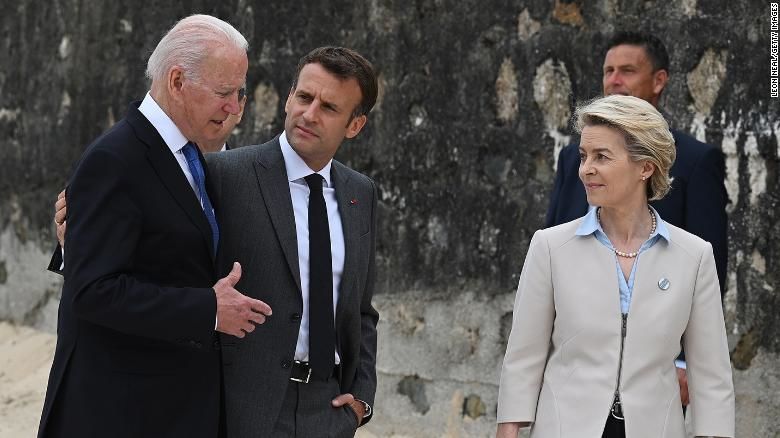 US President Joe Biden, President of France, Emmanuel Macron and
European Commission Ursula von der Leyen speak after posing for photos
during the Leaders official welcome and family photo during the G7
Summit In Carbis Bay, on June 11, 2021 in Carbis Bay, Cornwall.
US President Joe Biden, President of France, Emmanuel Macron and
European Commission Ursula von der Leyen speak after posing for photos
during the Leaders official welcome and family photo during the G7
Summit In Carbis Bay, on June 11, 2021 in Carbis Bay, Cornwall.
He adds that beyond intergovernmental bilateral issues like defense, political rows can spill into a toxic atmosphere in wider society, which in turn could cause spats that are out of either government's hands -- for example fishing boats ramming each other at sea.
"It's not just the UK where some in the media are ready to whip up bad feeling. Politicians, on both sides, should focus on lowering the temperature, not fanning the flames," King says.
One consequence of the tumultuous past five years in world politics is a bizarre dynamic of diplomatic competition in Europe.
The UK, outside the EU, wants desperately to be the best friend of English-speaking democracies like the US, Australia, Canada and others.
Simultaneously, the EU is trying to build its own power base that, while independent of the US, will force Washington and other global players to take it seriously. Despite its best efforts, the 27 member states cannot agree on some of the most basic principles of what this EU Mark Two will be.
In this environment, artificial rows are inevitable and, in some cases, useful. What leaders must be careful of, however, is not letting them boil over from performative fluff into policies that are damaging to themselves and others.

