

Analysis: Boris Johnson's government in fresh swirl of murk and sleaze accusations
On Wednesday night, Johnson's lawmakers were whipped to vote in favor of overturning the suspension of a fellow Conservative Member of Parliament.
Owen Paterson, an influential Conservative backbencher and former cabinet minister, was facing a 30-day suspension after being accused of an "egregious" breach of lobbying rules.
Paterson sent multiple emails to government officials on behalf of two companies that between them paid him a salary of £100,000 ($136,000) as a consultant. Paterson claims he was raising concerns about the quality of milk and pork; Kathryn Stone, the parliamentary standards commissioner, disagrees.
On Wednesday, Paterson persuaded Johnson's government to back an amendment that would overrule his suspension and instead refer the case to a newly set-up parliamentary committee of MPs chaired by one of his Conservative colleagues, John Whittingdale.
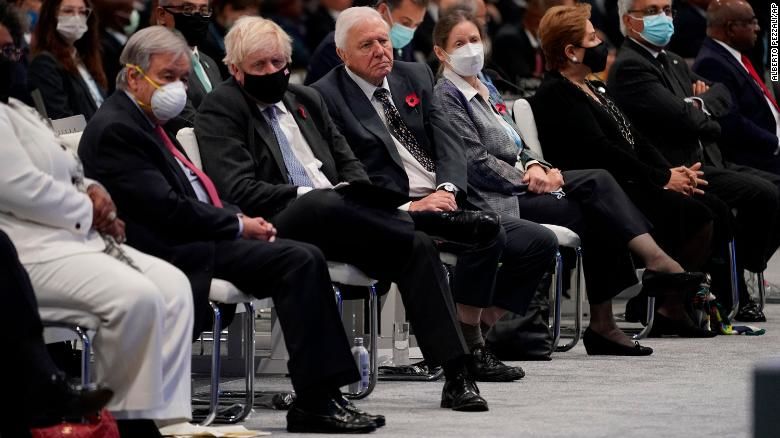 British broadcaster and naturalist David Attenborough, center, sits next
to British Prime Minister Boris Johnson at the COP26 climate summit in
Glasgow.
British broadcaster and naturalist David Attenborough, center, sits next
to British Prime Minister Boris Johnson at the COP26 climate summit in
Glasgow.
The backlash was so severe the government appeared to make a U-turn on Thursday morning, indicating the proposals to overrule the suspension on Paterson would not go ahead.
A Downing Street spokesperson said in a statement: "There must be tough and robust checks against lobbying for profit. There must be a proper process to scrutinise and -- if necessary -- discipline those who do not follow the rules."
On Thursday afternoon, Paterson announced he would stand down as a Member of Parliament, saying: "The last two years have been an indescribable nightmare for my family and me.
"I maintain that I am totally innocent of what I have been accused of and I acted at all times in the interests of public health and safety."
Adding to an already bad look, Johnson left the COP26 summit in Glasgow on Wednesday before the vote, flying back to London from Scotland, voted on the amendment to protect Paterson, then, sources have confirmed to CNN, attended a private dinner at a men's-only club with former colleagues at the Conservative-leaning Daily Telegraph newspaper. He is now facing criticism for leaving the climate talks that he is hosting, and by private plane.
The leader of the opposition Labour Party, Keir Starmer, has called the reversal and attempts to set up a new committee "outright corruption." Writing in the Guardian newspaper, he says "the rot starts at the top. We have a prime minister whose name is synonymous with sleaze, dodgy deals and hypocrisy."
Downing Street has yet to respond to Starmer's criticism.
It's true that Johnson and his government are facing accusations of sleaze on many fronts. There is, for instance, an ongoing investigation into precisely how Johnson funded a refurbishment of his flat in Downing Street.
Prime ministers are given £30,000 ($41,000) of public money a year to renovate their official residence during their term, but Johnson's reportedly cost £200,000 ($280,000). He has been accused of trying to get Conservative donors to pay for the work, plans that his former adviser Dominic Cummings called "unethical, foolish, (and) possibly illegal." Johnson has denied any wrongdoing.
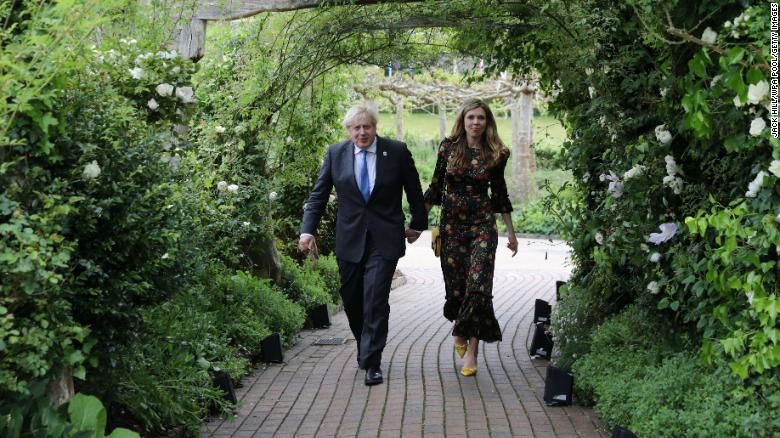 Boris Johnson and his wife Carrie attend a reception at The Eden Project
during the G7 summit on June 11, 2021 in Cornwall, England.
Boris Johnson and his wife Carrie attend a reception at The Eden Project
during the G7 summit on June 11, 2021 in Cornwall, England.
Johnson faced harsh criticism when he was photographed painting in a luxury villa on holiday on the same day a report critical of the government's handling of the Covid-19 pandemic was released.
During the Covid-19 pandemic, the British government has also been accused of handing lucrative contracts to people with connections to the Conservative Party. Transparency International UK, a respected campaign group, reported that one in five of the contracts awarded to private companies raised one or more red flags. They single out the government's "high priority" or "VIP" lane that was shrouded in mystery and effectively eliminated competition for public money. The government has repeatedly maintained that a fair and proper process was carried out.
Johnson also stands accused of trying to get a Conservative-friendly, right-wing former newspaper editor, Paul Dacre, the top job at Britain's media regulator, Ofcom.
The government has appointed a lobbyist with very close links to the Conservative Party as the senior external interviewer for the job, which has been seen as an attempt to smooth the way for Dacre.
On top of all these problems, Johnson's private life has also not been without scandal in recent years. He has been accused of having an affair with someone who was receiving public money while he was Mayor of London, which he denies, and for some time refused to disclose precisely how many children he has fathered.
Frustratingly for the opposition Labour Party, these scandals don't necessarily translate to public condemnation of the government. While Starmer is right in his claim that, for some, Johnson's name is synonymous with sleaze, other voters have baked a certain amount of scandal into this prime minister.
"It's not like it's news to anyone that Boris Johnson is a man who plays fast and loose with the rules. This is not an aspect of his personality he has sought to hide in his long career in the public eye," says Rob Ford, professor of politics at the University of Manchester. He points out that while Johnson's poll numbers have been falling, "that's unlikely to be sleaze related, more the shine coming off from vaccines. But on the main numbers he's still ahead enough to win an election."
However, while this isn't hurting Johnson right now, sleaze, Ford notes, does have a habit of building up over time.
"It could affect him though. Sleaze is more like a corrosive fog than an immediate problem. It could build up. A lot of the voters he won over by backing Brexit were inherently distrustful of politicians in the first place, so there could come a time where it suddenly hurts him badly."