

An American lawyer went on a lunch date in Moscow. Now he's languishing in a jail cell in Belarus
Ziankovich's wife, Alena Dzenisavets, says that according to the manager of the Nordic Rooms hotel, the men -- all in plain clothes -- put a hood over his head and bundled him into a car outside the hotel in the Moscow suburb of Ostankino.
She told CNN that Youras was then spirited across the Russian border in a three-vehicle convoy and driven more than 700 kilometers (435 miles) to the Belarusian capital, Minsk.
Dzenisavets says she pieced together what happened to her husband through his court-appointed lawyer in Belarus. She has not had any direct contact with Youras for nearly three months.
Ziankovich's lunch companion, Alexander Feduta, was detained at the same time. He, too, was driven to Minsk. Feduta served as spokesman for Alexander Lukashenko, in 1994, before falling out with the Belarusian leader. He went on to join the country's opposition.
A well-known writer in Belarus, he spent time in jail after taking part in a protest in 2010.
On arrival in Minsk, Ziankovich was taken to the Belarus KGB's pre-trial detention center. He has had occasional visits from the lawyer, but US consular officials have been unable to visit him in the weeks since he was hustled off a Moscow street.
For the Belarusian authorities, detaining Ziankovich was part of a bigger play -- and they were about to make some dramatic claims.
Six days after the abduction, President Alexander Lukashenko told journalists in Belarus of a plot to assassinate him and abduct his children, as part of a coup attempt.
"We discovered the involvement of the apparently foreign intelligence services, most likely, the Central Intelligence Agency, the FBI," Lukashenko said.
"Agents flew from the United States, [someone called] Ziankovich. We were trailing and watching them."
The US State Department quickly responded that "any suggestion that the US Government was behind or involved in an assassination attempt on
Lukashenka is absolutely untrue."
 Youras Ziankovich, in an undated photo provided by his wife, Alena Dzenisavets.
Two others were arrested in connection with the alleged plot, including Olga Golubovich, a former employee in Ziankovich's law firm. They have all been charged with "conspiracy or other actions committed for the purpose of seizing state power;" none has entered a plea.
Belarus is also seeking the extradition of five others alleged to have been part of the conspiracy from the US and Lithuania.
Konstantin Bychek, head of investigations for the Belarus State Security Committee, later announced that Ziankovich had confessed and was cooperating with the investigation. Bychek told Belarus state television that Ziankovich was involved in attempts to bribe members of Belarus's security forces to join the plot to overthrow Lukashenko.
Alena Dzenivasets insists the charges against her husband are ludicrous and that if he confessed it was to save his life.
When the Belarusian KGB found out Ziankovich was in Moscow, Bychek said, "we asked the [Russians] about the possibility of sending a group of Belarusian agents to Russia."
Russia's internal security service, the FSB, said later that the arrests had been a joint operation with the Belarus KGB, aimed at preventing "unlawful activity."
Russian President Vladimir Putin backed Lukashenko's claim of a coup plot, complaining in his annual state of the union address "that even such flagrant actions have not been condemned by the so-called collective West. Nobody seemed to notice. Everyone pretends nothing is happening."
Foreign Minister Sergey Lavrov doubled down on the claim last month, saying "It's hard to imagine that US intelligence agencies could have been unaware of such a large-scale activity." And Kremlin spokesman Dmitry Peskov said Putin had discussed the alleged assassination plot on a call with President Biden on April 13.
The US embassy in Minsk says it can't discuss the case -- and because Ziankovich is a dual citizen, consular officials don't have an automatic right to see him.
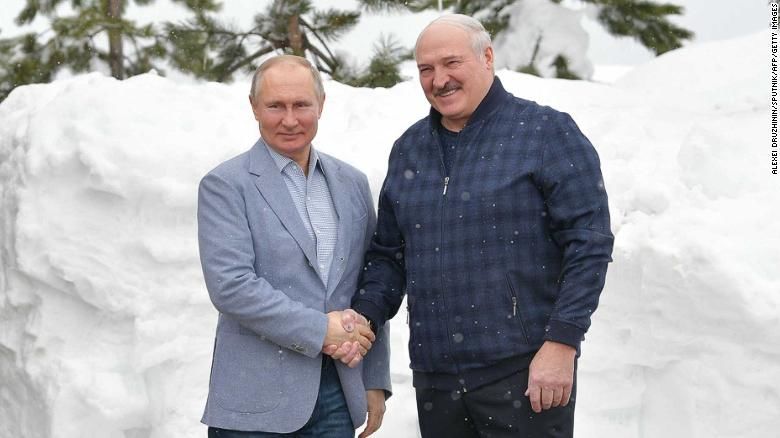 Russian President Vladimir Putin (left) shakes hands with his
Belarussian counterpart Alexander Lukashenko during their meeting in
Sochi, Russia, on February 22.
Russian President Vladimir Putin (left) shakes hands with his
Belarussian counterpart Alexander Lukashenko during their meeting in
Sochi, Russia, on February 22.'To kill the President'
Dzenivasets is worried about his health; she says her husband's lawyer has told her Ziankovich's "blood pressure is jumping every day."
"He had his medicine with him in a travel bag, but was not allowed to take it," she told CNN.
For Lukashenko, claims of a coup plot sponsored by the US served several ends: They allowed him to portray the opposition as reliant on a foreign power, and ready to commit acts of violence. Plus, the cooperation between the Russian and Belarus security services has helped build a rapprochement with Moscow.
To promote the government's narrative, Belarus state television produced a melodramatic documentary, "To Kill the President."
The program included secret footage of Ziankovich, filmed in the Avignon restaurant in Minsk in 2020. It is time-stamped August 21 -- almost two weeks after the disputed election which led to an explosion of popular protest across the country.
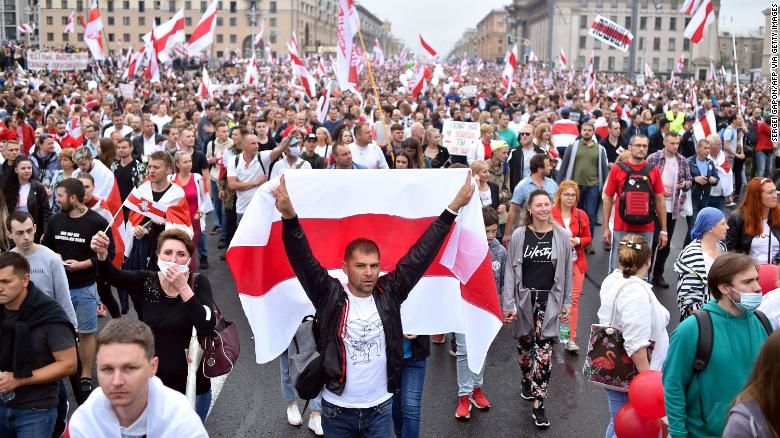 Belarus' contested elections in August 2020 led to huge anti-government protests and calls for the resignation of Lukashenko.
Ziankovich is alleged to say: "I spoke to some businessmen, I will see them after this, they will provide me with a restaurant venue for the first event. I also have the backing of the Jewish capital of America."
But the audio in the film appears to have been doctored. Ziankovich's words don't match the movement of his lips.
The documentary's narrator says: "He doesn't hide his goal. His task is to reveal a vulnerability, to recruit and to induce an armed mutiny."
At the time the secret footage was shot, Ziankovich's wife Alena says, the couple were on a visit to Belarus to see family members and finalize the purchase of a property. "We wanted to have a house where we could come to meet with the family and friends in summer," she told CNN.
She said they also wanted to vote in person in Belarus' presidential election, which took place on August 9.
Days after that lunch in Minsk, Alena says, Ziankovich was detained. She'd noticed that they had been followed for several days after attending one of the many protests that were held against the election result, which was widely regarded as fraudulent and which gave Lukashenko a fifth term as President.
Youras served ten days of what was called "administrative arrest." Alena says her husband went on hunger strike while detained, and when released headed straight for the Polish border.
Soon after, she told CNN, the couple decided to close their Minsk office "because it became dangerous for Youras to come to Belarus, and because we did not want to support the dictatorship by paying rent, utilities, taxes."
Ziankovich has a long history of opposing Lukashenko as a member of the Belarusian Popular Front (BPF) party. He was granted political asylum in the US in 2011 and became a citizen in 2017 but stayed in touch with a number of Belarusian opposition activists. In 2016 he ran for election to the Belarus House of Representatives, and he has previously tried to raise funds in the US for the BPF.
His decision to visit Moscow for a number of meetings in April -- using his Belarus passport -- gave the authorities in Minsk the chance they had been waiting for: To cast at least some of their opponents as the tools of hostile governments.
It's still unclear when Ziankovich and his co-defendants will go on trial.
And his wife has no idea when she will be able to talk to him, let alone see him. The last time they spoke was on April 11, when he called her at home in Houston to wish her goodnight, hours before setting out for that fateful lunch date with Alexander Feduta.

