

All but one among 53 held under Hong Kong national security law released
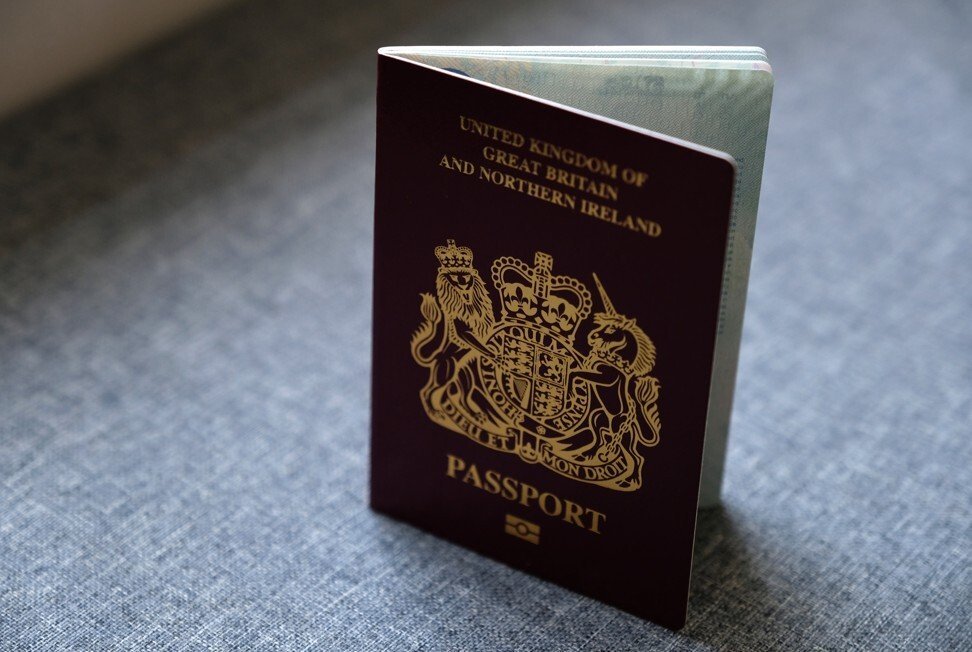
Police have released all of the more than 50 Hong Kong opposition activists arrested earlier this week under the national security law, the Post has learned, except for former Democratic Party chairman Wu Chi-wai, who was remanded after he failed to surrender his British National (Overseas) passport as ordered by a magistrate.
West Kowloon Court on Friday revoked Wu Chi-wai’s bail, as police accused the 58-year-old of violating the conditions of his temporary release arising from a previous charge.
Wu, who was among those arrested on Wednesday, was accused of failing to submit his BN(O) passport to the court when he was ordered to surrender all travel documents after he was charged on December 17 over an unapproved rally last summer.
Instead, he only presented his Hong Kong passport and home return permit, in addition to signing a declaration indicating he did not own a BN(O) document.
When police arrested Wu on Wednesday morning at his home in Wong Tai Sin and asked him to surrender his travel documents, he allegedly said he had already done so in previous criminal proceedings. Officers found the BN(O) passport only after the former lawmaker confessed to keeping one during a police interview.
Wednesday’s mass arrest of 53 people marked the biggest crackdown on the opposition since the Beijing-imposed national security law took effect on June 30 last year.
Those held, including Wu, were accused of subversion for their involvement in an unofficial primary poll ahead of elections for the city’s legislature last year. The government subsequently postponed the polls for a year on public health grounds. Those found guilty of the crime could face the maximum punishment of life imprisonment.
With the release of the suspects on bail and without any charge, political analysts and critics, as well as legal experts, have raised questions over the need then to haul up the entire group without yet proceeding with a case. Several analysts also wondered about the detention of lesser-known activists who only ran in the primary elections and were not the organisers.
University of Hong Kong law professor Albert Chen Hung-yee said as these were national security cases, the city’s justice secretary had to tread cautiously to avoid prosecution without a strong chance of conviction.
“If people are prosecuted and the court rules that they are not guilty, the political consequences will be hard to predict. Therefore, the secretary should not prosecute anyone unless she is quite certain that the case can be won in court,” Chen warned.
Aside from Wu, six other Democratic Party members were arrested, including former lawmakers Lam Cheuk-ting, Helena Wong Pik-wan and Andrew Wan Siu-kin. At a press conference on Friday, Lam said he and his family were shocked when police arrived at their home on Wednesday.
“The primary was just intended to find candidates to represent the camp in the Legco elections. The police’s allegations were ridiculous, and the pan-democratic camp must be united and show no fear,” he said.
Wong said the mass arrest was aimed at stopping opposition activists from running in elections, or monitoring the government.
Among those released on bail on Thursday was the architect of the primary poll, legal academic Benny Tai Yiu-ting, who left Ma On Shan Police Station just before midnight.
Writing on his Patreon page, Tai said on Friday: “I am now safe at home. It is difficult to tell what will happen in the future. I have prepared for the worst. Thank you for your continued support for me to continue my journey against the wind.
“In the coming days, I may not express my views publicly that much. I will focus on my writing on the rule of law. I hope that the days of spring will not be too far away.”
Tai, who had drafted a “35-plus” strategy to win more than half of the 70 seats in the legislature, was singled out by both the Office for Safeguarding National Security and Beijing’s liaison office in Hong Kong, which issued statements backing the crackdown on Wednesday.
Wu, meanwhile, had been remanded by the court on Thursday pending Friday’s bail hearing.
William Siu Kai-yip, for the prosecution, asked the court to revoke Wu’s bail, adding the Department of Justice might press further charges, including making a false declaration and misleading police.
Wu’s lawyer, Christopher Grounds, urged the court to continue his bail, saying he had obeyed all other conditions during the period concerned and was willing to accept more stringent terms.
But Principal Magistrate Peter Law Tak-chuen sided with the prosecution and ordered Wu be remanded until he was brought to court again next month.
“I revoke your bail … You are in breach of your bail conditions,” the magistrate said.
The same court will review Wu’s bail application on January 15 in relation to last summer’s rally.
Wu faces three charges over the unauthorised rally on July 1 last year, when police banned the annual opposition procession for the first time since the city’s handover to China in 1997.
The charges, including inciting others to take part in an unauthorised assembly, organising an unauthorised assembly, and knowingly taking part in an unauthorised assembly, each carry a maximum jail term of five years.
Wednesday’s mass arrests, which included a raid on a law firm and the serving of court orders to four media outlets demanding journalists surrender documents related to the case, was welcomed by Beijing, but Western nations condemned the move as an attack on human rights.
In a statement, the EU said the arrests penalised political activity that should be entirely legitimate in any political system that respected basic democratic principles.
“They are the latest indication that the national security law is being used by the Hong Kong and mainland authorities to stifle political pluralism in Hong Kong,” the statement read.
The EU called for the immediate release of those arrested, and for local officials to safeguard Hong Kong’s civil liberties.
In a separate statement, five prominent Hong Kong lawyers, including Eric Cheung Tat-ming and Mark Daly, also urged the city government to clarify whether it had abandoned any due regard for the fundamental rights guaranteed under the Basic Law, including freedom of expression and assembly.
They noted that in 2003, when the Hong Kong government tried to enact national security legislation, the Security Bureau acknowledged the need for that to be consistent with the Johannesburg Principles, which stated that “a restriction [seeking] to be justified on the grounds of national security is not legitimate unless its genuine purpose … is to protect a country’s existence or its territorial integrity against the use or threat of force”.