London Daily

Focus on the big picture.
Saturday, Apr 11, 2026

After Brexit, Merkel probably dabbed her eyes – and moved on

After Brexit, Merkel probably dabbed her eyes – and moved on

Analysis: when the German chancellor steps down in September, her departure will leave a gaping hole

Angela Merkel, now on an affable UK farewell tour including tea with the Queen, leaves a paradoxical legacy for many British.

She is often hailed as the upholder of a liberal Europe that faced a populist onslaught from Donald Trump. But she is also the woman who refused to throw David Cameron a lifeline on immigration ahead of the Brexit referendum, judging it not in the national interest. But for Merkel’s stance then, her jocular host now might not have been Boris Johnson, who leaves her cold, but an ageing Cameron in his 11th year in office.

Cameron liked her, describing the east German as an Anglophile who admired British science and democracy from the wrong side of the Berlin Wall. She was the best-briefed person in the room, he recalled, capable of working out in advance other people’s negotiating needs and strategies.

Not that Cameron in his autobiography begrudges Merkel’s unwillingness to concede more on the free movement of EU workers. He largely blames himself in not selling a deal that could have given the UK a comfortable future in the EU.
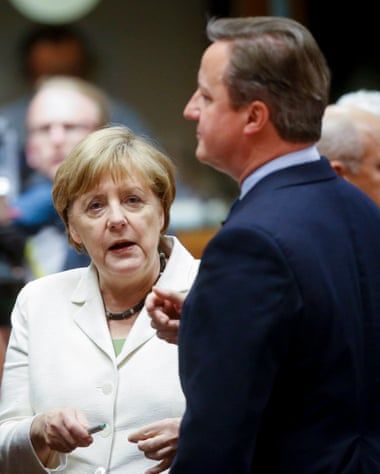
David Cameron with Angela Merkel in 2016.


Sir Paul Lever, the former British ambassador to Berlin in the six years to 2003, said Berlin weighed the odds of Britain’s importance to the EU, and the euro: “Berlin’s judgement of the price the EU should pay to keep the UK in the EU reflected their assessment of the value of continued British membership.”

That does not mean there was no emotional side to Germany’s attachment to British membership of the EU, not least as a free-trading, liberal counterweight to France’s more protectionist tendencies. Asked how Germany would react if the UK left the EU, the German finance minister, Wolfgang Schäuble, replied: “We will cry.”

As a woman of famously pragmatic temperament, one suspects Merkel dabbed her eyes relatively quickly after the referendum result before asking: “What’s next?”

Indeed, within a year, Merkel gave the go-ahead for her diplomats to start negotiating a bilateral agreement with the UK on continued cooperation with Germany on defence and foreign policy. That joint declaration got shelved during the bitter Brexit talks, and if relations had truly soured over the Northern Ireland protocol or vaccine nationalism, it might have died completely.

But the current German ambassador to London, Andreas Michaelis, has been an assiduous advocate of greater cooperation and helped revive the initiative, leading to its publication this week.

Much of it is non-controversial, but it was striking that London and Berlin could find consensual words on Nato, Iran, the Indo-Pacific, future relations with Putin, and the balance between the pursuit of trade and human rights. Both cabinets will now meet once a year, giving a focal point for ministers to think about the relationship.

Johnson even signed up to an affirmation of European unity, something the Germans prize, since they do not want bilateral cooperation with the UK to be seen as a way for the UK to weaken EU foreign policy, or make smaller EU states feel sidelined.

But Merkel will be gone by the end of September, leaving a hole in European politics. The 90-minute foreign policy debate between the candidates to be her successor hosted last week by the Munich Security Conference showed how Brexit is part of the past. The European issue gripping German politicians is relations with Joe Biden and Hungary’s Viktor Orbán, not Britain. True, if the Greens make it into government, perhaps via a traffic light coalition, there will be a sharper edge to German foreign policy on arms exports, human rights and relations with autocratic powers. But it is the German-French motor that will drive Europe from now on. The UK has chosen a detachable sidecar.

Newsletter

Related Articles

0:00
0:00
Close
Starmer and Trump Hold Strategic Talks on Securing Strait of Hormuz Amid Rising Tensions
Unofficial Australia Visit by Prince Harry and Meghan Expected to Stir Tensions with Royal Circles
Pipeline Attack Cuts Significant Share of Saudi Arabia’s Oil Export Capacity
UK Stocks Rise on Ceasefire Momentum and Renewed Focus on Diplomacy
UK to Hold Further Strategic Talks on Strait of Hormuz Security
Starmer Voices Frustration as Global Tensions Drive Up UK Energy Costs
UK Students Voice Concern Over Proposal for Automatic Military Draft Registration
Rising Volatility Drives Uncertainty in UK Fuel and Petrol Prices
UK Moves to Deploy ‘Skyhammer’ Anti-Drone System to Strengthen Airspace Defense
New Analysis Explores UK Budget Mechanics in ‘Behind the Blue’ Feature
Man Arrested After Four Die in Channel Crossing Tragedy
UK Tightens Immigration Framework with New Sponsor Rules and Fee Increases
UK Foreign Secretary Highlights Impact of Intensified Strikes in Lebanon
UK Urges Inclusion of Lebanon in US-Iran Ceasefire Framework
UK Stocks Ease as Ceasefire Doubts in Middle East Weigh on Investor Confidence
UK Reassesses Cloud Strategy Amid Criticism Over Limited Support Measures
UK Calls for Full and Toll-Free Access Through Strait of Hormuz Amid Rising Tensions
Starmer Signals Strategic Shift for Britain Amid Escalating Iran-Linked Tensions
UK Issues Firm Warning to Russia Over Covert Underwater Military Activity
OpenAI Halts Stargate UK Project, Casting Uncertainty Over Britain’s AI Expansion Plans
Starmer Voices Frustration Over Global Pressures Driving UK Energy Costs Higher
UK Deploys Military Assets to Protect Undersea Cables From Suspected Russian Threat
Canada Aligns With US, UK and Australia as Europe Prepares Major Digital Border Overhaul
Meghan Markle’s Planned Australia Appearance Sparks Fresh Speculation
Starmer Warns Sustained Effort Needed to Ensure US–Iran Ceasefire Holds
UK to Partner with Shipping Industry to Rebuild Confidence in Strait of Hormuz, Cooper Says
UK Interest Rate Expectations Ease Following US–Iran Ceasefire Agreement
Starmer Signals Major Effort Needed to Fully Reopen Strait of Hormuz During Gulf Visit
UK Fuel Prices Face Ongoing Volatility Amid Global Pressures and Domestic Factors
Kanye West’s Planned Italy Festival Appearance Draws Debate After UK Entry Ban
Smuggling Routes Shift Toward Belgium as Migrant Crossings to UK Evolve
Ceasefire Offers Potential Relief for UK Fuel and Food Prices Amid Ongoing Uncertainty
Iran Conflict Raises Questions Over UK’s Global Influence and Military Preparedness
Senator McConnell Visits Kentucky to Highlight Federal Investment in Local Projects
Kanye West Barred from Entering UK as Legal Grounds Come into Focus
UK Denies Visa to Kanye West After Sponsors Withdraw from Wireless Festival
Trump-Era Forest Service Restructuring Leads to Closure of UK Lab Focused on Kentucky Woodland Health
Foreign Students in the UK Describe Harsh Living Conditions and Financial Pressures
Reform UK Proposes Visa Restrictions on Nations Pursuing Reparations Claims
Public Reaction Divides Over UK Decision to Bar Kanye West
Calls Grow for UK to Review US Base Access Following Concerns Over Escalating Rhetoric
UK Indicates It Will Not Permit Use of Its Bases for Potential US Strikes on Iran’s Energy Infrastructure
UK Prime Minister Defends Decision to Bar Kanye West, Questions Festival Booking
UK Accelerates Efforts to Harmonise Medical Technology Rules with United States
Wireless Festival Cancelled After Kanye West Denied Entry to the United Kingdom
Australia’s most decorated living soldier was arrested at Sydney Airport and charged with five counts of war-crime murder for the killing of unarmed Afghan civilians
The CIA’s Secret Technology That Can Find You by Your Heartbeat Successfully Locates Downed Airman
Operation Europe: Trump Deploys Vance to Hungary to Save the EU
King Charles Faces Criticism From Some UK Christians Over Absence of Easter Message
Former UK Defence Secretary Raises Concerns Over Ability to Counter Iran Missile Threat
×