

Adam Neumann’s latest big idea? To become America’s biggest landlord
Adam Neumann presided over one of the most spectacular business collapses in recent history. A New Age-spouting, barefoot business messiah, he managed to build and burn his last startup, the office-sharing company WeWork, in such spectacular fashion that even Hollywood paid attention.
And now he is back – on a quest to become America’s biggest landlord.
Neumann, it was reported this week, is at the helm of a new company looking to reinvent apartment living. Details are sketchy but the company, called Flow, aims to address the world’s housing crisis with “community-driven” rentals – so basically WeWork for renters.
Flow is off to a flying start after receiving one of the most sought-after blessings a new venture could get from Silicon Valley: an $350m investment from venture capital giant Andreessen Horowitz, known as A16Z.
The announcement of the firm’s investment in Flow, which values the “pre-seed” company – meaning it has not yet launched – at $1bn rocked the startup world. Not only is it A16Z’s biggest single investment in a venture yet, but it is also a sizable endorsement of Neumann, who has become an entrepreneurial antihero. The news immediately lent itself to numerous jokes on Twitter, and a lot of anger.
After promising to reshape the office world, and successfully becoming the largest office landlord in many cities, including London and New York, WeWork came to a jarring crash in 2019 when the company was revealed to be worth much less than investors had thought.
The company was planning to join the stock market at a $47bn valuation, but when investors started scrutinizing the company’s business model and corporate governance structure, its value collapsed and it called off its plans. WeWork laid off 2,400 employees and Neumann was given $445m to leave the company.
While the co-working company is by no means a failure, and is slowly finding its footing post-Neumann, it was a textbook example of startup boom and bust and an avatar of trouble ahead.
Investors started to realise that, pumped with venture capital cash, many “unicorn” companies – those valued over $1bn – had heavily inflated values and were often subsidizing the price of services and products to kill off competitors.
In the last few years, WeWork’s story has been told over and over again in numerous books, documentaries and a movie, many of which focused on the eccentricities and intensity of Neumann’s leadership.
Lessons have been learned, according to Marc Andreessen, cofounder of A16Z. This week he described Neumann as “a visionary leader” who had revolutionised commercial real estate and was ready for his next adventure.
“It’s often under-appreciated that only one person has fundamentally redesigned the office experience and led a paradigm-changing global company in the process: Adam Neumann,” Andreessen wrote in a blogpost. “We understand how difficult it is to build something like this and we love seeing repeat-founders build on past successes by growing from lessons learned.
“For Adam, the successes and lessons are plenty.”
Neumann kept a low public profile in the years since leaving WeWork, but he has slowly been making more appearances. In November, he appeared at a New York Times’ DealBook summit where he said WeWork’s growth “went to my head”.
“I’ve had a lot of time to think, and there have been multiple lessons and multiple regrets,” he said.
In the spring, he spoke to the Financial Times about his new ambitions, including the then-not-yet-named Flow and his new role as an investor in startups. Through his family office, Neumann invests in more than 45 startups and has over 50 employees, according to the Financial Times.
“The opportunity is tremendous,” Neumann told the newspaper about his new idea. “We started by buying this real estate, but then I started walking the buildings, just feeling, and it felt like there’s so much more that could be done to make these tenants’ lives better.
“It felt like, frankly, there’s room for more community.”
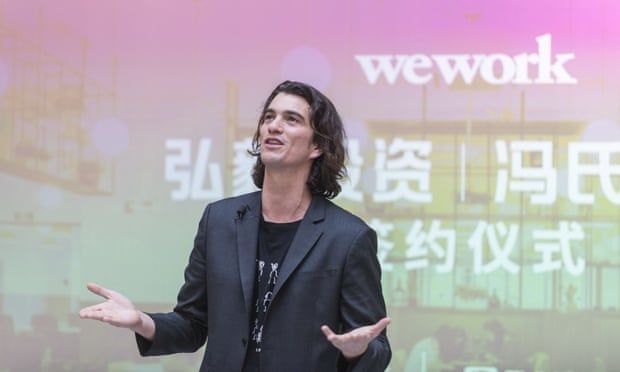 ‘For Adam, the successes and lessons are plenty.’
Even before he came out publicly with his idea for Flow, a report from the Wall Street Journal in January revealed Neumann had quietly bought 4,000 apartments, valued at more than $1bn, in large metropolitan areas in the Sunbelt, including Miami, Atlanta and Nashville. Neumann had started telling friends and associates that he was looking to build a company that would create branded apartments that come with amenities. One of the apartments in Nashville has a saltwater pool and a dog park.
There is no arguing that the US has a housing crisis. Lack of supply and soaring prices have made home ownership unaffordable for many and rents have risen sky-high.
As Neumann has pointed out: “If you stopped construction today, you [would] run out of homes in less than two months. Crazy, huh?”
Andreessen, too, sees the need for more housing, just not in his back yard. In a 2020 essay on his vision of the future titled “It’s Time to Build”, Andreessen proclaimed: “We should have gleaming skyscrapers and spectacular living environments in all our best cities at levels way beyond what we have now; where are they?”
“We can’t build enough housing in our cities with surging economic potential – which results in crazily skyrocketing housing prices in places like San Francisco, making it nearly impossible for regular people to move in and take the jobs of the future,” he wrote.
Despite this declaration, it is unlikely that Flow’s first apartment will be in Atherton, California, Andreessen’s upmarket neighbourhood. Earlier this month, the Atlantic reported that Andreessen and his wife, Laura Arrillaga-Andreessen, sent a public comment laced with all-caps words against zoning for multifamily housing development in Atherton.
An effort to increase the housing supply in the area would “MASSIVELY decrease our home values, the quality of life of ourselves and our neighbors and IMMENSELY increase the noise pollution and traffic,” they wrote.
And it’s not just housing advocates who have rolled their eyes at Flow. A16Z is coming under criticism for giving a sizable backing to Neumann as women and Black and Hispanic founders struggle to get funding. Recent data has shown that as little as 2% of venture capital funds in recent years have gone to underrepresented founders.
“This is disgusting,” tweeted Kate Brodock, CEO of Switch and a general partner at the W Fund. “A16Z’s largest check going to a (straight white male) founder of one of the most toxic companies we’ve seen. Firms like this perpetuate over and over again a traditional system that favors a small, homogenous set of founders.”
But for all the shock and surprise of Neumann’s resurrection, McKeever Conwell II, founder and managing partner at RareBreed Ventures, said we shouldn’t really be surprised. Neumann is an example of the norm, rather than an exception, in venture capital.
“At the end of the day, we as VCs are essentially money managers – we’re glorified financial advisers. We take money from rich people or groups that have large pockets of capital, and our job is to make them more money,” Conwell, who is Black, said. “Our job is not necessarily to care about ethics, morality, systemic racism or financial inequalities. There are many VCs who care about that, but that’s not the job.”
Despite Neumann’s past, Conwell noted that the founder brought generous returns to early investors of WeWork who sold out before its crash.
“From a VC’s perspective, if you were an earlier investor in WeWork, you made a lot of money,” Conwell said. “It’s very common for VCs to reinvest in folks they’ve invested in before, especially those who have made them money. Adam Neumann made a lot of people a lot of money.”