

5,000 people hit by Heathrow flight cancellations
The airport asked airlines to cut 10% of flights from schedules across terminals two and three on Monday.
It comes after problems at baggage reclaim areas, with images of luggage being piled up high emerging last week.
Elsewhere, EasyJet announced plans to cut 7% of its 160,000 flights scheduled between July and September.
The move came after Gatwick, EasyJet's main airport, said it will reduce the number of flights taking off from its airport during the peak summer season because of staff shortages.
Tens of thousands of passengers have been hit by airport disruption and flight cancellations in recent weeks.
The BBC understands some airlines might be able to combine flights at Heathrow meaning some passengers will not have their journeys postponed.
Heathrow said cutting the number of flights would "minimise" the impact of the technical issues affecting baggage systems.
"We apologise unreservedly for the disruption passengers have faced over the course of this weekend," the company said.
British Airways, which operates from terminals three and five, told the BBC it had made a "small number of cancellations" as a result of the airport's request.
It understood BA will be able to re-accommodate the vast majority of customers onto new flights.
Hundreds of flights across the UK were cancelled during the week of the Platinum Jubilee and half-term holidays, and concerns have been raised of further travel woes during the summer.
The disruption has been caused by several factors, but staff shortages has left the aviation industry struggling to cope with resurgent demand.
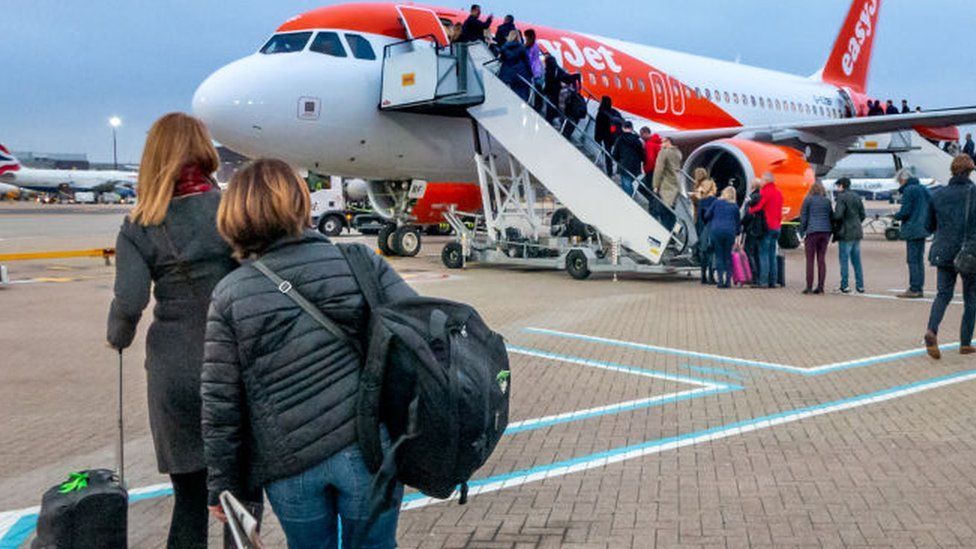
As well as Gatwick, EasyJet also confirmed there would be flight cancellations at other airports across the airline's network including Amsterdam's Schiphol hub but it has not yet worked out a precise number.
Last week, Schiphol said it would cap the number of passengers allowed at the airport over summer, leading to a 16% fall in planned flights.
EasyJet said customers would be given advance notice and the potential to rebook onto alternative flights. It added many would be able to rebook on the same day they had originally planned to travel.
It said in recent weeks the sector had experienced an "unprecedented ramp-up" in demand for travel, with April and May passenger numbers reaching seven times higher than same months last year.
EasyJet's chief executive, Johan Lundgren, said the airline would usually operate about 160,000 flights during the summer months.
He apologised that the company "had not been able to deliver the service" that customers "have come to expect from us".
"I can't tell you how many flights will be impacted," he said. "It would be misleading for me to give any numbers today because we simply don't know."
The airline said it was cancelling the flights to build additional resilience in the face of operational issues including staff shortages in ground handling and at airports as well as air traffic control delays.
"Coupled with airport caps, we are taking pre-emptive actions to increase resilience over the balance of summer, including a range of further flight consolidations in the affected airports, giving advance notice to customers and we expect the vast majority to be rebooked on alternative flights within 24 hours," Mr Lundgren added.
Can you get compensation if your flight is cancelled?
If your flight is cancelled, you have the right to either a full refund, or a replacement flight.
"And that different flight does not need to be with the same carrier - it can be an alternative, as long it flies on the same day," says Julia Lo Bue-Said, CEO of Advantage Travel Partnership.
If you and the airline can't agree on a new flight, it will refund you.
If the flight was cancelled with 14 days or less notice, you may also be entitled to compensation - but only if the airline is at fault.
"If it's a direct result of the airline, you're entitled to compensation, but if it's the airport, your compensation doesn't kick in," says Mrs Lo Bue-Said.
He said EasyJet was trying to recruit from a tighter labour market, but added the main problem wasn't numbers but the time it was taking identity checks to be processed so people are able to work.
"It's been slow to get people in the system, not so much the fact we have been struggling to recruit," he said.
However, Mr Lundgren said the company was having to "turn down EU applications" for jobs because of Brexit, which had also contributed to the smaller pool of potential workers.
"We turned down 8,000 applicants from the EU," he said, which equates to 40% of all people applying for jobs at the airline.
"I'm not blaming... but of course it has an impact. It's just smaller, it's just maths," he said.
A spokesperson for the Department for Transport said the government was "committed to building a robust and dependable domestic aviation industry" and added it launched a skills scheme last year to "help develop, and hold onto, UK talent".
"We are absolutely focused on seeing an end to the disruption at airports and will continue to work with industry. But as the Transport Secretary has made clear, it is not obvious that reaching for the lever marked 'more immigration' will solve the problem," they added.
They also suggested that changes in the law following Brexit had afforded the sector more flexibility when training new employees.
Airlines have been blamed in recent weeks for taking more bookings than they can manage following steep staff cuts during the height of Covid when travel ground to a halt.
But industry leaders have argued the government could have done more to support the sector during the pandemic.
Following a wave of cancellations and delays at airports, the DfT and the Civil Aviation Authority wrote to airlines telling them to review their schedules and to cancel flights that could not be delivered "at the earliest possibility".

