
War, Power and the Rising Price of Political Decisions
Escalating United States-Iran hostilities are driving up household costs as Washington confronts disputes over politically targeted funding, experimental medicine, presidential construction projects and the changing channels of global diplomacy.
The United States and Iran remain locked in an escalating confrontation, with American forces carrying out a thirteenth consecutive night of strikes and Iranian state media reporting attacks on United States-linked assets across the Gulf.
Officials in Washington and Tehran have both disputed a report that Iran rejected a ceasefire proposal, leaving no confirmed agreement in place.
President Donald Trump has said he is considering a substantially larger attack, while diplomatic attention has shifted toward Omani talks concerning navigation and control in the Strait of Hormuz, the strategic waterway at the center of the conflict.
The military pressure is already reaching American households.
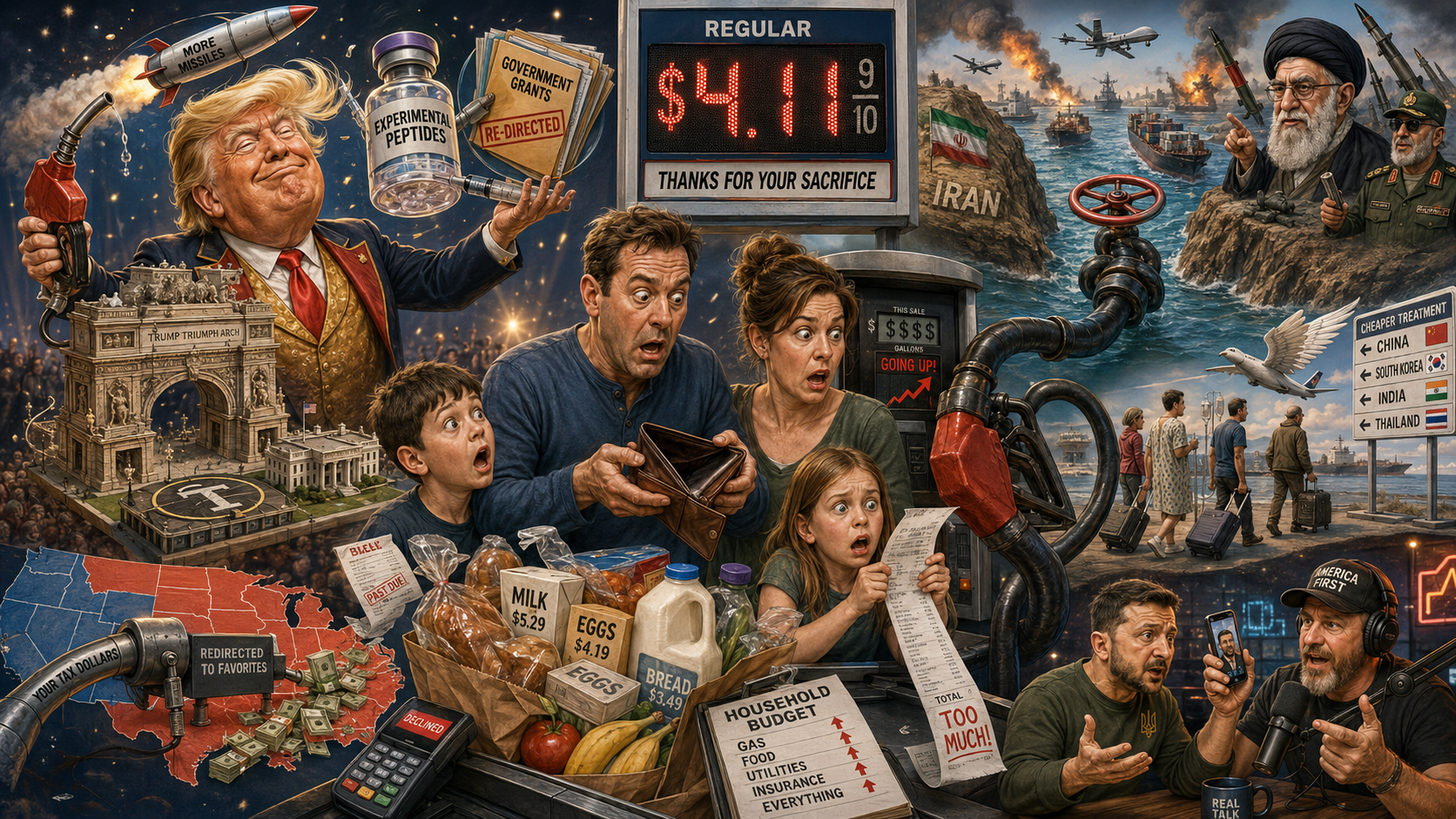
The national average price of regular gasoline has risen to about four dollars and eleven cents a gallon, more than one dollar above its level before the war, while Brown University researchers estimate that consumers have absorbed more than seventy-three billion dollars in additional gasoline and diesel costs.
Higher transportation, grocery and mortgage expenses have pushed the estimated burden toward fourteen hundred dollars for an average household, demonstrating how disruption around a distant maritime chokepoint can rapidly become a domestic cost-of-living problem.
That economic strain is unfolding alongside a separate dispute over the federal government's treatment of politically unfriendly states.
Court documents described in the supplied reports indicate that Energy Department grant decisions were made according to whether projects were located in states that voted Democratic in the 2024 presidential election.
The administration had previously attributed the cancellations to economic viability and national energy priorities, but the disclosed language has intensified legal and constitutional questions surrounding congressionally appropriated funds.
The same struggle over institutional safeguards is appearing in American health regulation.
A Food and Drug Administration advisory panel is reconsidering whether compounding pharmacies should be permitted to produce seven peptides promoted for recovery, longevity and other health benefits.
Supporters argue that regulated domestic compounding would be safer than an expanding gray market, while critics warn that several substances lack the large, controlled human trials normally required to establish safety and effectiveness.
The advisory recommendations are not binding, leaving the final decision with the agency.
Cost and access are also redirecting patients across borders.
China reported a record one-point-two-eight million foreign patients last year as it seeks a larger share of a global medical-tourism industry valued at roughly one hundred billion dollars in 2024. South Korea remains the regional benchmark, attracting about two million foreign patients and generating billions of dollars in medical spending and wider economic activity, while India, Thailand and Macau are developing specialized offerings.
Lower prices remain the central attraction, but differences in licensing, follow-up care, medical records and legal recourse continue to create substantial risks.
Washington's institutional landscape is changing physically as well as administratively.
A proposed two-hundred-and-fifty-foot triumphal arch near the approach to Reagan Washington National Airport has raised concerns among pilots navigating an already restricted flight path, although the Federal Aviation Administration concluded that the structure would have no significant adverse effect if warning lights are installed.
The project still requires further federal review and faces litigation, while construction of a separate permanent granite helipad on the White House South Lawn is proceeding toward its planned completion.
Diplomacy itself is moving through less conventional channels.
Ukrainian President Volodymyr Zelensky met conservative activist and Trump ally Laura Loomer after she publicly reversed parts of her earlier hostility toward Ukraine following a visit to the country.
Zelensky said his relationship with Trump had improved after a brief Vatican meeting, while the interview illustrated Kyiv's increasingly direct effort to reach influential figures inside the president's political orbit.
Loomer's encounter with Zelensky has now become an active element in the broader contest over Republican attitudes toward Ukraine and Russia.
Officials in Washington and Tehran have both disputed a report that Iran rejected a ceasefire proposal, leaving no confirmed agreement in place.
President Donald Trump has said he is considering a substantially larger attack, while diplomatic attention has shifted toward Omani talks concerning navigation and control in the Strait of Hormuz, the strategic waterway at the center of the conflict.
The military pressure is already reaching American households.
The national average price of regular gasoline has risen to about four dollars and eleven cents a gallon, more than one dollar above its level before the war, while Brown University researchers estimate that consumers have absorbed more than seventy-three billion dollars in additional gasoline and diesel costs.
Higher transportation, grocery and mortgage expenses have pushed the estimated burden toward fourteen hundred dollars for an average household, demonstrating how disruption around a distant maritime chokepoint can rapidly become a domestic cost-of-living problem.
That economic strain is unfolding alongside a separate dispute over the federal government's treatment of politically unfriendly states.
Court documents described in the supplied reports indicate that Energy Department grant decisions were made according to whether projects were located in states that voted Democratic in the 2024 presidential election.
The administration had previously attributed the cancellations to economic viability and national energy priorities, but the disclosed language has intensified legal and constitutional questions surrounding congressionally appropriated funds.
The same struggle over institutional safeguards is appearing in American health regulation.
A Food and Drug Administration advisory panel is reconsidering whether compounding pharmacies should be permitted to produce seven peptides promoted for recovery, longevity and other health benefits.
Supporters argue that regulated domestic compounding would be safer than an expanding gray market, while critics warn that several substances lack the large, controlled human trials normally required to establish safety and effectiveness.
The advisory recommendations are not binding, leaving the final decision with the agency.
Cost and access are also redirecting patients across borders.
China reported a record one-point-two-eight million foreign patients last year as it seeks a larger share of a global medical-tourism industry valued at roughly one hundred billion dollars in 2024. South Korea remains the regional benchmark, attracting about two million foreign patients and generating billions of dollars in medical spending and wider economic activity, while India, Thailand and Macau are developing specialized offerings.
Lower prices remain the central attraction, but differences in licensing, follow-up care, medical records and legal recourse continue to create substantial risks.
Washington's institutional landscape is changing physically as well as administratively.
A proposed two-hundred-and-fifty-foot triumphal arch near the approach to Reagan Washington National Airport has raised concerns among pilots navigating an already restricted flight path, although the Federal Aviation Administration concluded that the structure would have no significant adverse effect if warning lights are installed.
The project still requires further federal review and faces litigation, while construction of a separate permanent granite helipad on the White House South Lawn is proceeding toward its planned completion.
Diplomacy itself is moving through less conventional channels.
Ukrainian President Volodymyr Zelensky met conservative activist and Trump ally Laura Loomer after she publicly reversed parts of her earlier hostility toward Ukraine following a visit to the country.
Zelensky said his relationship with Trump had improved after a brief Vatican meeting, while the interview illustrated Kyiv's increasingly direct effort to reach influential figures inside the president's political orbit.
Loomer's encounter with Zelensky has now become an active element in the broader contest over Republican attitudes toward Ukraine and Russia.