London Daily

Focus on the big picture.
Sunday, Jul 12, 2026

US Treasury blocks Russian bond payments, raising risk of default

US Treasury blocks Russian bond payments, raising risk of default

The decision further complicates Russia’s attempts to keep meeting debt obligations amid the sanctions imposed after it invaded Ukraine.

Russia’s efforts to avoid a sovereign default took another blow after the U.S. Treasury halted dollar debt payments from the country’s accounts at U.S. banks.

The decision further complicates Russia’s attempts to keep meeting debt obligations amid the sanctions imposed after it invaded Ukraine. As the government tries to sidestep its first external default in about a century, those restrictions have hampered and delayed the process of transferring money to bond holders.

Other governments are also planning tougher sanctions after allegations that Russian troops massacred civilians in Bucha and other Ukrainian towns. The European Union is proposing to ban coal imports from Russia, which would be a major step-up for a region that’s so far shied away from targeting energy flows crucial to the bloc’s economy.

The U.S. announcement is intended to force Russia into either draining its domestic dollar reserves or spending new revenue to make bond payments, or else go into default, according to a spokesperson for the Treasury’s Office of Foreign Assets Control, who discussed details on condition of anonymity.

“Clearly this latest announcement by the U.S. Treasury is designed to put additional pressure on the Russians,” said Gary Kirk, a portfolio manager at TwentyFour Asset Management. “The alternative payment methods are significantly more punitive and more challenging for Russia and hence it does increase the chances of a technical default.”

Despite warnings from credit-rating companies and others, Putin’s government has so far stayed current on its foreign debt obligations.

But the sweeping sanctions have already led to the seizure of an estimated two-thirds of Russia’s reserves. The central bank says it’s also sold some of its foreign currencies to support the ruble, leaving questions on how long it can pull from its local coffers to pay its debts.

Russia’s foreign-currency and gold reserves were about $604 billion as of March 25, down $38.8 billion from a February peak. Still, it’s reaping in huge sums from exports of energy. Bloomberg Economics expects it will earn nearly $321 billion this year if the commodities continue flowing.
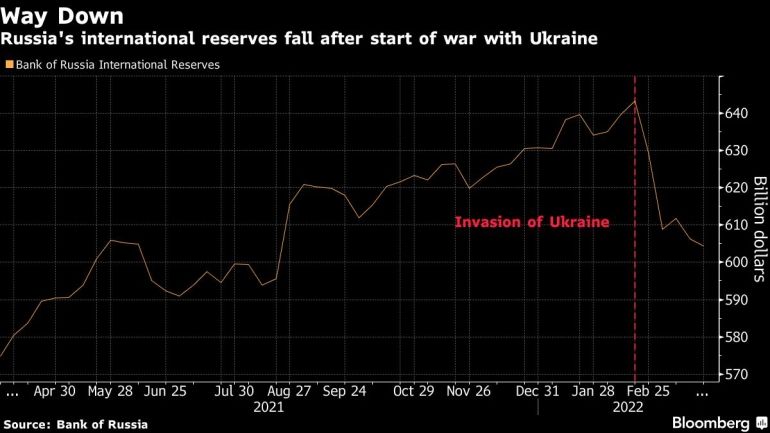

But even with the funds, payments haven’t been smooth, with many delayed by banks doing lengthy checks to ensure they aren’t breaching sanctions.

A once-$2 billion dollar bond that matured Monday served as the most recent stress test, though Russia was able to buy back about three-quarters of the outstanding amount in rubles before the note came due. The latest U.S. move will intensify scrutiny on its ability to pay back the remainder of that debt.

Additionally, coupon payments due Monday on a 2042 bond had yet to reach some investor accounts as of Tuesday morning in London, according to bondholders who declined to be named because they are not authorized to speak publicly.

Russia’s dollar bonds, which were already trading well into distressed territory, fell on Tuesday. The 2042 declined 7 points to about 28 cents on the dollar, according to CBBT pricing.

The U.S. announcement “increases the risk of default, not because of lack of money,” said Lutz Roehmeyer, chief investment officer at Berlin-based Capitulum Asset Management. “The new sanction will cause technical issues with regard to the settlement systems, so it is now an open question how Russia will construct the payment routes.”

Newsletter

Related Articles

0:00
0:00
Close
World Cup Visitors Turn American Big-Box Stores Into Souvenir Stops
Netflix Weighs Always-On Channels, Bundles and Short-Form Video
Passenger Is Pulled Partly Outside Ryanair Jet After Window Fails Mid-Flight
Innovation-led growth strategy
Public service reform pressure
Defence and industrial security
Labour leadership transition and economic reset
Northern England Pushes for Greater Influence in Britain’s Future Economic Model
UK Technology Strategy Focuses on Life Sciences, Digital Innovation and Research Investment
Britain and United States Maintain Focus on Pharmaceuticals Cooperation and Industrial Growth
UK Public Services Face Continued Pressure as Government Promises Visible Improvements
Regional Economic Power Becomes Key Theme in Britain’s Next Political Phase
Britain Expands Support for Small Businesses as Firms Seek Better Access to Finance
UK Economy Remains Central Political Challenge as Cost of Living and Growth Concerns Persist
National Health Service Introduces New Workplace Reviews to Improve Conditions for Healthcare Staff
UK Life Sciences Sector Secures More Than Three Billion Pounds in Investment to Support Innovation
Britain Strengthens Defence Strategy as Security Concerns Reshape Military and Industrial Policy
Andy Burnham Promises Stronger UK Defence Industry and Expanded Domestic Production
UK Government Faces Difficult Spending Choices as Labour Leadership Transition Approaches
Rachel Reeves Warns Andy Burnham of Immediate Economic Challenges After Expected Leadership Change
Andy Burnham Prepares to Lead UK Government With Plans for Regional Power Shift and Economic Reset
Government Creates Emergency Support Scheme for Financially Struggling Universities
United Kingdom Replaces Traditional Farm Subsidies With Payments Linked to Environmental Performance
National Grid Reports First Week of Electricity Generation Without Fossil Fuels
United Kingdom Financial Regulator Introduces Tougher Capital Rules for Cryptocurrency Exchanges
Belfast Harbour Expands Operations to Attract Investment Through United Kingdom and European Union Market Access
Scottish Government Threatens Legal Challenge Over Westminster Cuts to North Sea Transition Funding
United Kingdom Accelerates Trans-Pennine High-Speed Rail Project Linking Northern Cities
United Kingdom Secures Ten Billion Pound Investment for Cambridge Quantum Computing Campus
Port Talbot Steelworks Wins Support for Green Hydrogen Transition and Protection of Industrial Jobs
United Kingdom Sends Royal Navy Carrier Strike Group to Indo-Pacific as Regional Security Focus Expands
National Health Service Expands Artificial Intelligence Diagnostics Across England to Reduce Screening Backlogs
United Kingdom Launches Fifty Billion Pound Infrastructure Fund to Accelerate Housing and Construction
UK Medical Chiefs Update Health Guidance to Promote Everyday Physical Activity
Office of Communications Keeps Wikipedia Under Review Under UK Online Safety Rules
UK Defence Ministry Expands Deep-Strike Capability Through Precision Missile Programme
Russell Group Universities Warn Funding Cuts Could Damage NHS Workforce Training
UK Parliament Calls for National Emergency Broadcast as Heatwave Conditions Intensify
UK and Netherlands Strengthen Naval Cooperation With New Amphibious Defence Partnership
UK Defence Ministry Joins International Missile Programme With One Hundred and Ninety Million Pound Investment
Bank of England Warns Middle East Conflict and AI Risks Could Pressure UK Economy
UK Government Introduces New Rules to Limit Foreign Influence in Political Donations
UK and France Prepare Naval Mission to Protect Shipping Through Strait of Hormuz
United States Pressures UK to Increase Defence Spending at NATO Summit
Bank of England Warns Artificial Intelligence Investment Boom Could Create Financial Stability Risks
Bank of England Begins Direct Oversight of Critical Technology Providers Supporting UK Finance
Andy Burnham Set to Become UK Prime Minister After Labour Leadership Race Clears Path to Downing Street
Scottish Fishing Industry Calls for Emergency Support Amid Rising Costs
UK Supports Stronger European Response to Russian Actions in Ukraine
Devon and Cornwall Police Release Suspect in Ann Widdecombe Murder Investigation
×