

Universities rankings firm says Hong Kong higher education in ‘good health’
Four Hong Kong universities have dropped in the latest worldwide rankings, with only Chinese University (CUHK) and Polytechnic University (PolyU) rising in the league table, but researchers said the city’s higher education remained in “rather good health”.
CUHK moved up four places to 39th among 1,300 higher education institutions worldwide assessed in the Britain-based Quacquarelli Symonds (QS) World University Rankings 2022 released on Wednesday, while PolyU rose nine places to 66th.
Both campuses suffered severe damage to facilities in clashes between protesters and police at the height of the 2019 anti-government protests, but QS researchers said it was hard to determine if the incidents affected their performances.
The pair placed 43rd and 75th in the 2021 rankings, respectively.
Researchers added they did not see “evidence that Hong Kong’s universities are systemically suffering” despite the Beijing-imposed national security law
coming into effect last June.
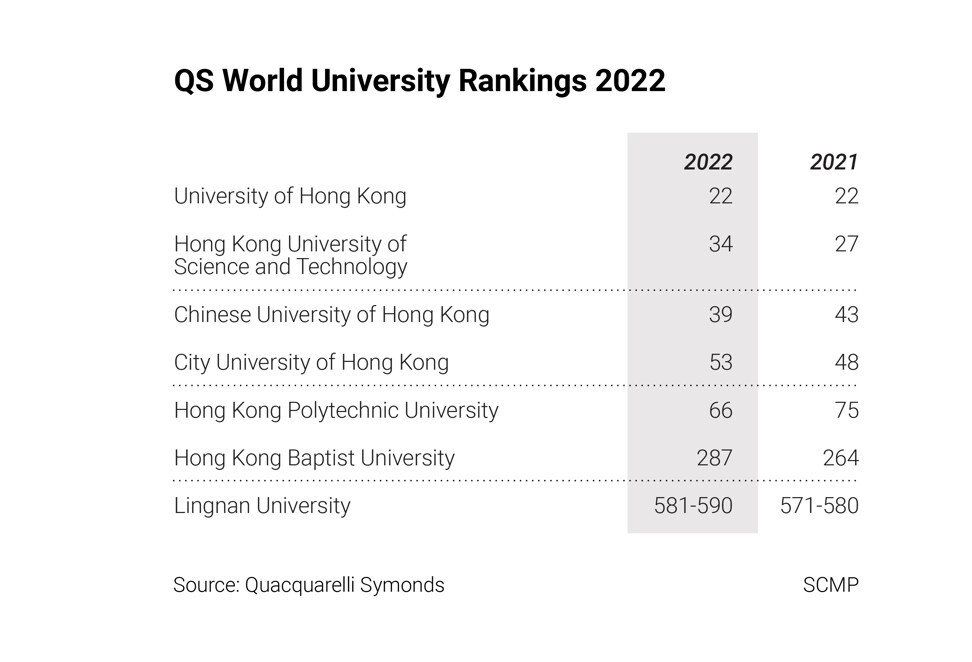
The University of Hong Kong (HKU), the top ranked university in the city, remained 22nd globally, followed by the University of Science and Technology (HKUST) which dropped seven places to 34th. City University slipped five places to 53rd, while Baptist University suffered the biggest drop of 23 places from 264th to 287th.
Lingnan University, meanwhile, also fell from the range of 571-580 to 581-590.
Six indicators were used to compile the annual league table: academic reputation, employer reputation, citations per faculty, student-to-faculty ratio, as well as international faculty and student ratios.
According to the ranking body, the four universities which fell in rankings dropped in two to six indicators, while the rise for CUHK and PolyU were reflected by an improvement in performances such as in research impact and employers’ recognition.
In November 2019, protesters occupied several campuses while heeding calls for a citywide strike, resulting in severe damage to facilities during clashes with police. The chaos resulted in weeks of class suspension, while many students from mainland China and overseas returned home during that period.
The rankings’ release came at a time when Hong Kong’s academic field faces rapid changes following the introduction of the sweeping national security law, which targets acts of secession, subversion, terrorism and collusion with foreign forces.
Universities are required to promote national security education and were recently reminded by their funding body of the need to do so, while CUHK and HKU distanced themselves from their student unions this year over concerns related to the legislation.
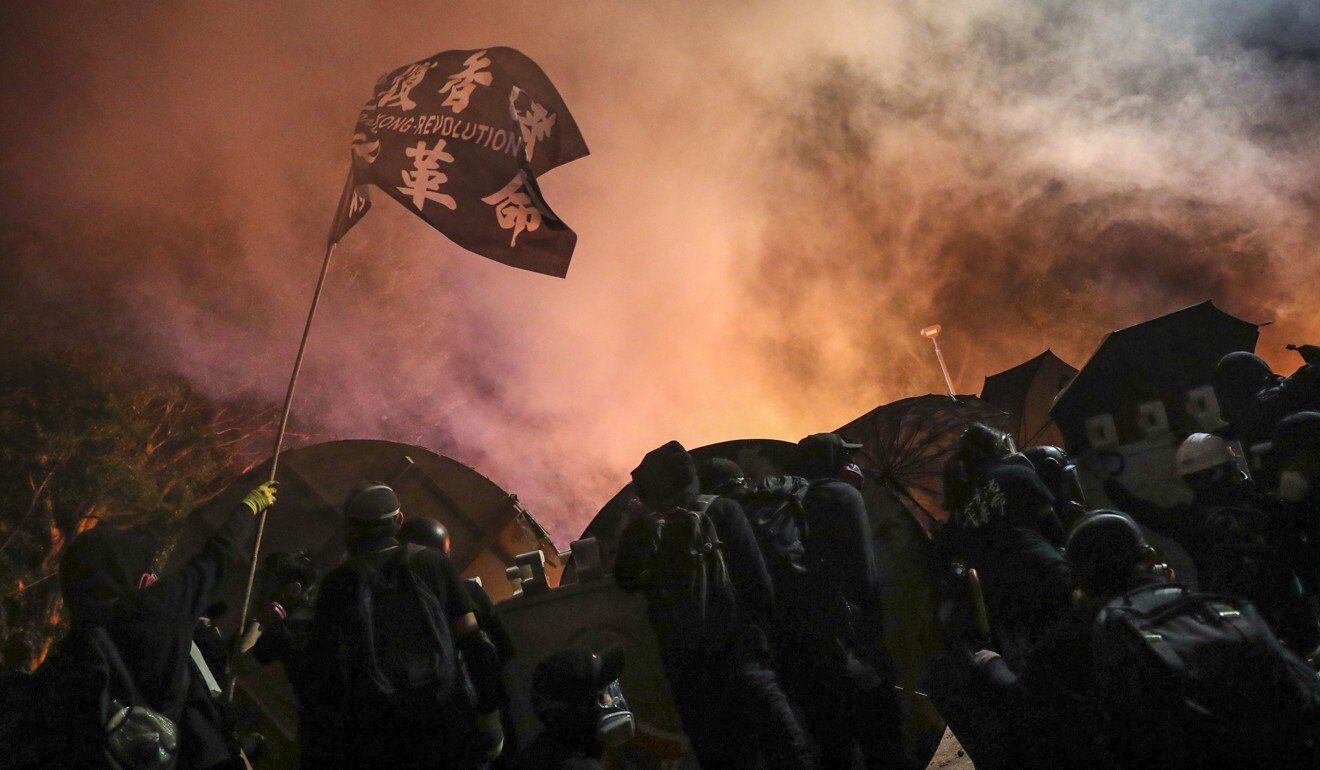 Clashes break out between riot police and students at Chinese University in November, 2019.
Critics have expressed concerns over shrinking autonomy at higher education institutions under the law, but these have been dismissed by senior managers, with the heads of five universities signing a joint statement last June in support of the law.
“There is no evidence that Hong Kong’s universities are systemically suffering from any particular issue at the moment,” a QS spokeswoman said when asked about the impact of the security legislation and the 2019 protests on the latest rankings.
“The world of higher education remains extremely competitive, and we believe that the latest results show that Hong Kong’s higher education sector remains in rather good health, relatively speaking.”
The data collection period from universities was only up to last year, the spokeswoman said, while the annual academic and employer reputation surveys were conducted between February and April this year and would be looked at also based on previous years’ results.
CUHK and PolyU said they would “continue to strive for excellence” in areas such as teaching and research, while Baptist and HKUST said they would make reference to the ranking for improvements.
Globally, the Massachusetts Institute of Technology (MIT) remained the top ranked institution, followed by the University of Oxford which rose three places to 2nd, and Stanford University which fell from 2nd to 3rd.
The top university in Asia is the National University of Singapore, which maintained its ranking at 11th, while Nanyang Technological University in Singapore rose one place to 12th. Tsinghua University dropped from 15th to 17th, but Peking University rose five places to 18th.