
UK’s Keir Starmer in Beijing for Strategic Reset as China Courts Western Allies
British prime minister holds rare talks with President Xi Jinping to deepen economic and diplomatic ties amid global uncertainty
British Prime Minister Sir Keir Starmer travelled to Beijing this week for the first visit by a UK leader to China since 2018, seeking to reset bilateral relations and expand economic engagement against a backdrop of shifting global geopolitics and trade dynamics.
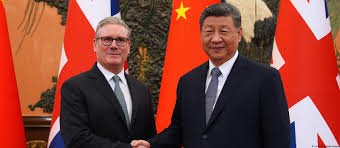
Starmer met Chinese President Xi Jinping in discussions aimed at building a long-term strategic partnership, emphasising cooperation on trade, investment, climate change and global stability at a time of heightened international uncertainty.
Starmer described the relationship as being in a “good place” following the talks and underscored the need for a more “sophisticated” and consistent partnership between the United Kingdom and the world’s second-largest economy.
China’s president, for his part, highlighted the importance of strengthening ties to support peace and stability, urging both nations to “rise above differences” in their approach to global challenges.
The British delegation accompanying Starmer included more than fifty senior business leaders and representatives from cultural organisations, reflecting the emphasis on trade opportunities and market access.
A series of agreements and deliverables have emerged from the visit, including commitments to lower Chinese tariffs on Scotch whisky and a new thirty-day visa-free arrangement for British visitors to China.
High-profile business announcements were also made, such as a multi-billion-pound investment by AstraZeneca in Chinese manufacturing and research, illustrating the economic dimension of the mission.
Beyond commercial priorities, Starmer sought to balance economic engagement with national security considerations, asserting that the UK will protect its security interests while pursuing pragmatic cooperation.
This approach reflects London’s attempt to navigate complex ties with Beijing amid lingering tensions over issues including espionage concerns, human rights and China’s support for Russia in the Ukraine conflict.
Starmer’s visit also occurs amid broader strategic recalibration by Western governments, as allies reassess relations with China and pursue diversified trade and investment partnerships.
The trip follows a period of strained ties during which the UK’s previous government adopted measures to curb Chinese investment in sensitive infrastructure.
The Labour government’s current policy seeks a pragmatic engagement that supports British economic priorities while maintaining “guardrails” on security risks.
As Starmer continues his visit with engagements in Shanghai and further meetings with Chinese officials, the United Kingdom’s reset with Beijing underscores the complexity of balancing diplomatic outreach, economic opportunity and strategic caution in an evolving global landscape.
Starmer met Chinese President Xi Jinping in discussions aimed at building a long-term strategic partnership, emphasising cooperation on trade, investment, climate change and global stability at a time of heightened international uncertainty.
Starmer described the relationship as being in a “good place” following the talks and underscored the need for a more “sophisticated” and consistent partnership between the United Kingdom and the world’s second-largest economy.
China’s president, for his part, highlighted the importance of strengthening ties to support peace and stability, urging both nations to “rise above differences” in their approach to global challenges.
The British delegation accompanying Starmer included more than fifty senior business leaders and representatives from cultural organisations, reflecting the emphasis on trade opportunities and market access.
A series of agreements and deliverables have emerged from the visit, including commitments to lower Chinese tariffs on Scotch whisky and a new thirty-day visa-free arrangement for British visitors to China.
High-profile business announcements were also made, such as a multi-billion-pound investment by AstraZeneca in Chinese manufacturing and research, illustrating the economic dimension of the mission.
Beyond commercial priorities, Starmer sought to balance economic engagement with national security considerations, asserting that the UK will protect its security interests while pursuing pragmatic cooperation.
This approach reflects London’s attempt to navigate complex ties with Beijing amid lingering tensions over issues including espionage concerns, human rights and China’s support for Russia in the Ukraine conflict.
Starmer’s visit also occurs amid broader strategic recalibration by Western governments, as allies reassess relations with China and pursue diversified trade and investment partnerships.
The trip follows a period of strained ties during which the UK’s previous government adopted measures to curb Chinese investment in sensitive infrastructure.
The Labour government’s current policy seeks a pragmatic engagement that supports British economic priorities while maintaining “guardrails” on security risks.
As Starmer continues his visit with engagements in Shanghai and further meetings with Chinese officials, the United Kingdom’s reset with Beijing underscores the complexity of balancing diplomatic outreach, economic opportunity and strategic caution in an evolving global landscape.