

UK on track to meet target of vaccinating 15,000,000 most vulnerable by Monday
The Prime Minister posted a video on Twitter hailing the immunisation programme, which has now seen more than 14 million people receive a first dose of a Covid jab.
He said: ‘As I speak we’ve vaccinated about 14 million people now across the whole of the UK – that’s the first jab for 14 million people. It looks like we are on target, we very much hope to reach the JCVI, the most vulnerable groups one to four, by the 15th.
‘There’s obviously a lot of work going on to make sure we do that and I want to thank, again, everyone involved who’s helping.’
The PM added that people were working ‘absolutely flat out’ to keep the vaccinations going, despite Storm Darcy bringing snow, ice and record breaking temperatures of -23C, forcing some vaccination centres to close.
He urged those in the top four groups who had not yet received a first dose to come forward.
‘There are still a million or more who have not yet come forward to get your vaccinations in this group. Please do so,’ he said.
There are an estimated 15 million people in the top four priority groups, which are people aged 70 and over, care home residents and staff, health and care workers and clinically extremely vulnerable patients.
Government data up to February 11 shows that 14,012,224 people in the UK have now received a first dose of the vaccine.
Earlier today, NHS England said everyone in that cohort has been offered the opportunity to be vaccinated and urged health and care workers who have not accepted a vaccine but would like one to contact their employer to arrange an appointment.
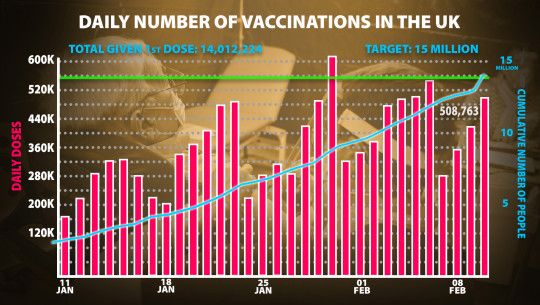 Over 14 million people have been given a first dose of a
People aged 65 to 69 can now have a Covid-19 vaccine in England if GPs have supplies.
Welsh First Minister Mark Drakeford also said some over-50s have already begun to be contacted and offered a vaccination as the top four groups had been reached.
Scotland’s First Minister Nicola Sturgeon has said she expects many in the 65-69 age group to have had their first jab by the middle of this month after the vast majority of older people were vaccinated.
And in Northern Ireland, the Department of Health is offering everyone over 65 a vaccine by the end of February as it works its way through priority groups four and five.
It comes as the reproduction number, or R value, for coronavirus is now estimated to be between 0.7 and 0.9 across the UK.
 Boris Johnson posted an update on the vaccination target on Twitter
This is the first time since July that R has been this low, and shows that lockdown restrictions are having an impact and the epidemic is shrinking.
Elsewhere, new data from the Office for National Statistics shows a drop in infections, with around one in 80 people in private households in England having Covid-19 between January 31 and February 6, the equivalent of 695,400 people.
This is down from around one in 65 people for the period January 24 to 30.
The data is based on swab results from people with and without symptoms.
The number of patients in hospital with Covid is also falling.
On February 9, the latest date for which figures are available, 25,621 people were in hospital across the UK, down 35% from a peak of 39,236 on January 18, and the lowest number since December 29.
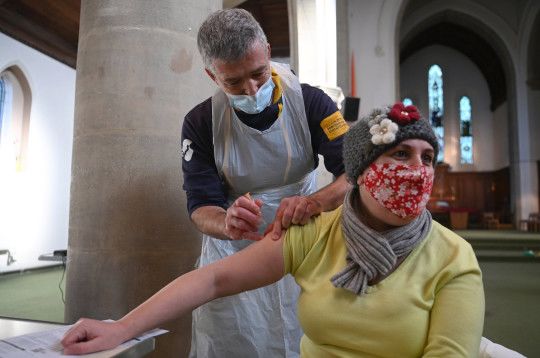 There are still one million people in the top four priority groups who haven’t had their first dose
But while scientists advising the Government believe cases of Covid-19 are dropping at a decent pace across England, they have warned that infection levels remain high and it is too soon to lift restrictions.
In a string of warnings this week, scientists have said cases should drop below 10,000 before lockdown is lifted, that some measures should remain in place until all adults are vaccinated and that reopening schools too quickly could push the R rate above one.
SAGE advisers believe that only by driving case numbers to much lower levels can NHS Test and Trace and surge testing work properly as with low case numbers, outbreaks can be identified more easily and new mutations can be picked up.
The current halving time of the virus (the time it takes to the number of new infections to halve in size) is thought to be at around 14 to 17 days.
Scientific advisers believe that if this continues, aided by the rollout of vaccines, then low case numbers can be achieved in the next two to three months.
This has caused anger from Tory lockdown-sceptics who are urging the PM to relax measures once pressure on the NHS eases.
Boris Johnson is due to unveil a roadmap out of lockdown on February 22. So far only a target date for reopening schools has been set, which is March 8.