

UK health regulator concerned over use of rapid coronavirus tests
The UK’s healthcare regulator has expressed concern to the government that its multibillion-pound mass testing programme is “a stretch” of the authorised use of rapid tests, the Guardian has learned.
The Medicines and Healthcare products Regulatory Agency (MHRA) has approved the lateral flow devices to be used to find coronavirus cases but not to act as a “green light” for people who test negative to enjoy greater freedoms.
The regulator is concerned that people who test negative will be given false reassurance by their result and will let down their guard if they believe they are Covid-free.
There is very little data to show how well the Innova lateral flow devices detect the virus when used as a self-test by someone who has no symptoms. They are being used by millions of people a week in England under the government’s universal testing programme.
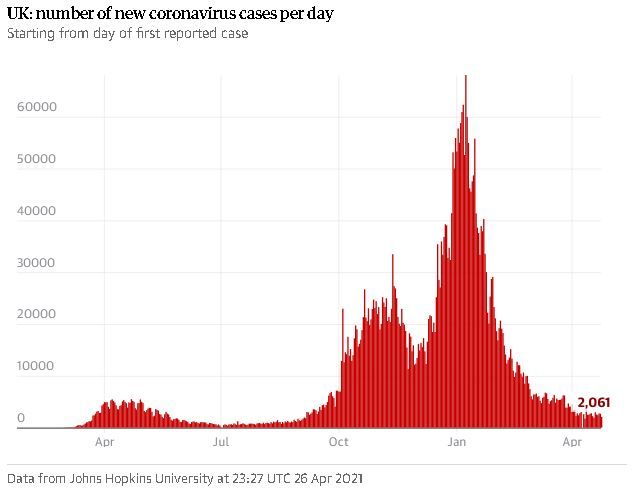
Boris Johnson has put mass testing at the centre of his strategy to lift the UK permanently out of lockdown, alongside the vaccine programme. The government has bought millions of the lateral flow tests as part of the £37bn budget for NHS test and trace.
However, the MHRA told officials in the Department of Health and Social Care (DHSC) that the twice-weekly testing regime unveiled earlier this month was “a stretch” of its authorisation for how the tests should be used.
The regulator raised the concerns before and after the programme was announced on 5 April, the Guardian has learned.
The MHRA has authorised LFTs to be used as a “red light” test – to find infectious people and order them to self-isolate – but not as a “green light” test to allow people greater freedoms if they test negative. The regulator is concerned that the government’s universal testing programme blurs the lines between the two.
The concern stems from a lack of data on how well the tests perform when taken by people who do not have Covid-19 symptoms. It is estimated that one in three infected people will display no symptoms of the virus, making it more difficult to track.
A recent Cochrane review – an analysis of 64 studies – found that rapid tests correctly identify on average 58% of people who are infected with the virus but have no symptoms, meaning more than one in three cases are missed. However, this was based on relatively few samples, limiting the conclusions that could be drawn.
The concern is that people will take a one-off test before visiting loved ones indoors, for example, and that they may be carrying the virus even though they have tested negative.
The MHRA is understood to have asked Matt Hancock’s department to provide evidence about the expected accuracy of the test – and how it performs in reality – and to carry out a public information campaign to explain the benefits and the risks of universal testing.
The MHRA said the government was “the legal manufacturer of the test and as such are responsible for the safety and performance of the test whilst it is in use in the UK”.
The regulator said it met government officials regularly “to discuss a range of issues, including the data they collect on performance”, and added: “False negatives carry a risk of unwitting onward transmission. Therefore, even with a negative test result people must continue to follow national and local rules and guidelines including regular handwashing, social distancing and wearing face coverings, where required.”
A million people a day are taking coronavirus tests, with the majority using lateral flow tests that produce a result in about 30 minutes. Use of the tests has risen steadily to about 830,000 a day since 9 April, when every adult in England was encouraged to request free twice-weekly tests to be taken at home in the biggest expansion of the government’s testing programme to date.
A DHSC spokesperson said the department had been clear that nobody should interpret a negative test result or a vaccine dose as a green light to drop their guard and that, regardless of a test or vaccine, people must stick to lockdown rules.
She added: “There is clear evidence that by using rapid testing we are identifying cases we would otherwise not find, allowing people to isolate, so they can prevent further spread of the disease and save lives.”
Innova’s lateral flow devices are cheaper and quicker than the gold-standard PCR tests and are good at finding the most infectious cases and those that might not otherwise be found, but they are more likely to produce erroneous results.