

UK failing on childcare, finds survey of over 20,000 working parents
Tens of thousands of working parents say the government is failing them with inadequate childcare policies that leave them financially crippled, stymied in their careers and desperate for radical change, according to a major survey.
The survey of more than 20,000 working parents, which was shared with the Guardian and involved more than a dozen organisations, found that 96% believed ministers were not doing enough to support parents with the cost and availability of childcare while 97% said childcare in the UK was too expensive.
One-third of parents said they paid more for childcare than their rent or mortgage. This proportion rose to 38% for both those in full-time work or were single parents, and to 47% of respondents from a black ethnic background.
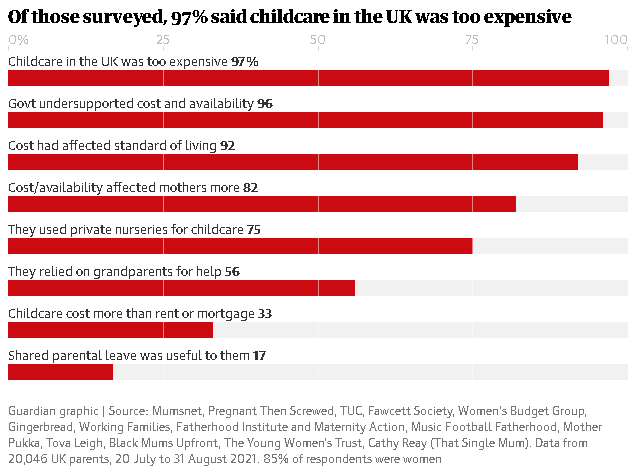 Childcare survey graphic
The survey comes before a debate on childcare in parliament on Monday that was triggered after more than 100,000 parents signed a petition calling for an independent review of childcare funding and affordability.
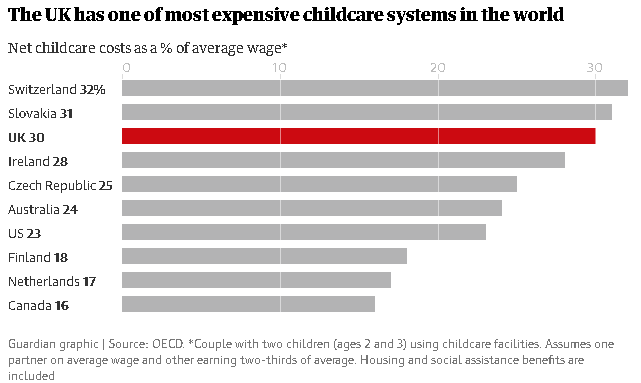 OECD childcare comparison graphic
According to data from the Organisation for Economic Co-operation and Development, the UK has the third most expensive childcare system in the world, behind only Slovakia and Switzerland; a full-time place costs £12,376 a year on average.
Research by the Trades Union Congress (TUC) found that between 2008 and 2016 the cost of a one-year-old child’s nursery provision grew four times faster than wages in England. In London, it was more than seven times faster.
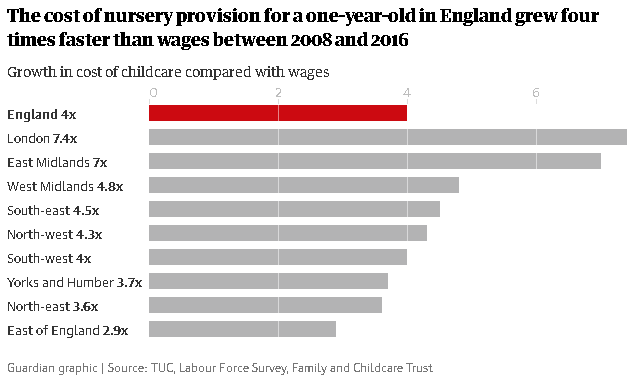 Childcare costs rose four times faster than wages graphic
Warnings that the early years sector is at risk of collapse have been largely ignored and morale is low: research by Nursery World found that one in 10 childcare workers is living in poverty.
Justine Roberts, the chief executive of the online forum Mumsnet, said: “This is a problem that’s been hiding in plain sight for years, and parents know exactly how badly they’re being failed. The government must not ignore the misery and stress this issue causes for parents across the whole country.”
The survey found that people who were struggling the most were on the lowest incomes, on universal credit, were single parents, had disabilities or had a black ethnic background. One in three parents with a household income of less than £20,000 has had to cut back on essential food or housing as a direct result of childcare bills, while four in 10 single parents have had to use credit cards to pay for essential items.
Ninety-two per cent of parents said the cost of childcare had affected their standard of living, while 50% said the cost was completely unaffordable or had resulted in a substantial impact. Ninety-four per cent of parents who changed their working patterns after having children said childcare costs were a factor in the decision.
The survey also revealed how heavily parents relied on family for childcare – while 75% used private nurseries for childcare, 56% of parents said they relied on grandparents for help. Overall, the survey found 99% of all respondents agreed that childcare should be recognised as a vital part of the UK’s economic and social infrastructure.
Joeli Brearley, the founder of the charity Pregnant Then Screwed, said: “All we want from the government is transparency. The cost of childcare continues to increase, forcing more parents out of their jobs, and the quality of our early years settings decrease, which will have serious long-term consequences for all of us. We don’t believe the government has a grasp of how big the issue is and the impact it is having on families and the economy.”
The survey was produced and distributed by Mumsnet, Pregnant Then Screwed, the TUC, the Fawcett Society, the Women’s Budget Group, Gingerbread, Working Families, the Fatherhood Institute, Maternity Action, Music Football Fatherhood, Mother Pukka, Tova Leigh, Black Mums Upfront, the Young Women’s Trust and Cathy Reay (That Single Mum).
The data, which was not weighted, was collected from 20,046 parents in the UK with at least one child aged 18 or under, carried out between 20 July and 31 August 2021 – with 97% of respondents being women.
It presented compelling evidence that lack of access to childcare was preventing progress on gender equality. Only 16% of women said childcare had not affected their seniority or income at work, compared with 42% of men. Of the female respondents, 83% said childcare costs and availability affected mothers more than fathers; 41% of male respondents said it affected parents equally. Two-thirds of female respondents reduced their hours after having a baby, compared with 26% of men.
Felicia Willow, the chief executive of the Fawcett Society, said: “Our government cannot drop the ball on this – it’s clear that a lack of access to childcare is stopping women both going to work and progressing at work.”
The survey also suggested the government’s flagship shared parental leave policy was a particular failure; only 17% of respondents said it was useful for their family.
Ros Bragg, the director of Maternity Action, said: “The deeply flawed shared parental leave has been about as helpful to working parents as a chocolate teapot. Take-up rate among eligible families is now less than 4% in its fifth year of operation. It’s clear that we need to start again.”
Elliott Rae, the founder of Music Football Fatherhood, said: “Extortionate childcare costs reinforce traditional gendered parenting roles and make it difficult for dads to have flexibility in their work and be fully active and engaged fathers.”
The survey suggested that respondents wanted to see a radical overhaul of the childcare system: 90% of all parents supported at least three months of “use-it-or-lose-it” parental leave for fathers, paid at at least minimum wage level, while 94% believed subsidised childcare should start from the end of paid maternity leave.
Frances O’Grady, the TUC secretary general, said: “We don’t want tinkering around the edges. Our broken parental leave system is in need of complete overhaul.”
The Department for Education said parents’ ability to claim 30 “free” hours a week during term time for three- and four-year-olds could save them up to £5,000 a year and the number of childcare places offered by providers was stable.
A spokesperson said early years providers had been given financial support during the pandemic, and the government had invested £3.5bn yearly in childcare since 2018, adding: “We’re making millions more available through our recovery fund to level up children’s early outcomes, raising the quality of early education even further.”