

UK at 'critical moment' with coronavirus
The prime minister told a No 10 briefing the UK was at a "critical moment" and the rising number of cases and deaths shows "why our plan is so essential".
He said he would "not hesitate" to impose further restrictions if needed.
Chief scientific adviser Sir Patrick Vallance said: "We don't have this under control at the moment."
"There's no cause for complacency here at all," he added.
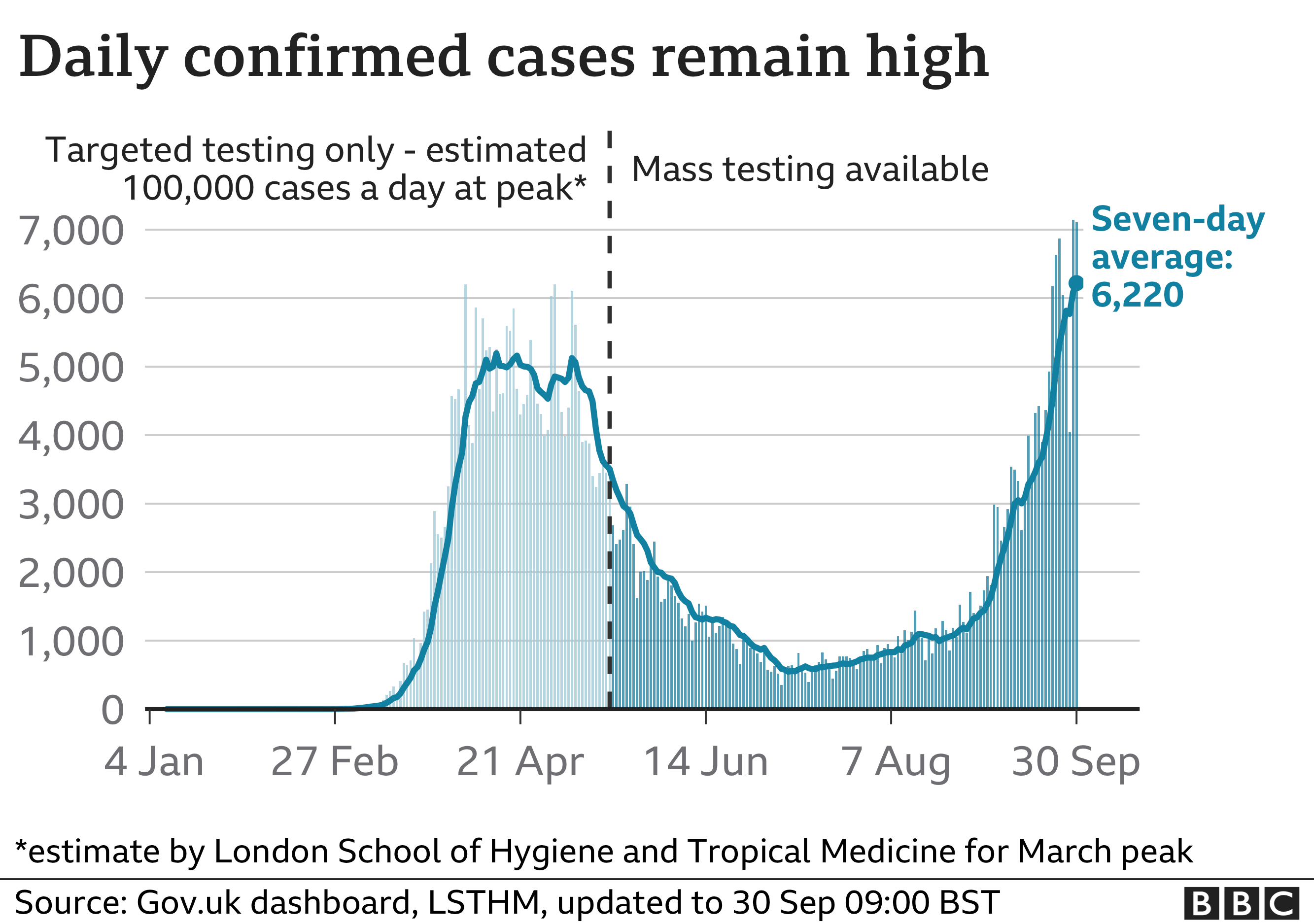
It comes as the latest UK coronavirus figures showed there have been a further 7,108 cases and another 71 deaths.
Last week, Mr Johnson introduced restrictions including a 10pm closing time for pubs, bars and restaurants in England, with similar announcements in Scotland and Wales, and a 15-person limit on weddings.
Since then, further local lockdowns have come into force, including in north-east England, where households are banned from mixing indoors.
At the press conference at Downing Street, Mr Johnson also said the nation could face the winter "with confidence" because it was now better prepared than in March.
The preparations include being on track for 500,000 tests a day by the end of October, 2,000 beds in seven Nightingale hospitals and a four-month supply of protective equipment (PPE) such as masks, gowns and visors.
He said they had trebled the number of ventilators in the NHS to 31,500 in the last six months.
There were 312 Covid-19 patients in mechanical ventilator beds as of Tuesday, the government said, and 2,252 in hospital, as reported on Monday.
'Will the second wave be less severe?'

It is now clear the second wave is here. Infections, hospital cases and deaths are all rising.
But what happens next is the big unknown.
The doomsday scenario of a doubling of cases every week that was put forward last week is not materialising.
The increase in hospital admissions is even more gradual - and the total numbers being admitted are more than 10 times lower than they were at the peak.
It points to a slower, less severe wave this time round.
But it is still early days.
We are just at the start of the autumn and winter period when respiratory viruses circulate more.
The situation could easily unravel.
However, the UK, like other countries, is in a much stronger position than we were when we walked blind into the first wave.
Better treatments are in place, social distancing has become routine and - despite the problems - there is much more testing available.
The odds are certainly stacked in our favour more than they were six months ago.
Mr Johnson also thanked "everyone for the fantastic national effort that we are seeing".
"No matter how impatient we may be, how fed up we may become, there is only one way of doing this, and that's by showing a collective forbearance, common sense and willingness to make sacrifices for the safety of others," he said.
Mr Johnson paid particular tribute to university students, hundreds of whom have been forced to self-isolate, and are "experiencing a first term back at university unlike anything they could have imagined".
Plans were being put in place to allow students home safely for Christmas, the prime minister promised.
He urged people to use the NHS Test and Trace app, saying it had reached 14 million downloads.
He also said he would resume providing regular Downing Street briefings.
'A long winter ahead'
The prime minister warned he was prepared to take "more costly" action against the virus if necessary.
"If we put in the work together now, then we give ourselves the best possible chance of avoiding that outcome and avoiding further measures," he said.
England's chief medical officer Prof Chris Whitty told the press conference that the number of Covid-19 patients was rising, especially in hotspots, although they remained lower than in early April.
In London, the north-east and north-west of England there was a "significant uptick" in the number of people admitted to intensive care, he said.
"We are pointing out that the direction of travel for both hospitals and intensive care is going in the wrong direction, particularly in these areas that have seen rapid increases in cases," he said.
"We have got a long winter ahead of us."
Prof Whitty said the pattern of cases was "rather different" in the second wave, with a "heavy concentration" of infections in areas such as the the Midlands, as well north-east and north-west England, alongside the general rise in Covid-19.
He said cases were increasing "quite rapidly" among older teenagers and under-21s, but the rate of transmission among school-age children was not changing very much.
The government has faced criticism in recent days over the lack of parliamentary scrutiny of its coronavirus measures and the complexity of the changing rules.
'Urgent review'
Labour leader Sir Keir Starmer said there had to be "a national effort to prevent a second lockdown".
But he said the government was not fulfilling its role of providing a "very clear strategy", instead offering "confusion".
Sir Keir said there needed to be an "urgent review" of local restrictions, as they had now been imposed in 48 areas and only lifted in one - Luton.
A third of the UK population will be affected by some form of local coronavirus rules when new measures come into effect in four more local council areas in Wales on Thursday.
The prime minister, who on Tuesday apologised for misstating the rules in the North East, admitted there could be complexities but defended the local approach.
"The best thing I can tell you is that everybody in the North East or elsewhere, in Merseyside, the Midlands, everywhere there are local restrictions, get on the websites, look at precisely what you're supposed to do," he said.