London Daily

Focus on the big picture.
Monday, Jul 13, 2026

Rising energy and food bills tip inflation to highest level since 1981 at 11.1%

Rising energy and food bills tip inflation to highest level since 1981 at 11.1%

The rate of inflation rises by much more than economists expected in October, piling pressure on the Bank of England to maintain the pace of interest rate rises to curb demand in the economy.

There has been a higher than expected leap in the rate of inflation, to a 41-year high of 11.1% last month, led by the latest rise in energy bills.

The Office for National Statistics (ONS) revealed the increase, from 10.1% in September, as the cost of light and heating for homes rose further despite help from the government's energy price guarantee that limits wholesale charges for gas and power.

Food was cited as the other major element adding inflationary pressure during October, rising at the fastest annual pace since 1977.

The ONS estimated that the 11.1% reading for the consumer prices index (CPI) measure of inflation was the highest since October 1981.
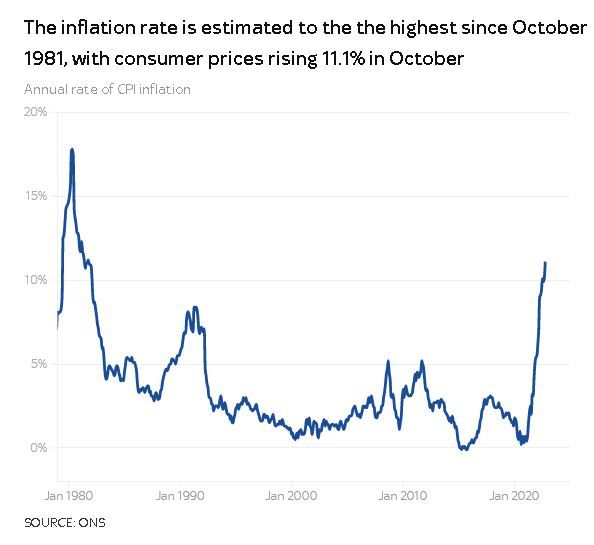


It added that prices rose between September and October 2022 by as much as they did in the entire year to July 2021.

Economists polled by Reuters had expected the rate of inflation to rise to 10.7% - itself still almost double the pace of wage growth.

Surging energy prices have been the main driver of the cost of living crisis - mostly a consequence of Russia's invasion of Ukraine in February that sent the cost of many commodities such as wheat, and the cost of producing them, through the roof.

Wholesale energy costs currently remain below their conflict era peaks, raising hopes that the worst inflation is behind us.

However, there remains a lack of clarity on the support for energy bills beyond April, when the price guarantee will be reviewed. Further information could come in the chancellor's autumn statement to MPs due on Thursday.

Jeremy Hunt is tipped to protect the most vulnerable from the worst by raising benefits and pensions in line with inflation but has warned that we all face higher taxes to help balance the books.

PM Rishi Sunak told a news conference at the G20 Summit in Bali: "My absolute number one priority is making sure that we deal with the economic situation that we face at home.

"With more news of inflation today, it's the number one thing on people's minds. It's the thing that's causing most anxiety, opening up bills, the emails come in with rising prices. And that's why it's right that we grip it."

The Bank of England had expected that inflation would have surged above 13% last month without the government energy bill intervention because average annual bills under the Ofgem-set price cap would have skyrocketed to around £3,450.

Policymakers were tipped, by financial markets, to impose a further 0.5 percentage points increase to Bank rate when its rate-setting committee meets again next month.

That would take the rate to 3.5%.

But the higher than expected inflation figure could mean a more aggressive rate rise is considered - piling even more misery on borrowers after November's 0.75 percentage point hike.

The Bank has signalled that curbing inflation is its priority despite revealing last month that it expected the country was already in recession.

Official figures last week showed the economy contracted by 0.2% in the three months to September.

The Bank has raised the prospect of seven further quarters of negative growth.

Rachelle Earwaker, senior economist for the living standards-focused Joseph Rowntree Foundation said of the gloom: "The cost of living has millions fearing for the future, contributed to by soaring cost rises for food, transport and energy.

"Every day sees still more stories of people selling their possessions, or borrowing money at punishing interest rates, just to afford these essentials."

Head of research for the British Chambers of Commerce business group, David Bharier, said separate ONS data covering factory gate prices indicated that inflation was yet to peak.

"We speak to thousands of businesses who tell us this is unsustainable", he said.

"Our research shows that confidence is falling fast as many SMEs find it almost impossible to absorb or pass on rising costs.

"While the Bank of England seeks to control inflation through further interest rate rises, this is a blunt instrument that fails to address the core drivers of inflation for most firms: soaring energy costs, global supply chain disruption, and rising staff costs due to labour shortages.

"Ahead of tomorrow's autumn statement, businesses will need to see a clear plan from the chancellor to boost business investment and growth, as well as targeted measures that ease the specific causes of inflation.

"The UK economy otherwise faces a lethal combination of recession and runaway inflation."

Newsletter

Related Articles

0:00
0:00
Close
World Cup Visitors Turn American Big-Box Stores Into Souvenir Stops
Netflix Weighs Always-On Channels, Bundles and Short-Form Video
Passenger Is Pulled Partly Outside Ryanair Jet After Window Fails Mid-Flight
Innovation-led growth strategy
Public service reform pressure
Defence and industrial security
Labour leadership transition and economic reset
Northern England Pushes for Greater Influence in Britain’s Future Economic Model
UK Technology Strategy Focuses on Life Sciences, Digital Innovation and Research Investment
Britain and United States Maintain Focus on Pharmaceuticals Cooperation and Industrial Growth
UK Public Services Face Continued Pressure as Government Promises Visible Improvements
Regional Economic Power Becomes Key Theme in Britain’s Next Political Phase
Britain Expands Support for Small Businesses as Firms Seek Better Access to Finance
UK Economy Remains Central Political Challenge as Cost of Living and Growth Concerns Persist
National Health Service Introduces New Workplace Reviews to Improve Conditions for Healthcare Staff
UK Life Sciences Sector Secures More Than Three Billion Pounds in Investment to Support Innovation
Britain Strengthens Defence Strategy as Security Concerns Reshape Military and Industrial Policy
Andy Burnham Promises Stronger UK Defence Industry and Expanded Domestic Production
UK Government Faces Difficult Spending Choices as Labour Leadership Transition Approaches
Rachel Reeves Warns Andy Burnham of Immediate Economic Challenges After Expected Leadership Change
Andy Burnham Prepares to Lead UK Government With Plans for Regional Power Shift and Economic Reset
Government Creates Emergency Support Scheme for Financially Struggling Universities
United Kingdom Replaces Traditional Farm Subsidies With Payments Linked to Environmental Performance
National Grid Reports First Week of Electricity Generation Without Fossil Fuels
United Kingdom Financial Regulator Introduces Tougher Capital Rules for Cryptocurrency Exchanges
Belfast Harbour Expands Operations to Attract Investment Through United Kingdom and European Union Market Access
Scottish Government Threatens Legal Challenge Over Westminster Cuts to North Sea Transition Funding
United Kingdom Accelerates Trans-Pennine High-Speed Rail Project Linking Northern Cities
United Kingdom Secures Ten Billion Pound Investment for Cambridge Quantum Computing Campus
Port Talbot Steelworks Wins Support for Green Hydrogen Transition and Protection of Industrial Jobs
United Kingdom Sends Royal Navy Carrier Strike Group to Indo-Pacific as Regional Security Focus Expands
National Health Service Expands Artificial Intelligence Diagnostics Across England to Reduce Screening Backlogs
United Kingdom Launches Fifty Billion Pound Infrastructure Fund to Accelerate Housing and Construction
UK Medical Chiefs Update Health Guidance to Promote Everyday Physical Activity
Office of Communications Keeps Wikipedia Under Review Under UK Online Safety Rules
UK Defence Ministry Expands Deep-Strike Capability Through Precision Missile Programme
Russell Group Universities Warn Funding Cuts Could Damage NHS Workforce Training
UK Parliament Calls for National Emergency Broadcast as Heatwave Conditions Intensify
UK and Netherlands Strengthen Naval Cooperation With New Amphibious Defence Partnership
UK Defence Ministry Joins International Missile Programme With One Hundred and Ninety Million Pound Investment
Bank of England Warns Middle East Conflict and AI Risks Could Pressure UK Economy
UK Government Introduces New Rules to Limit Foreign Influence in Political Donations
UK and France Prepare Naval Mission to Protect Shipping Through Strait of Hormuz
United States Pressures UK to Increase Defence Spending at NATO Summit
Bank of England Warns Artificial Intelligence Investment Boom Could Create Financial Stability Risks
Bank of England Begins Direct Oversight of Critical Technology Providers Supporting UK Finance
Andy Burnham Set to Become UK Prime Minister After Labour Leadership Race Clears Path to Downing Street
Scottish Fishing Industry Calls for Emergency Support Amid Rising Costs
UK Supports Stronger European Response to Russian Actions in Ukraine
Devon and Cornwall Police Release Suspect in Ann Widdecombe Murder Investigation
×