London Daily

Focus on the big picture.
Wednesday, Jun 24, 2026

Pollution on some new UK trains ‘13 times one of London’s busiest roads’

Pollution on some new UK trains ‘13 times one of London’s busiest roads’

Nitrogen dioxide levels far exceed average recorded on traffic-clogged Marylebone Road, according to a study

The amount of diesel pollution on some new trains is 13 times higher than on one of central London’s busiest roads, researchers found.

Passengers travelling onboard a Great Western Railway carriage running from London to Bristol, procured by the government as part of a £5.7bn scheme, were subject to huge spikes in nitrogen dioxide (NO2) pollution when it switched to diesel from electric.

NO2 levels on the two-year-old bi-mode Hitachi trains peaked at more than 13 times the average recorded on the traffic-clogged Marylebone Road in central London, according to a study by the Rail Safety and Standards Board (RSSB).

The Department for Transport (DfT) said ministers had commissioned more research after the “concerning findings”, as well as an immediate review of air quality standards and regulations for trains.

The Hitachi-built bi-modes were part of a £5.7bn government procurement of trains to run on the Great Western mainline and East Coast, with a controversial design that twinned diesel and electric power. The trains were also recently pulled out of service after cracks were discovered in the carriages.

GWR trains run on electricity from London until Cardiff, but services farther west and south-west run on diesel. Planned electrification of part of the line into south Wales, as well as the branch from Chippenham to Bath and Bristol Temple Meads, was scrapped by the then transport secretary Chris Grayling in 2017 after huge budget overruns.
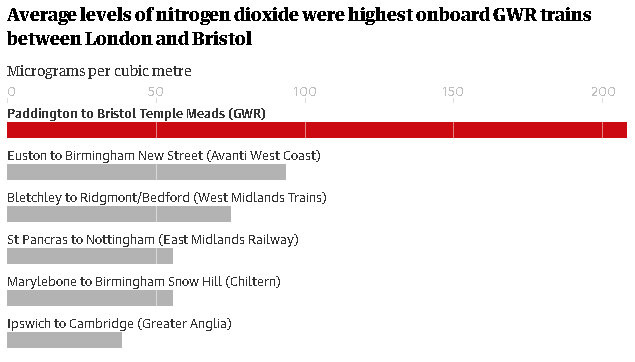
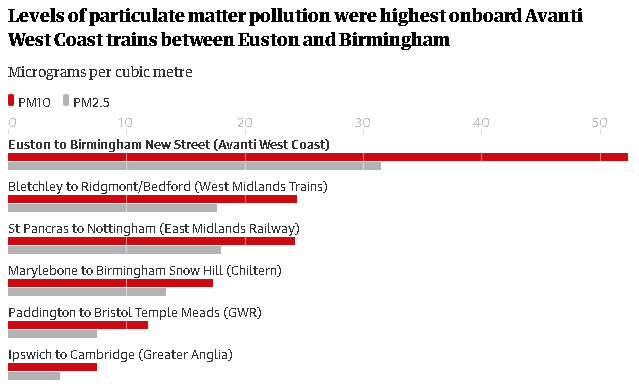

Pollution increases significantly when trains are in tunnels or idling in stations, the RSSB said. Passengers on trains pulled by diesel locomotives are more exposed to fumes when sitting in rear rather than front carriages, the researchers found, possibly due to the how the exhaust is drawn into the train’s windows or air conditioning system.

The RSSB examined six types of diesel train, and found high levels of particulate pollution on older diesel trains operated by Avanti West Coast, the Super Voyager class 221 models built by Alstom.

However, the RSSB concluded: “Newer train types do not necessarily have better onboard air quality compared to older trains.” The worst NO2 pollution was found on the GWR bi-mode trains, which were just two years old.

The DfT said that the RSSB report had independently concluded that the quality of air on services remained within legal workplace limits. It said cross-industry research was already under way to understand the issues and identify solutions, while it had commissioned further studies to measure air quality on another eight types of train used in Britain.

Rail minister Chris Heaton-Harris said: “The safety of staff and passengers is our absolute priority. While these findings are within limits, I do not believe people should have to accept anything less than the highest levels of air quality.

“I have asked the industry to immediately conduct further research and explore all engineering modifications and options to rapidly improve air quality on trains and in stations.

He added: “If required, we will not hesitate to strengthen legislation to ensure the highest standards of air quality are met and maintained.”

A spokesperson for industry body the Rail Delivery Group said: “Rail is one of the greenest forms of transport … We welcome the government’s action to improve air quality onboard trains, but investment by government is also needed to electrify more of the railway and eliminate more polluting trains altogether.”

GWR said it was working with the manufacturers to help develop potential solutions. A spokesperson said: “In the long term, this is why the government’s ambition to electrify the network and reduce the number of diesel-operated trains is so important.”

An Avanti West Coast spokesperson said most of its fleet was fully electric, and it would be replacing the diesel Voyager trains with electric and bi-mode trains in coming years.


Newsletter

Related Articles

0:00
0:00
Close
UK Biotechnology Sector Receives Increased Public Funding to Support Regional Growth
Police Chiefs Update National Protest Management Guidelines Amid Rising Demonstration Activity
UK Aviation Regulator Expands Support for Regional Airports to Strengthen Domestic Routes
CMA Launches Investigation Into Retail Pricing Across UK Grocery Sector
UK Energy Operator Warns of Winter Supply Pressures Despite Stable Overall Grid Outlook
UK Research Council Expands Funding for Regional Biotechnology and Life Sciences Clusters
UK Compensation Scheme for Post Office Horizon Scandal Reaches 80 Percent Completion
Police Chiefs Issue Updated National Guidance on Managing Large Public Demonstrations
UK Expands Regional Airport Funding Scheme to Boost Domestic Connectivity
UK Competition Watchdog Launches Inquiry Into Grocery Pricing Practices
National Grid Warns of Tight Energy Management Needs During Upcoming Winter Peak Demand
UK Education Department Introduces National Standards for AI Use in Secondary Schools
UK High Court Clears North Sea Carbon Capture Project After Final Legal Challenge Fails
Northern Ireland Leaders Hold Emergency Talks on Trade Disruption Under Windsor Framework
Welsh Government Moves to Expand Social Housing in Response to Severe Affordability Pressures
UK Economy Sees Unexpected Rise in Business Investment in Second Quarter, ONS Data Shows
Scottish Government Unveils Multi-Billion Pound Investment Plan for Renewable Energy and Grid Expansion
UK and EU Agree Enhanced Defence Cooperation Pact Covering Intelligence and North Sea Security
Prime Minister Orders Independent Review of NHS Performance After Record Waiting Lists
Bank of England Holds Interest Rates at 5 Percent as Services Inflation Remains Persistent
UK Heatwave Disrupts Transport, Healthcare and Public Services as Red Weather Alerts Expand Nationwide
Barclays Warns of Growing Cyber Risk Divide Between Large UK Firms and Micro Businesses
European Defence Plans Including Ukraine Integration Prompt UK Strategic Reassessment
UK Equity Markets React as US–Iran Peace Roadmap Eases Oil Price Pressures
United Kingdom Expands Global Clean Energy Partnerships With Brazil, Morocco and Tanzania
Lord David Frost Urges Incoming UK Leadership to Abandon EU Regulatory Reset Strategy
Housing Groups Support Amendment to Strengthen Fire and Gas Safety Access Powers in Social Housing
South London NHS Estates Staff Ballot on Industrial Action Over Pay Structures in Hospital Maintenance Services
United Kingdom Government Invests £60 Million in AI Research Labs at Oxford and University College London
Barclays Cyber Security Report Highlights Rising Threat Exposure Among UK Small Businesses in AI-Driven Attacks
UK Met Office Heatwave Triggers Transport Warnings as Rail Operators Urge Cancellations Amid Infrastructure Strain
South London NHS Estates Workers Ballot for Strike Action Over Pay Disputes Across Major London Hospitals
Barclays Warns of Severe Cyber Security Gap Between Large Corporations and Small Businesses in the United Kingdom
United Kingdom Government Allocates £60 Million for Artificial Intelligence Research Laboratories at Oxford and UCL
National Health Service Approves Teplizumab Treatment to Delay Onset of Type One Diabetes in First European Rollout
Met Office Issues Rare Red Extreme Heat Warning Across London, South East and West Midlands as Transport and Health Systems Face Disruption
Prime Minister Keir Starmer Resigns After Labour Party Revolt Following Economic Stagnation and Local Election Losses
United Kingdom Economy Contracts for Second Consecutive Month as Private Sector Weakens and Job Loss Fears Rise
Taxpayer Support Grows for Higher Digital Levies on Multinational Tech Companies
Bank of England Signals Caution Over Inflation Despite Easing Energy Prices
Lloyds Banking Group Expands Artificial Intelligence Hiring Amid Sector-Wide Automation Shift
Film Producer Corporate Collapse Leaves Creditors Facing Unrecoverable Losses
UK Ten-Year Brexit Anniversary Highlights Ongoing Political and Economic Uncertainty
Nottingham Maternity Scandal Inquiry Reveals Systemic Failings in NHS Care
Met Office Heatwave Prompts Public Health Warnings Across United Kingdom
Concerns Rise Over Fiscal Stability as Political Uncertainty Weighs on UK Borrowing Costs
UK Taxpayers Back Higher Digital Taxes on Global Technology Firms, Survey Shows
Bank of England Holds Interest Rates Steady Amid Persistent Services Inflation
Reform UK and Opposition Leaders Call for General Election Following Starmer’s Departure
Ten Years After Brexit Referendum, UK Faces Ongoing Political Fragmentation and Economic Debate
×