London Daily

Focus on the big picture.
Tuesday, Sep 22, 2026

NI Protocol: Will Rishi Sunak's deal pass DUP checkpoint?

NI Protocol: Will Rishi Sunak's deal pass DUP checkpoint?

Rishi Sunak started the week in the green lane heading for a deal and ended up trapped in the red lane with no clear path out.

The prime minister thought he had his paperwork complete after months of delicate negotiation.

All he needed was clearance from the Democratic Unionist Party (DUP) and his backbench Brexiteer MPs before signing off with the EU.

But, as his predecessors at Number 10 discovered, dealing with the DUP is challenging.

Thanks to those same predecessors, trust between DUP leader Sir Jeffrey Donaldson and the Tory leadership has been slowly eroded.

That is why the party was not moved by the assurances offered by the prime minister in the House of Commons on Wednesday.

"We've heard the same warm words from the same dispatch box before, it counts for nothing," said one DUP MP.

That is why the DUP leader warned against "tweaking" the protocol and demanded the "legally binding text" be rewritten.
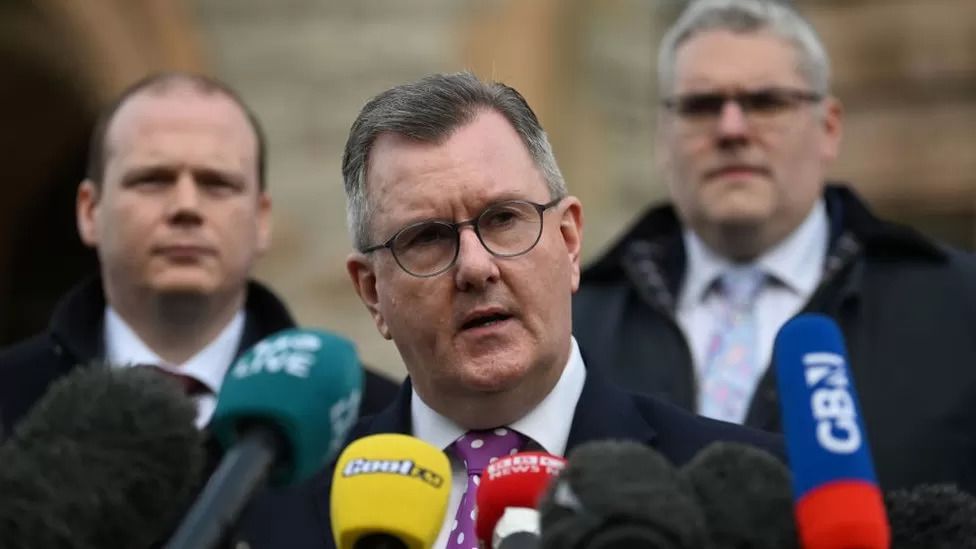
Sir Jeffrey Donaldson led a DUP delegation to meet the PM near Belfast on Monday

Unless the DUP can read it in a bill, they can't sell it.

While sidestepping that part of Sir Jeffrey's question, the prime minister hinted in another answer that legislative changes are in the mix.

That will be key for the DUP to be able say the old Northern Ireland Protocol is gone.

But any changes will come in the form of new legislation "overlaying" what has gone before both in London and Brussels.

Overlay but not replace.

So the EU will equally be able to say the original protocol text remains.

Nuances like that matter when it comes spinning and disguising compromises if we ever reach the point of a deal.

Judging by the Westminster whispers this week that is far from clear.

There is real concern among some less vocal Tories that a deal which was within touching distance could slip through their grasp.

Some of those non-European Research Group (ERG) MPs question why the Prime Minister is spending so much political capital on an issue which does not stir their voters at a time when other more pressing issues need attention.

The protocol does not appear in Mr Sunak's five key priorities and there is a budget looming within weeks.

"There are some on our back benches who are certifiable and Mr Sunak needs to stand up to them" said one frustrated Tory.

After briefing heavily that the deal was to be published this week, Team Sunak are now in crisis management.

The daily calls with European Commission Vice-President Maros Sefcovic on the surface suggest Brussels is being squeezed for more concessions, but equally it could be for the optics ahead of a deal being agreed next week.


Real progress?


Mr Sunak has invested too much to walk away.

He cannot sit on a deal which provides much needed remedies for businesses struggling under the burden of the Northern Ireland Protocol.

Plus, he is desperate to bank the gains he has secured.

That may include taking back control of state aid, VAT and other tax breaks in Northern Ireland which, under the protocol, fell to Brussels.

That was leaked this week and was not totally discounted by sources in Brussels.

Such leaks are useful in countering back bench and DUP pressure in the absence of publishing the deal.

Could this be one of the important areas where Sir Jeffrey Donaldson told us real progress has been made?

But what the prime minister really needs is for the DUP to hold back on its verdict of any deal.

This would allow the government time to win over business leaders and other stake holders before the DUP passes judgement.

But if the government is to secure its goal of restoring the Stormont institutions then the DUP will have to be won over at some stage

The party is expecting the deal to be published early next week and it will likely flag concerns but reserve full judgement until it sees any accompanying legal text

With a council election looming in May, rejecting the deal is the easiest option for Sir Jeffrey.

But saying no is not a long term sustainable position and that is the calculation the government will be banking on .

Newsletter

Related Articles

0:00
0:00
Close
Michelin Guide Faces Industry Questions Over Restaurant Inspection Coverage
English Woodlands Face Renewed Weather Stress From Dry Conditions and Strong Winds
Research Finds Extensive Alcohol, Gambling and Unhealthy Food Branding During 2026 World Cup
Five Charged After Newborn Baby Dies From Stab Wounds in Sheffield
BT Could Reap £2 Billion From Recycling Copper as Full-Fibre Network Expands
FCA Urges Young Adults to Trace £1.5 Billion in Unclaimed Child Trust Funds
Reform UK Names Helen Jenner as New Leader in Wales After Dan Thomas Steps Down
Resolution Foundation Calls for Broad-Based Tax Rises to Fund Higher UK Defence Spending
Ed Davey Calls for Global Treaty to Halt Development of Super-Intelligent AI
Scotland Consults on Legal Price Caps for Essential Foods
NHS Productivity Reforms Could Prevent More Than 20,000 Early Deaths a Year, Report Says
United Kingdom and ASEAN Deepen Trade and Investment Cooperation
United Kingdom Deploys RAF Refuelling Support to Saudi Arabia After Houthi Attacks
UK Fiscal Headroom Shrinks as Higher Borrowing Costs Complicate Autumn Budget
UK Public Borrowing Jumps to £18.3 Billion in August, Raising Pressure Before Budget
Andy Burnham Reaffirms UK Net-Zero Target With £30 Million Community Energy Fund
Scottish Labour Leader Backs Rosebank and Jackdaw North Sea Projects
UK Consumer Confidence Falls to Three-Year Low
UK Diesel Prices Approach £2 a Litre as Global Supply Shortages Intensify
Chiltern Railways Returns to Public Ownership as UK Rail Nationalisation Advances
British Museum Faces Questions Over Peter Thiel’s Private Bayeux Tapestry Viewing
Earl Spencer Memoir Excerpts Renew Public Debate Over Diana’s Death
Liberal Democrats Gather in Brighton for Autumn Conference
Mothercare Shares Plunge as Middle East Store Closures Threaten Long-Term Solvency
Kent Police Treat Folkestone Hotel Fire as Suspicious
Caribbean Governments Advance Reparations Campaign Seeking Engagement With Britain
Scottish Labour Leader Backs Rosebank and Jackdaw North Sea Projects
FCA Urges Young Adults to Trace £1.5 Billion in Unclaimed Child Trust Funds
UK Competition Regulator Opens Inquiry Into McCormick-Unilever Foods Deal
Public Inquiry Into Tees, Esk and Wear Valleys Mental Health Failings Set to Begin
Nigel Farage Looks to US Immigration Enforcement Model for UK Border Policy
Chiltern Railways Moves Into Public Ownership
Security Review Raises Concerns Over Sensitive UK Police Data Stored on Microsoft Cloud
Burnham Government Warns of Difficult Autumn Budget as Fiscal Headroom Narrows
Bank of England Holds Rates at 3.75% as Inflation Rises to 3.1%
Ed Sheeran Tour Faces Backlash After Macklemore Is Removed Over Pro-Palestinian Remarks
Vandalism of Traffic Cameras Intensifies Across Parts of England
Nearly 300 Evacuated as Fire Hits Grand Burstin Hotel in Folkestone
King Charles Warns AI Executives About Risks From Uncontrolled Technology
Church of England Apologises for Role in Historical Forced Adoption Practices
UK Debate Over Online Speech Intensifies After Arrest Figures Draw Scrutiny
Oxfordshire Village Holds Symbolic Independence Vote Over Asylum Accommodation Plan
Nigel Farage and Richard Tice Sue National Crime Agency Over Alleged Banking Data Leaks
Apple Introduces Stricter Age Checks for UK Accounts
BBC Cash Reserves Fall 66% to £125 Million as Broadcaster Restructures
McLaren Announces £500 Million UK Investment and Plans 1,000 Jobs
Green Party Wins Historic Gorton and Denton By-Election as Labour Falls to Third
Burnham Government Prepares October Budget Under Growing Fiscal Pressure
UK Energy Suppliers Pull Fixed-Price Deals as Wholesale Markets Turn More Volatile
Bank of England Holds Rates at 3.75% as Middle East Energy Shock Raises Inflation Risks
×