

NI Protocol: Irish Sea border checks ordered to end at midnight
He had been threatening to act, as part of the DUP's ongoing opposition to the Northern Ireland Protocol.
Mr Poots said he had taken legal advice which meant he could direct the checks to stop in the absence of executive approval for them.
Sinn Féin, the DUP's power-sharing partners, criticised the move as a "stunt".
Northern Ireland Deputy First Minister Michelle O'Neill, of Sinn Féin, said it was an attempt by the Democratic Unionist Party (DUP) to "unlawfully interfere with domestic and international law".
The protocol was agreed by the UK and EU to ensure free movement of trade across the Irish land border after Brexit.
But unionist politicians have been critical of the arrangements, saying they are damaging Northern Ireland's place in the UK.
A UK government spokesperson has said the operation of checks "is a matter for the Northern Ireland Executive".
"We have been consistently clear that there are significant problems with the protocol which urgently need fixing, which is why we are in intensive talks with the EU to find solutions," the spokesperson said.
Under power-sharing arrangements, if the matter was put to the executive, it would need an agreed approach from both the first and deputy first minister if changes were to be made.
Sinn Féin has previously said it will block any attempt to halt border checks.
Foreign Secretary Liz Truss is expected to speak to EU Commision Vice-President Maroš Šefčovič again on Thursday.
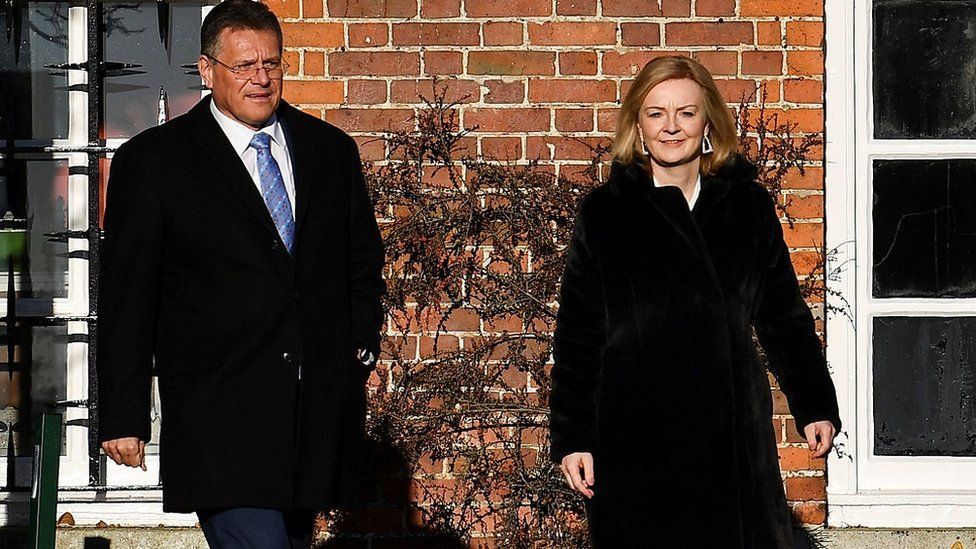 Foreign Secretary Liz Truss is due to talk with Maros Sefcovic later this week
The UK's former Brexit negotiator Lord Frost said he believed that the protocol still needed to be dramatically altered.
"The best way of resolving this situation would be for the EU to negotiate seriously with us to change the protocol so that these unnecessary checks aren't required in the first place," he said.
Irish Foreign Minister Simon Coveney said the move, if officials do follow Mr Poots' direction, would be a "breach of international law".
He said on Wednesday night that the British government had "an obligation to comply with international law".
"Surely that's not too much to ask as we all work to find agreement on flexible & pragmatic implementation of the NI Protocol," he tweeted.
Under the Northern Ireland Protocol, checks on goods from Great Britain must take place at Northern Ireland's ports to make sure they comply with EU laws.
But Mr Poots believes the checks are unlawful and cannot continue without approval from the Stormont Executive.
Last week, his bid to force an executive rethink on the issue was blocked by Sinn Féin.
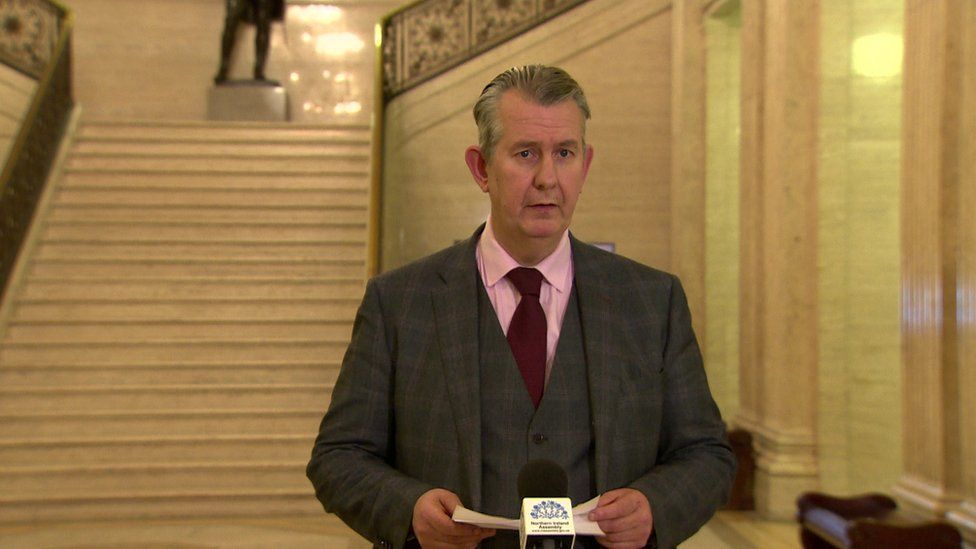 Mr Poots said he had received legal advice on Wednesday
He said legal advice he had received on Wednesday confirmed that the implementation of Sanitary and Phytosanitary (SPS) checks required approval from the Stormont Executive.
Mr Poots said that meant he was able to direct the checks to cease, and he had issued a formal instruction to his department's permanent secretary to halt all checks not in place on 31 December 2020 as of midnight tonight.
The body which represents manufacturing businesses in Northern Ireland, Manufacturing NI, responded to the decision by saying it was advising its members to continue to enact the measures that they had been.
Business leaders have previously told politicians that trading issues needed to be resolved as "a matter of priority".

Anthony Harbinson has only been in post as the top civil servant at Northern Ireland's Department of Agriculture, Environment and Rural Affairs (Daera) for seven months.
Now he finds himself with a difficult political dilemma - to follow or not to follow orders from his minister?
Edwin Poots believes he has a democratic mandate to issue instructions on the checks, and that his legal advice backs that up.
But critics argue that civil servants are already bound by current law on the protocol and must not stop their work.
Then there is the other question of how Westminster will respond.
It stepped in before to remind Stormont of its legal obligations when it comes to operating the protocol.
But that was two years ago, and the political temperature has risen significantly.
With the assembly election only months away, Number 10 could take a back seat on this for now but there is every chance the issue could still end up in court.
A spokesperson for the Department of Agriculture, Environment and Rural Affairs said Mr Poots had received "senior counsel advice and has issued an instruction on that basis".
The BBC has also contacted the UK's Department for Environment, Food & Rural Affairs for a response.
The minister added that he would prepare a further paper for the executive seeking approval for the measures in due course.
Sinn Féin maintains that Stormont has a legal obligation to enforce the checks, and that the executive agreed in May 2020 to designate Mr Poots' department to perform the controls.
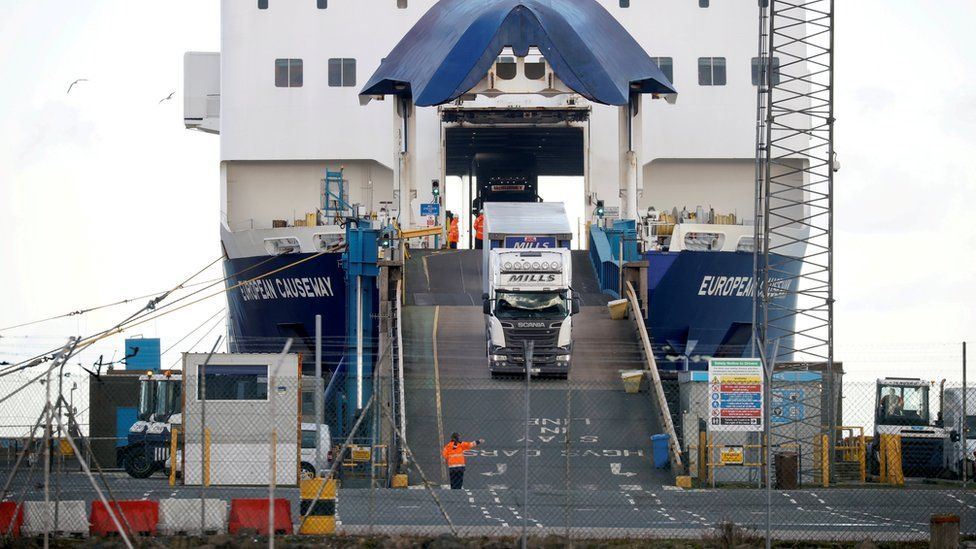 The protocol created a new trade border between Northern Ireland and the rest of the UK
Political reaction
Mr Coveney said the protocol was part of an international treaty.
"So, to deliberately frustrate obligations under that treaty, I think, would be a very serious matter indeed," he said.
An EU diplomat told BBC News the move "won't do the UK's reputation any good" and questioned the legality of the decision.
Sinn Féin's Michelle O'Neill tweeted that the DUP were "fixated on their own priorities, which are clearly at odds with where the wider community is at".

The reaction of the European Commission will be key in this.
The Irish government will be very concerned as well. That raises the question - if stuff isn't being checked at the Irish Sea then where is it being checked?
Will the companies sending stuff here - will they still fill out the export health certs, will they still produce the Common Health Entry Documents even if there is nobody to actually carry out the physical inspections?
Might they want to do that for their own legal certainty? That's another question I'm not certain about.
An industry source was suggesting that the advice they would give is that to have legal certainty you should do what you've been doing under grace periods as it stands.
That will be an individual decision for businesses - particularly the big supermarkets.
The Alliance Party's John Blair said it was "not a time for causing further disruption".
"The minister knows the solutions won't be found in the assembly or the department - it's a matter for the joint UK-EU committee," he said.
He added that the Alliance Party would consider "very carefully" how the matter progresses in the coming days before deciding whether the decision should be challenged in court.
Matthew O'Toole, the SDLP's Brexit spokesperson said the order given by Edwin Poots to civil servants was "outrageous" and that the general public was more concerned with other matters.
"The pretence that this is the biggest issue facing political leaders is a scandalous lie," he said.
"It will not command the support of the Assembly or the Executive and it will be challenged."
The move was welcomed by Traditional Unionist Voice (TUV) leader Jim Allister, who said the protocol implementation was "never compatible" with Northern Ireland's position within the UK.
"The fundamental question though remains, why did it take a year to do this - a year which included excuses and justifications for the very checks Minister Poots now abandons," he said.