

MI5 spy reveals secret 'unauthorised' IRA talks
He has revealed he met IRA leaders in March 1993, despite talks being called off by the British government after IRA bombs killed two young boys in England.
What he said in that meeting encouraged them to declare the ceasefire and move towards the process that eventually led to the 1998 Good Friday Agreement.
The BBC's Peter Taylor has been trying to find the spy for almost 30 years.
He has discovered that what the spy said during the talks was not authorised by the British government.
The minutes of the meeting had been published by Sinn Fein - the IRA's political wing - in 1994. They allege that the spy said: "The final solution is union… this island will be as one."
"Those words are so controversial and so important," says Taylor in a BBC documentary The MI5 Spy and the IRA: Operation Chiffon.
"To Unionists such words would be seen as the ultimate betrayal."
The journalist says he wanted to hear what was actually said from the spy's own lips, but to do that he would have to track him down.
It is extremely rare to hear an MI5 officer talk about a top-secret operation like this. Its codename was "Chiffon" and it was designed to get the IRA to call a ceasefire and embrace the political process.
"It was a seminal meeting that I believe in the long term culminated in the Good Friday Agreement 25 years ago," the veteran reporter says in the documentary.
Set up in 1991, Operation Chiffon worked as a secret back channel of communication between the leaders of the IRA and the British government. By then the conflict had caused more than 3,000 deaths.
Taylor discovers that the spy was known to the IRA as "Fred" but his real name is Robert.
In the documentary, Robert reveals to Taylor that his face-to-face talks with the IRA on 23 March 1993 had not been authorised by the British government.
"I was... on my own, dealing at one remove with the IRA's leadership in the most crucial matter affecting Irish and probably British politics. I knew I had to succeed, and only consistency and patience would achieve this." He said that for years, he felt guilty for doing what he did.
"Yes, I misled the prime minister so I misled the Queen as well. It was a hard and really very unpleasant thing to have on your conscience. I felt very alone."
The IRA had just carried out a bomb attack in Warrington, injuring 50 people and killing two children aged three and 12. It put an end to the British government's willingness to engage with the IRA, and the secret meeting was called off at the last minute by then-prime minister John Major.
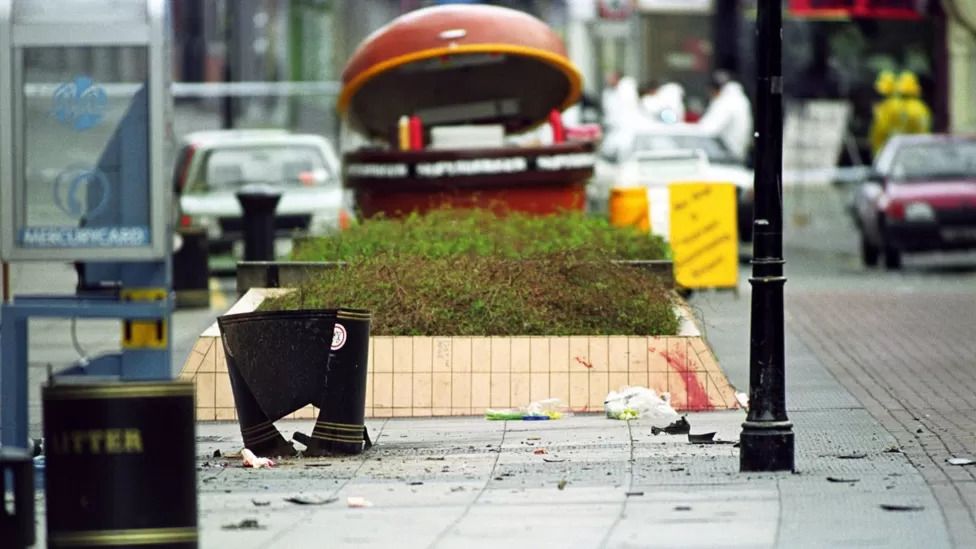 Talks were called off after the Warrington bombs
But Robert had received a previous message from the IRA indicating they were shifting towards a political rather than military way forward and was worried that by not turning up for the meeting, the embryonic peace process would be put in jeopardy.
"I had all sorts of thoughts going through [my mind]. A concern that I was going against my own government and the Queen," Robert tells Taylor in the documentary.
After hours spent soul-searching in the countryside south of Stormont, the spy resolved to go ahead, defying his boss John Deverell, the head of MI5 in Northern Ireland who had ordered him not to go.
Senior republicans Martin McGuinness and Gerry Kelly were at the meeting, representing the leadership of the IRA and Sinn Fein. It lasted around three hours and took place in Londonderry at the home of Brendan Duddy, a nationalist businessman passionate about peace. The republicans had expected Robert to be accompanied by his boss, and were suspicious that he had turned up alone.
"McGuinness did most of the talking. It was not a friendly interrogation," says Robert.
During the meeting, Martin McGuinness asked what the intentions of the 'Brits' were, believing that Robert was speaking as he had presented himself - "the British Government Representative".
Robert said that the goal was ultimately to unify Ireland.
His exact words were noted down in minutes written by Gerry Kelly:
"The final solution is union. It is going to happen anyway. The historical train - Europe - determines that. Unionists will have to change. This island will be as one."
Robert admits to Taylor that he had no authority to make such a claim and that it flew directly in the face of British government policy.
"Those words are so incendiary and so important because they appeared to indicate that, behind the scenes, the British government had a policy - that it wasn't divulging at this stage - to work towards Irish unity," explains Taylor.
His words appeared to have resonated with the Republicans.
Speaking to Taylor in February, Gerry Kelly described the meeting as a "seminal moment".
"We were told he was a British government representative. We just took him at his word - that's what he was there for, he would represent the British government and therefore we were talking to the British government," says Mr Kelly.
"It gave hope there was a possibility of a peace process through meaningful talks. I think he [Robert] did the right thing and he can claim to have been part of history," he said.
During a break in the meeting, the host Brendan Duddy said to Robert, "I think you've got them, I think they're going to call a ceasefire."
Robert did not come clean with the British government about the meeting but the secret came out later in the year [28 Nov 1993], when The Observer ran a front page scoop revealing that a British official had secretly met the IRA three days after the Warrington bomb.
"This is hugely embarrassing because the government had repeatedly denied that there had been any face to face meetings with the IRA," Taylor explains in the documentary.
Robert resigned from the Service.
Taylor tracked him down more than 20 years ago. The trail to Robert was triggered by a signed inscription in a book the spy presented to Brendan Duddy. The inscription - a quote in Latin from Virgil's Aeneid - translated, read: "Perhaps one day it will be good to remember these things," and was signed "Robert".
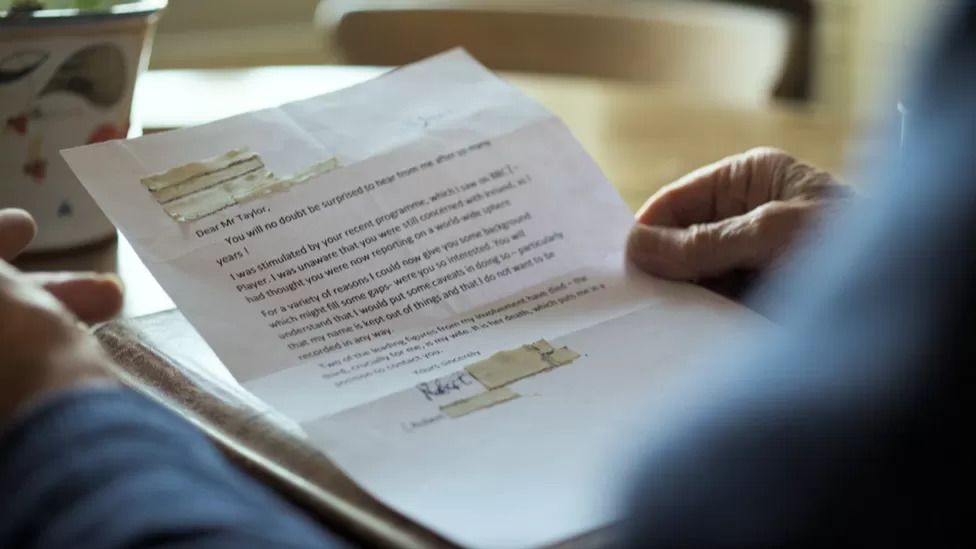 The letter Robert sent to Peter Taylor
But, following MI5's rules, he lied to Taylor, and said he wasn't the man he was looking for. But in 2021, the journalist received a letter.
"Dear Mr Taylor: You will no doubt be surprised to hear from me after so many years. For a variety of reasons I could now give you some background which might fill in some gaps - were you so interested. Two of the leading figures from my involvement have died [Martin McGuinness and Brendan Duddy] the third, crucially for me, is my wife. It is her death, which puts me in a position to contact you. Yours sincerely Robert [surname withheld]"
"I'd like what I did to be remembered," he tells Taylor in the documentary.