

Matt Hancock’s WhatsApp messages: what he said v Covid context
With lockdowns and enforced distancing a fading memory for many, and masks a relatively rare sight, it can be tricky to view the revelations from a horde of Covid-era government messages in the context of the time in which they were sent.
Below are five stories from the 100,000-plus WhatsApps passed by Matt Hancock to the journalist Isabel Oakeshott, who handed them on to the Daily Telegraph, and a reminder of where the UK was, clinically and politically, amid the progress of the pandemic.
Testing in care homes – 14 April 2020
The messages: Hancock, the health secretary at the time, seemingly pushes back against advice from England’s chief medical officer, Prof Chris Whitty, to test all people going into care homes for Covid. Hancock, backed up by Helen Whately, a current health minister, has insisted this was a partial picture, missing out vital counter-evidence.
The situation at the time: The UK was at the peak of the first Covid wave, with a vaccine not yet in sight and the Office for Budget Responsibility predicting a potential 35% shrinkage in GDP. Testing had been ramped up from a slow start, with just under 75,000 lab-based PCR tests taking place in the previous seven days. However, the country was still lacking the instant lateral flow tests that allowed mass, regular testing later in the pandemic. A total of 1,254 UK Covid deaths were recorded, with evidence emerging that a significant number were in care homes.
The 100,000 tests-a-day target – 28 April 2020
The messages: Desperate to meet his self-imposed target of 100,000 tests a day by the end of the month, Hancock messaged George Osborne, the Tory chancellor-turned-Evening Standard editor, to seek the “favour” of a page one story about testing the next day. Osborne agreed, in return for “some exclusive words”.
The situation at the time: You can see why Hancock wanted some positive news. With total Covid deaths in England nearing 20,000, the health secretary faced pressure at the nightly government press conference about the numbers dying in care homes, up to a quarter of the total, and whether he had been negligent in not testing people moved into care homes.
Face masks in schools – 25 August 2020
The messages: A decision on whether secondary school students in England should wear masks for the next academic year seemingly ended up being decided because Scotland had already ruled that pupils there should. Whitty advised Johnson in a message there were neither strong reasons for or against, concluding: “So agree not worth an argument.”
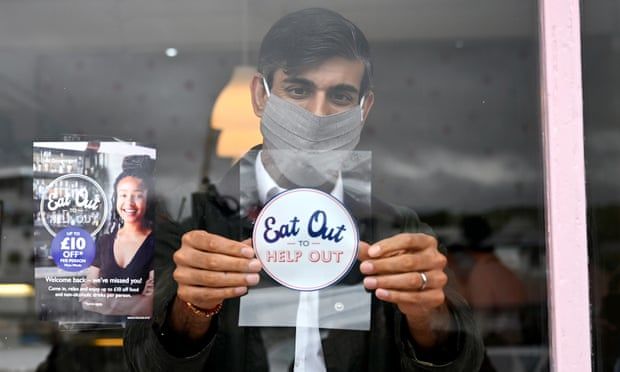 Rishi Sunak places an ‘eat out to help out’
sticker in the window of a business during a visit to Rothesay on the
Isle of Bute, Scotland.
Rishi Sunak places an ‘eat out to help out’
sticker in the window of a business during a visit to Rothesay on the
Isle of Bute, Scotland.
The situation at the time: This was something of a respite period between waves, with August being the time of the then-chancellor Rishi Sunak’s “eat out to help out” subsidy scheme to boost hospitality businesses – although subsequent evidence suggested it also helped to boost infections. For now, though, case levels were low, with 22 Covid deaths recorded across the UK. More attention was being focused on a knock-on pandemic effect: the debacle over A-level marking in England, which had brought the resignation of the head of Ofqual, the exams regulator.
Loosening lockdown rules for children – 11 October 2020
The messages: Helen Whately asked if the “rule of six” limit on gatherings could be amended in some areas to exclude younger children, saying there was not a “robust rationale” for it. Hancock told her Downing Street “don’t want to go there on this”.
The situation at the time: Both recorded cases and deaths were low after the summer lull – that day there were 128 Covid-related deaths across the UK – but this was the foothills of a new wave that peaked over Christmas and January. Boris Johnson, then prime minister, was consulting with ministers over a new system of regional “tiers”, allowing different levels of restrictions depending on case numbers.
Hancock and Gavin Williamson tussle over schools – 28 December 2020
The messages: With the UK in another lockdown, Hancock was complaining to an aide about the way Williamson, the education secretary, was “going absolutely gangbusters” to allow schools to reopen after Christmas, which Hancock was resisting.
The situation at the time: The country was building up rapidly towards another peak wave of recorded infections, which less than a week later would hit an all-time daily record of nearly 200,000. Later in January this brought 1,328 daily deaths, again the highest recorded. Shortly before Christmas, Johnson had been forced to suddenly tighten restrictions because of the emergence of a more infectious variant of Covid, B117, later named the Alpha variant.

