

Hope as cases fall all across London with infections down by third
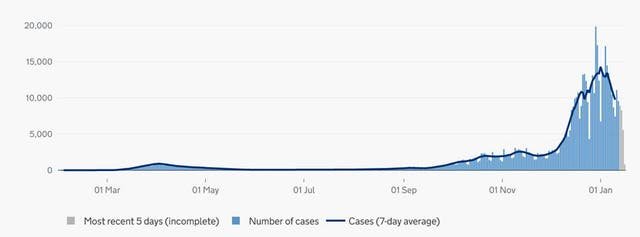
Coronavirus cases are falling in every London borough for the first time in months — raising hopes that the devastating second wave of the pandemic has finally passed its peak.
Falls of up to 30 per cent have been seen in some areas over the past week, with no borough recording an increase. London-wide, the number of confirmed infections has tumbled by almost a third since January 1.
However, the crisis in the capital’s hard-pressed NHS is still getting worse, the official data shows.
The number of Londoners filling up hospitals continues to break records, including for the number of critically ill people being kept alive by ventilation machines. Daily admissions are falling at last, but fewer deaths and slow recovery times means wards are getting more crowded.
In a heartfelt plea, Health Secretary Matt Hancock urged Londoners to protect the NHS by sticking to the rules. He told the Standard. “We all have a role to play and we owe it to the NHS and care staff working all hours to look after us. Please stay at home to protect the NHS and save lives.
“I know Londoners will keep displaying that amazing spirit they have shown throughout this pandemic. Vaccines are our way out and that’s why it’s so important we keep our resolve.”
Mayor of London Sadiq Khan “implored” Londoners to keep up the sacrifices they have made to protect the NHS.
In key developments in the capital’s fight against the pandemic:
- Only three London boroughs currently have infection rates of over 1,000 new cases per 100,000 population, down from 17 boroughs last week.
- Barking & Dagenham, which has the highest infection rate for its size, had a fall of 27 per cent, recording 2,537 new cases last week, which was 945 fewer than the week before. Next highest Newham had a fall of 22 per cent, with 3,972 new cases, down by 1,100 in a week.
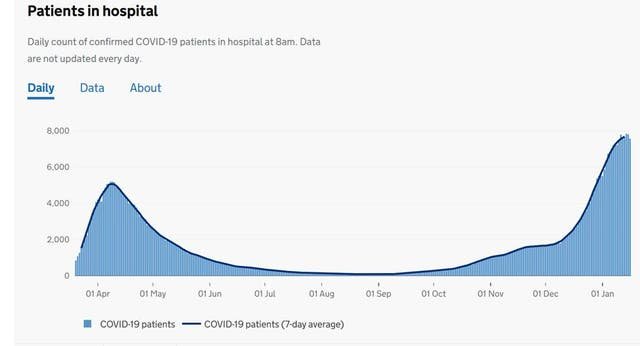
- The number of Covid patients in London hospitals has risen nine per cent in a week. There were 7,686 on January 13, the most recent date for which data is complete, up from 7,034 a week earlier. The figure is, shockingly, almost 50 per cent higher that at the peak of the first wave last April.
- The number of critically-ill patients in mechanical ventilation beds is still surging. There were 1,206 on Saturday, up from 1,020 a week before, a jump of 18 per cent. The number of people who have been intubated in London is risen higher than the 1,046 recorded at the peak of the first wave, on April 13 last year. Fewer are dying than did in the first wave, thanks to improved treatments.
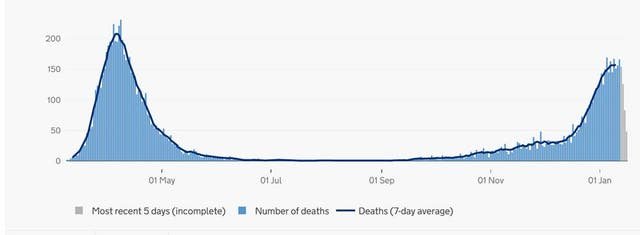
- London’s daily death toll from Covid-19 is rising but less quickly than it did from mid-December to early January. An additional 1,116 deaths in London hospitals of patients who tested positive plus an additional 66 where Covid-19 was mentioned on the death certificate were announced yesterday for the week ending January 16. That compared with 1,028 and 75 for the previous week.
- New admissions peaked in London on January 5 at 913 and were down to 795 on the most recent data. However, these still exceed the number being released because patients who might have died in the first wave are being slowly nursed back to health instead.
The Mayor told the Standard: “Londoners are making huge sacrifices to follow the lockdown restrictions, and there are early signs that the rapid increase in cases that we saw at the end of 2020 is levelling off.
“But the situation remains critical, placing huge pressure on the NHS. I am imploring Londoners to stay at home unless it is absolutely necessary for you to leave.”
The biggest falls in new cases were seen at Havering, down 40 per cent, Bromley, down 37, Redbridge, down 35, and Bexley, down 35.
On the UK-wide map, London appears to have clearly passed the peak of new infections, while many regions are still surging as the highly contagious Kent strain spreads northwards, including the East Midlands, the North-West, and Yorkshire and the Humber.
Meanwhile, Danny Mortimer, head of the NHS Confederation, said theatre staff are being diverted from surgery in most areas to help deal with the surge in Covid-19 patients. He warned: “I think, this next week, we will be at the limit of what we probably have the physical space and the people to safely do.”
Dr Vin Diwakar, medical director for the NHS in London, said: “Tragically, more than one thousand Londoners lost their lives to Covid last week, and nearly half of the capital’s hospital beds are treating those with coronavirus — so it is vital that people get protection against this devastating virus through a safe, effective and well-tested vaccine.”
Professor Stephen Powis, national medical director for the NHS in England, said: “There are signs in London that the growth in infection rates are slowing, but it will take several weeks before that starts to have an effect on reducing people in hospital. So it’s really going to be tough over the next couple of weeks.”
Here is the latest borough data released by Public Health England, showing the number of new cases in the most recent week, the percentage change in new cases and the rate of new infections over seven days per 100,000 population.
Barking and Dagenham: 2537 new cases (-27.1%); rate 1,191.6
Barnet: 3082 cases (-21.6%); rate 778.5
Bexley: 2032 cases (-34.8%); rate 818.4
Brent: 3279 cases (-7.8%); rate 994.3
Bromley: 2143 cases (-37.1%); rate 644.8
Camden: 1461 cases (-21.1%); rate 541.1
Croydon: 3570 cases (-19.1%); rate 923.2
Ealing: 3441 cases (-6.5%); rate 1,006.7
Enfield: 2898 cases (-32.6%); rate 868.2
Greenwich: 2505 cases (-21.7%); rate 870.0
Hackney + City of London: 2192 cases (-19.2%); rate 753.7
Hammersmith and Fulham: 1119 cases (-23.8%); rate 604.4
Haringey: 2279 cases (-19.4%); rate 848.3
Harrow: 2020 cases (-16.3%); rate 804.3
Havering: 2055 cases (-40.0%); rate 791.7
Hillingdon: 2553 cases (-20.8%); rate 831.9
Hounslow: 2615 cases (-19.7%); rate 963.1
Islington: 1525 cases (-25.0%); rate 629.0
Kensington and Chelsea: 961 cases (-2.6%); rate 615.5
Kingston upon Thames: 921 cases (-34.7%); rate 518.9
Lambeth: 2752 cases (-9.3%); rate 844.1
Lewisham: 2566 cases (-20.4%); rate 839.0
Merton: 1587 cases (-20.0%); rate 768.3
Newham: 3972 (-21.7%); rate 1,124.8
Redbridge; 2925 cases (-35.2%); rate 958.3
Richmond upon Thames: 807 cases (-31.8%); rate 407.5
Southwark: 2564 cases (-22.1%); rate 804.2
Sutton: 1548 cases (-29.6%); rate 750.2
Tower Hamlets: 2906 cases (-29.7%); rate 894.9
Waltham Forest: 2475 cases (-23.9%); rate 893.6
Wandsworth: 2062 cases (-22.6%); rate 625.5
Westminster: 1320 cases (-16.9%); rate 505.1