London Daily

Focus on the big picture.
Saturday, May 30, 2026

Germany’s Scholz: The way we deal with China must change

Germany’s Scholz: The way we deal with China must change

German leader noted that Beijing was veering back to a “Marxist-Leninist” political path.

Berlin must change the way it deals with China as the country lurches back toward a more openly "Marxist-Leninist" political trajectory, German Chancellor Olaf Scholz wrote in an op-ed on Thursday.

In his article for POLITICO and the German newspaper Frankfurter Allgemeine Zeitung, Scholz defended his trip to China on Thursday but stressed that German companies would need to take steps to reduce "risky dependencies" in industrial supply chains, particularly in terms of "cutting-edge technologies." Scholz noted that President Xi Jinping was deliberately pursuing a political strategy of making international companies reliant on China.

"The outcome of the Communist Party Congress that has just ended is unambiguous: Avowals of Marxism-Leninism take up a much broader space than in the conclusions of previous congresses ... As China changes, the way that we deal with China must change, too," Scholz wrote.

Germany has faced withering criticism for pressuring Europe into a strategically disastrous dependence on Russian gas over recent years, and Berlin is now having to hit back against suggestions that it is making exactly the same mistakes by depending on China as a manufacturing base and commercial partner.

While Scholz signaled a note of caution over China, he was far from suggesting that Germany was close to a major U-turn in its largely cozy relations with China. Indeed, he clearly echoed his predecessor Angela Merkel in insisting that the (unnamed but obviously identified) United States should not drag Germany into a new Cold War against Beijing.

"Germany of all countries, which had such a painful experience of division during the Cold War, has no interest in seeing new blocs emerge in the world," he wrote. "What this means with regard to China is that of course this country with its 1.4 billion inhabitants and its economic power will play a key role on the world stage in the future — as it has for long periods throughout history."

In a thinly veiled criticism of Washington's policies, Scholz said Beijing's rise did not justify "the calls by some to isolate China."

Crucially, he insisted that the goal was not to "decouple" — or break manufacturing ties — from China. He added, however, that he was taking "seriously" an assertion by President Xi that Beijing's goal was to “tighten international production chains’ dependence on China.”

Scholz is planning to fly to Beijing late on Thursday for a one-day trip to the Chinese capital on Friday, where he will be the first Western leader to meet Xi since his reappointment, and the first leader from the G7 group of leading economies to visit China since the outbreak of the coronavirus pandemic.

The chancellor also sought to counter criticism that his trip undermines a joint European approach to China. According to French officials, President Emmanuel Macron had proposed that he and Scholz should visit Xi together to demonstrate unity and show that Beijing cannot divide European countries by playing their economic interests off against each other — an initiative that the German leader rejected.

"German policy on China can only be successful when it is embedded in European policy on China," Scholz wrote. "In the run-up to my visit, we have therefore liaised closely with our European partners, including President Macron, and also with our transatlantic friends."
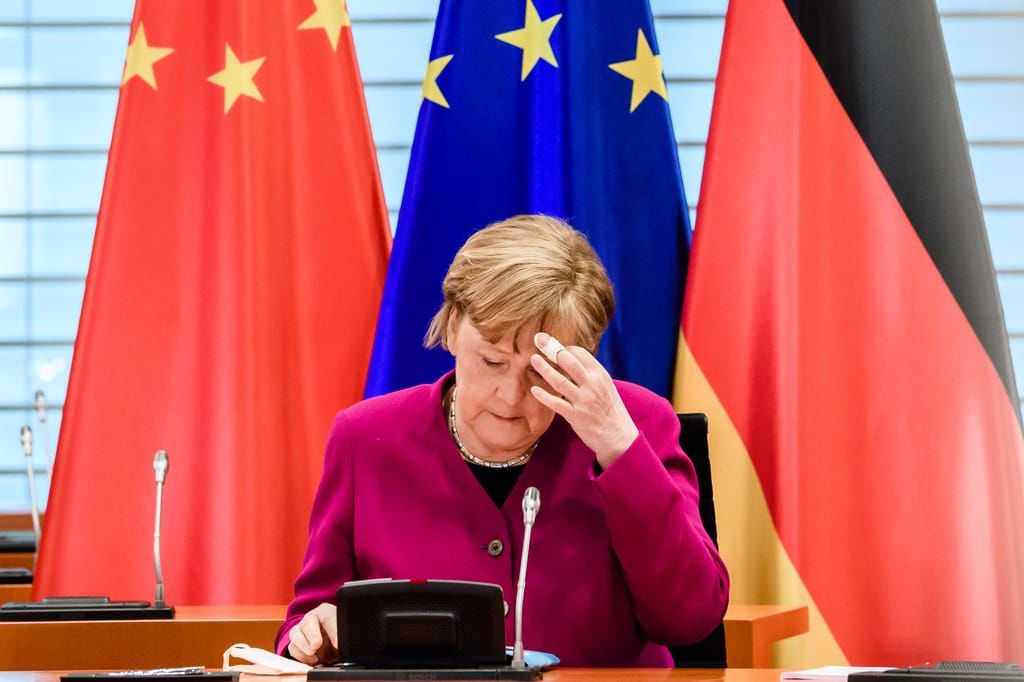
Chancellor Olaf Scholz echoed his predecessor Angela Merkel in insisting that the United States should not drag Germany into a new Cold War against Beijing


Scholz said he wanted Germany and the EU to cooperate with a rising China — including on the important issue of climate change — rather than trying to box it out.

At the same time, he warned Beijing that it should not pursue policies striving for "hegemonic Chinese dominance or even a Sinocentric world order."

Scholz also pushed China to stop its support for Russia's war against Ukraine and to take a more critical position toward Moscow: "As a permanent member of the [United Nations] Security Council, China bears a special responsibility," he wrote. "Clear words addressed from Beijing to Moscow are important — to ensure that the Charter of the United Nations and its principles are upheld."

Newsletter

Related Articles

0:00
0:00
Close
Japanese Technology Firm Fujitsu Launches Advanced Artificial Intelligence Tool for Corporate Disclosures
South Africa Officially Launches Nationwide Campaign for Highly Contested Local Government Elections
United Kingdom Commits Additional Funding for Unexploded Ordnance Clearance in Laos
Singapore Announces Stringent New Greenhouse Gas Regulations for Commercial Cooling Systems
Cambodia and Thailand Hold High-Level Border Security Talks at United Nations Headquarters
Myanmar Military Government and China Sign Major Agreement to Upgrade Media and Cultural Cooperation
Knife Attack at Swiss Train Station Leaves Three Injured in Suspected Act of Domestic Terrorism
Transnational Extortion Gang Threatens Canadian Police With Army of One Thousand Armed Operatives
Australia Imposes Forty-Two-Day Quarantine on Cruise Ship Passengers Following Deadly Hantavirus Outbreak
International Monetary Fund Unlocks Seven Hundred Million United States Dollars for Sri Lanka Following Economic Reforms
Australia Launches Record One Point Four Billion Dollar Lawsuit Against Chemical Giant 3M Over Contamination
China and Canada Foreign Ministers Meet in Ottawa in Effort to Stabilize Strained Diplomatic Ties
Indonesia Demands Urgent United Nations Security Council Reform Amid Escalating Global Conflicts
Extreme Weather Patterns Trigger Severe Drought in Madagascar and Destructive Flooding in East Africa
Indian State of Karnataka Faces Political Upheaval as Chief Minister Siddaramaiah Abruptly Resigns
Philippines and Japan Reaffirm Defense Ties as Crucial for Indo-Pacific Regional Stability
Norway Joins French Nuclear Deterrence Initiative in Major Shift for European Security Architecture
Global Critical Mineral Alliances Expand as Western Nations Move to Counter Chinese Supply Dominance
United States Imposes Fifty Percent Tariffs on Mexican Steel and Aluminum Ahead of Trade Pact Review
European Union and China Head Toward Major Trade Conflict Over Clean Technology Exports
United States Economic Growth Severely Downgraded to One Point Six Percent as Stagflation Fears Mount
World Health Organization Warns Central African Ebola Epidemic is Outpacing Containment Efforts
United States Treasury Department Conditions Sanctions Relief on Reopening of the Strait of Hormuz
Iranian Air Defenses Intercept and Destroy United States Military Drone Over Bushehr Province
Iranian Armed Forces Launch Ballistic Missiles Toward Unspecified Targets Prompting Regional Condemnation
United Nations Secretary-General Warns Global Order Facing Highest Level of Conflict Since 1945
Israel Issues Sweeping Evacuation Orders in Southern Lebanon Amid Intensified Hezbollah Conflict
Russia Announces Systemic Military Strikes Targeting Ukrainian Defense and Energy Infrastructure
United States and Iranian Negotiators Reach Draft Agreement to Extend Ceasefire and Resume Nuclear Talks
United Nations Security Council Deeply Divided Over United States Capture of Venezuelan President
US and Iran Exchange Direct Military Strikes Amid Fragile Gulf Ceasefire
World Health Organization Warns of Catastrophic Ebola Outbreak in DR Congo
Russia Threatens New Wave of Strikes on Ukrainian Infrastructure and Embassies
Scientists Warn Atlantic Ocean Currents Could Collapse Faster Than Projected
Anthropic Reaches $900 Billion Valuation in Historic AI Funding Round
Washington Imposes Crippling Sanctions on Iranian Maritime Authority
Japan and the Philippines Initiate Strategic Intelligence-Sharing Pact
Microsoft Deploys Autonomous Computer-Using AI Agents to Global Markets
Anthropic Secures $45 Billion Compute Infrastructure Agreement With SpaceX
U.S. Director of National Intelligence Resigns Amid Administration Shakeup
Micron Technology Crosses Trillion-Dollar Valuation Amid Unprecedented Hardware Demand
Canada and Germany Finalize Historic Long-Term LNG Export Agreement
China Expands International Travel Restrictions on Domestic AI Researchers
Japan Approves Sweeping Overhaul of National Intelligence Apparatus
Global Airlines Scramble Logistics as Middle East Airspace Remains Fractured
Japan's Naphtha Imports Plunge 47 Percent Amid Strait of Hormuz Closure
Global Crude Prices Retreat Below $96 as Gulf Tensions Momentarily Ease
Generative AI Outperforms Human Baselines in Landmark Global Creativity Study
NASA Partners With Private Aerospace to Unveil Permanent Lunar Base Architecture
South Korean Equity Markets Surge on Next-Generation Memory Chip Frenzy
×