London Daily

Focus on the big picture.
Sunday, Jul 19, 2026

G7: PM and Blinken discuss 'close alignment' of UK-US foreign policy

G7: PM and Blinken discuss 'close alignment' of UK-US foreign policy

Boris Johnson and US Secretary of State Antony Blinken discussed the "close alignment" between foreign policy in London and Washington during their meeting earlier, No 10 has said.

A No 10 spokeswoman said the PM and Mr Blinken agreed UK-US co-operation would be "instrumental" in tackling Covid-19.

They also welcomed their nations' joint work on areas like trade and defence.

It came as G7 powers met in London for their first face-to-face meetings in over two years.

The group is discussing challenges including climate change and threats to human rights. The talks, held amid tight Covid restrictions, will finish on Wednesday.

The G7 group - the world's seven largest so-called advanced economies - is made up of the UK, Canada, France, Germany, Italy, Japan and the United States.

Australia, India, South Korea and South Africa have also been invited as guests, as the UK tries to deepen ties with the Indo-Pacific region.

The UK, which currently holds the rotating presidency of the G7, will host a leaders' summit in Cornwall next month.

At their meeting, Mr Johnson and Mr Blinken agreed that UK-US co-operation would be "instrumental" in making progress in the fight against coronavirus, alongside "protecting the environment and other international priorities", the spokeswoman said.

They also agreed that the global rollout of coronavirus vaccines would be key in beating the pandemic, and emphasised the "importance of G7 work in this area, including efforts to increase international manufacturing capability".

The spokeswoman added that foreign policy issues, including Afghanistan, Iran and China, were also discussed, and Mr Johnson "looked forward to welcoming" US President Joe Biden to the UK when he attends the leaders' summit in June - his first overseas trip since his election victory.

Earlier, Foreign Secretary Dominic Raab said the summit of foreign ministers "demonstrates that diplomacy is back", and showed the importance of "getting countries together".

Mr Raab, wearing a face mask, welcomed counterparts earlier at Lancaster House in London, with forearm bumps replacing the usual handshakes.

After talks on Myanmar on Tuesday morning, the G7 discussed issues including the crisis in Libya and the war in Syria.
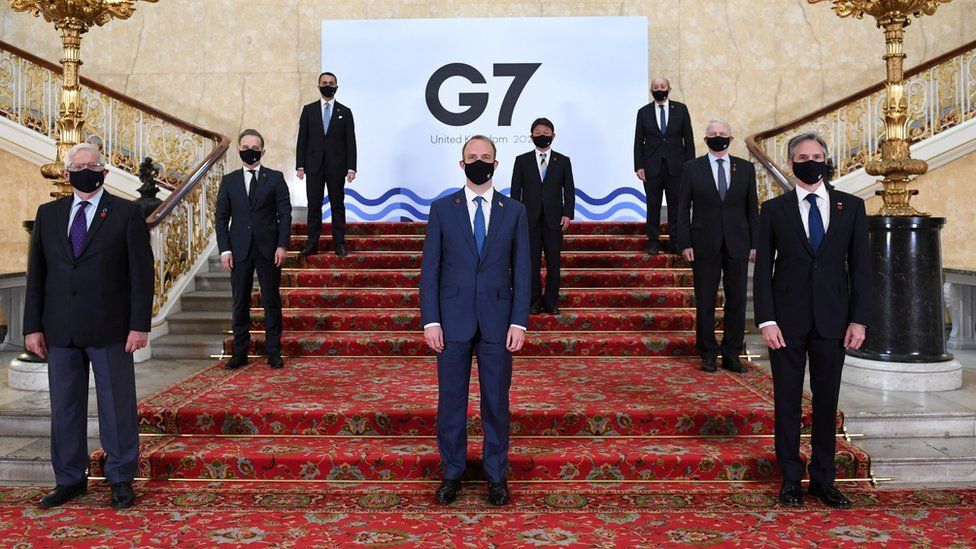
Politicians kept their distance for the traditional group photo

Mr Raab was expected to urge stronger co-operation between the G7 and the guest nations at a working dinner on Tuesday evening.

Speaking ahead of the dinner on Tuesday, he told reporters the summit provided a "good opportunity" to talk to India, a guest at the summit, about how G7 nations could help the country amid its spike in Covid cases.

This included a chance to seek "positive answers" about what developed nations would do with surplus domestic supplies of vaccines, he added.


Lancaster House in central London has played host to many historic negotiations, but rarely will it have seen such diplomatic speed dating as it will later.

For the next few days, foreign ministers will scurry round the clock from meeting to meeting, doing as much business face to face as they can after months of virtual diplomacy.

They will discuss the world's big geopolitical issues: from China to Myanmar, Ethiopia to Ukraine, Syria to the Sahel.

The underlying theme will be how they can best organise to defend international rules and open societies against the threat of autocratic regimes.

And for the UK, the meeting's host, it's a big test to see if its global foreign policy can live up to its name.

The summit comes amid criticism over the UK's decision to cut overseas aid spending from 0.7% of national income to 0.5% - a reduction of more than £4bn.

Mr Raab said this had been a "difficult decision" but that the UK still had scope "to be an even greater force for good in the world".

On Monday, it was announced that the G7 would use the summit to commit to investing $15bn (£10.8bn) to help women in developing countries.

They are also expected to agree a new target of sending 40 million more girls from low and middle-income countries to school within five years.

Newsletter

Related Articles

0:00
0:00
Close
Current AI Seeks to Build an Open Global AI Infrastructure Outside Big Tech Control
Turkey Explores S-400 Transfer to UAE in Bid to Rejoin F-35 Program
Germany’s Economic Malaise Reopens the Sunday Shopping Debate
Singapore Considers Lower Taxes for Fund Managers as Hong Kong Intensifies Talent Contest
US Retaliates Against Iran After Two American Troops Killed in Jordan
Bank of Asia BVI Enters Court-Supervised Liquidation After Regulators Find It Insolvent
Proposed U.S.-Saudi Nuclear Pact Could Permit Limited Uranium Enrichment Under International Safeguards
Netherlands Declares Water Shortage Emergency After Drought Pushes Rivers to Historic Lows
Why Kentucky Fried Chicken Became KFC—and Why the False Explanations Persist
Iran Claims It Destroyed Bahrain’s Main Artificial Intelligence Center in Missile and Drone Strike
Ukrainian Drones Strike Wildberries Warehouses Deep Inside Russia
Brothers Andrew and Tristan Tate Who Turned "Toxic Masculinity" Into a Brand Arrested in Miami as Britain Seeks Their Extradition
Reported CIA Mission Helped Clear the UAE’s Path to Advanced US AI Chips
Artificial Intelligence Capital Fuels Markets While Governments and Regulators Face Mounting Strategic Tests
China’s Moonshot’s Kimi K3 Narrows the Gap With Anthropic Through Scale, Openness and Lower Cost
Gold and Cash Seizure Puts Indonesia’s Senior Anti-Corruption Prosecutor Under Investigation
The Ledger Will Not Trust on Faith
Bank of England Warns Climate Shocks Could Trigger Sudden Asset Repricing
UK Treasury Places Microsoft, Google, AWS and Oracle Under New Financial Resilience Rules
Scottish Government Faces Pressure Over Delays in Vulnerable Group Background Checks
Crown Prosecution Service Authorises Additional Charges Against Andrew and Tristan Tate
NHS Approves At-Home Cancer Treatments for Rare Blood Disorders
Bank of England Gains Oversight of Major Cloud Providers Supporting UK Financial System
UK Government Plans Major Overhaul of English Local Councils Through New Unitary Authorities
British Steel Nationalisation Dispute Escalates as Chinese Owner Jingye Seeks Compensation
Bank of England Signals Interest Rates Will Stay High as It Warns of Financial Risks From Climate and AI
Trump Administration Pressures Banks to Restrict Financial Access for Undocumented Immigrants
Passenger Bound for Germany Refused to Sit Beside a Woman on a Plane — Then Slapped a Flight Attendant
Ukraine’s Leadership Rift Spills Into the Streets as Protesters Target Army Chief
Ukrainian Drone Barrage Kills Eight and Strikes Russian Logistics Network
Key Trends to Watch
Financial Conduct Authority Warns Cloud and Digital Risks Are Becoming a Financial Priority
Jeffrey Donaldson Appeals Sexual Abuse Conviction as Democratic Unionist Party Opens Review
Welsh Health Authorities Launch Emergency Meningitis Vaccination Programme for Students
Scottish Business Activity Falls for Third Month as Companies Face Rising Costs
Bank of England Regulators Demand Better Access to Digital Banking Services
United Kingdom Cuts Bilateral Aid to Several African Countries by Up to Ninety Per Cent
United Kingdom Introduces Tougher Deportation Rules After Rochdale Exploitation Scandal
NHS England Launches Wearable Technology Plan to Reduce Sepsis Deaths
Amazon Web Services Billing Error Sends Trillion-Dollar Invoices to British Companies
Bank of England Takes Direct Regulatory Role Over Major Global Cloud Providers
Extreme Summer Heat Drives Record Fire Risk and Rising Deaths Across Britain
United Kingdom Nationalisation of British Steel Sparks Diplomatic Dispute With China
United Kingdom Economy Shows Weak Growth Ahead of Major Autumn Budget
Andy Burnham Set to Become United Kingdom Prime Minister After Labour Leadership Victory
The Ten World Cup Finals That Defined Football History
Smartphones Are Getting More Expensive, Sales Are Collapsing, and Even Apple Admits: "Prices Will Rise"
The Monaco Bombing Has Become a Test of Ukraine’s Intelligence Accountability
Leadership Change and Strategic Rivalry Redraw the Political Map
Energy Risk, Uneven Growth and the New Geography of Global Capital
×