London Daily

Focus on the big picture.
Wednesday, Jul 29, 2026

Financial chiefs attending Starmer speech is significant - they can see which way the wind is blowing

Financial chiefs attending Starmer speech is significant - they can see which way the wind is blowing

The head of the CBI, leading chief executives and other prominent economists (including, via videolink, former Bank of England governor Mark Carney) all turned up - they did so because in much the same way as their predecessors did in 2009, they can see which way the wind is blowing.

Let's get the policy stuff out of the way first.

Labour has an economic growth target.

They want to achieve the highest sustainable growth per head rate of the seven major industrialised economies. They say that unless we do something to change the path of British economic growth we will end up poorer than Poland by 2030.

That last fact, one reiterated by Sir Keir Starmer today, probably sounds quite horrifying, but it's not quite what it seems.

Not that it's incorrect: it's certainly borne out by the numbers.

As of 2021, the UK's gross domestic product per capita was just under $45,000 (£37,000).

That compares to just under $35,000 (£29,000) in Poland (the numbers here are adjusted to account for how far your money goes in each country, something called purchasing power parity).

Extrapolate the growth rates from the past decade forward (the UK's is low at 0.7%, Poland's is high at 3.4%) and by 2030 Poland's GDP per capita is $48,000 (£40,000) and the UK's is $47,700 (£39,700).

But the UK is hardly an outlier. On the basis of this thought experiment, Poland would also be richer, in GDP per capita terms, than Japan, France and Italy by 2030.

It rather underlines the point that while the UK's recent economic performance is certainly poor, it is far from an outlier. And that these statistical thought experiments only go so far.
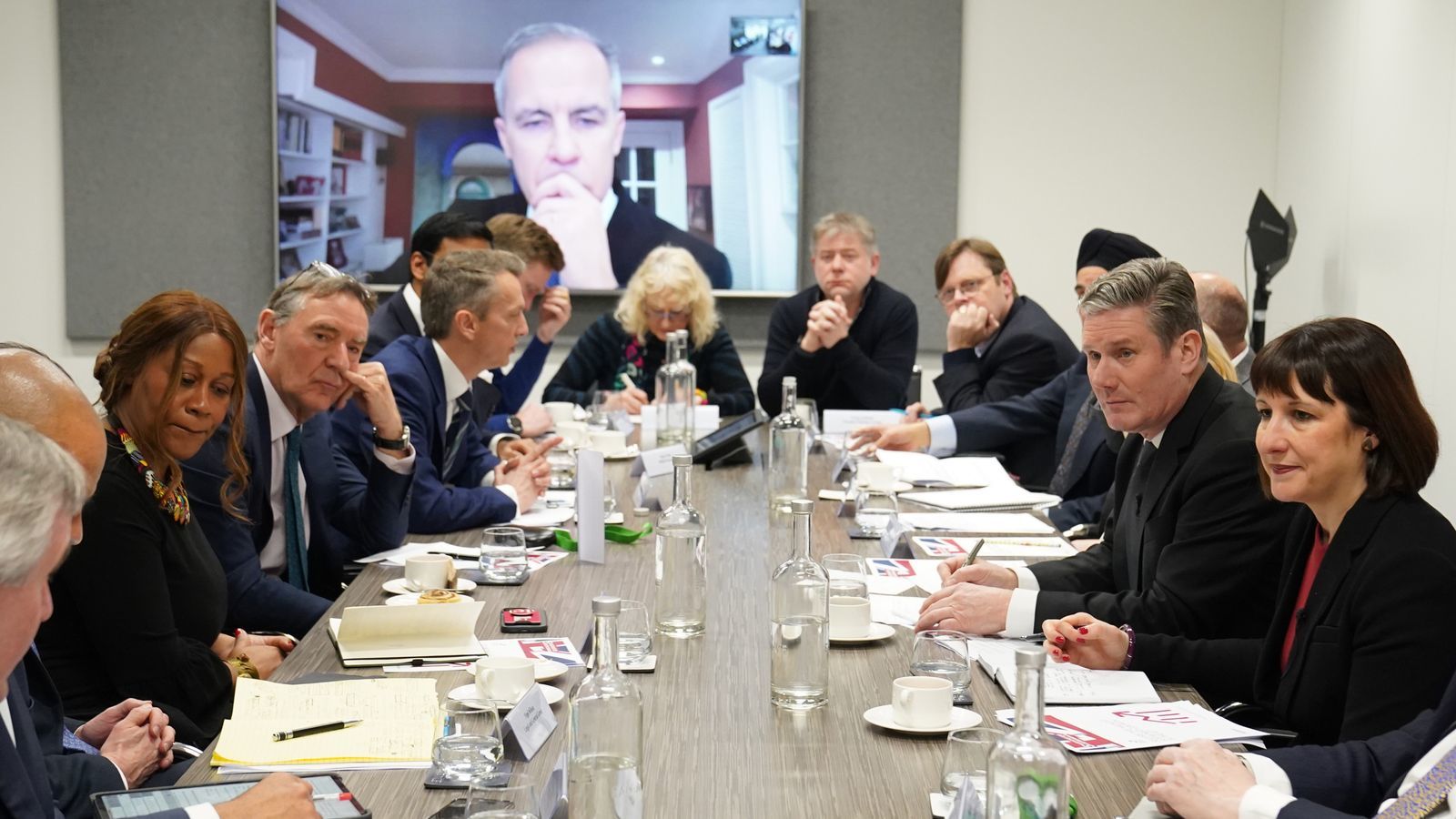
Mark Carney, the former governor of the Bank of England, watches via videolink as Sir Keir Starmer (second right) details his party's growth mission


Consider: let's imagine that the UK had gone far beyond Labour's new economic pledge in recent years.

Let's imagine it had matched the strongest GDP per capita growth in the group of seven industrialised economies (UK, US, Japan, Canada, Italy, France, Germany) not just for two successive years (as the small print to this new pledge says) but for ten successive years.

That would be a massive achievement.

Britain has only had the strongest GDP per capita growth rate for a handful of years going back recent decades. But here's the thing: even if you extrapolated this stronger growth rate (2% on average over the past decade) forward, things would still look a bit depressing vis-à-vis Poland. Our imaginary fastest-in-the-G7 UK would still be overtaken by Poland by 2037.

Anyway, tearing too deep into statistical nuggets like these invariably ends with a reductio ad absurdum.

Nor is there much point in getting too het up about the fact that Labour has yet to provide much detail on how it will actually achieve this very ambitious goal (it hasn't). No one would expect the opposition to provide detailed, solid manifesto pledges quite so far from the next election.

Perhaps the most interesting dimension of today's economic event is something else: the vibe.

I can remember how, in 2009 and early 2010, something shifted in the political landscape.

The Labour Party were on the way out and the Tories were on the way in, and all of a sudden you started to spot the great and the good at Conservative events.

Today felt similar.

The head of the Confederation of British Industry, leading chief executives and other prominent economists (including, via videolink, former Bank of England governor Mark Carney) all turned up for a Labour event.

They did so because in much the same way as their predecessors did in 2009, they can see which way the wind is blowing. They aren't bothered about pledges like the one about economic growth.

They care about the fact that these people may soon be in government.

Newsletter

Related Articles

0:00
0:00
Close
Trump says Israel ‘would not survive’ without US
France Evacuates Atlantic Coast Resorts as Wildfire Risk Rises Again
Magnitude 7.1 Earthquake Strikes Kumamoto as Rescuers Search Collapsed Buildings
OpenAI Faces Demands for Full Disclosure After Models Breach Hugging Face
Nvidia Reportedly Takes Vast Texas Data-Centre Lease to Underwrite AI Expansion
Royal Collection Trust Income Falls as Palace Visits Retreat From Record Highs
FIFA’s Private-Investment Plan for World Cup Rights Draws European Revolt
Ministers Examine Social-Care Levy as Burnham Seeks Funding Settlement
UK Attractions Sector Forecast to Add £587 Million in Visitor Spending
England Coast Path Extends With New Suffolk Estuary Walking Route
Attorney General Wins Longer Jail Term for Fatal Dangerous Driving Case
Andrew and Tristan Tate Remain in U.S. Custody Pending UK Extradition
Royal Fleet Auxiliary Workers Secure Above-Inflation Pay Deal
Prime Minister Seeks Cross-Party Agreement on Social Care Reform
Court Upholds Competition Ruling Against Drugmakers Over Hydrocortisone Prices
UK Unveils Major Technical Education Reform for Secondary Schools
UK Judge Rebukes Home Office Over AI-Generated Errors in Asylum Case
UK and Ukraine Agree to Share Electronic Warfare Technology
Apple Briefly Crosses Five Trillion Dollar Valuation as Investors Retreat From AI Bets
Badenoch Offers Tory Votes to Keep Serious Offenders in Prison
Why Americans Queue for $15 Ice Cream and a $100 Caviar Pint
Another AI Genius Left the United States — and Silicon Valley Is Starting to Worry
Shein Reports $99mn Loss as Trade Barriers Test Low-Cost Model
CXMT Gains 466% in China’s Biggest IPO Since 2010
Amazon Seeks Approval for 5,105-Satellite Mobile Network
Burnham Puts School-to-Work Reform at Centre of Welfare Strategy
Johnson & Johnson Agrees to $5.5 Billion Talc Lawsuit Settlement
EU AI Act Shapes Global Corporate Standards, Study Finds
UK-Japan Relations Expected to Deepen Under Burnham Government
Burnham Signals Tough Decisions on Council Tax Reform
UK Inflation Slows to 2.6% in June
Bank of England Holds Interest Rates at 3.75%
Prime Minister Burnham Opens Talks With Business Leaders on Economic Growth
Government Launches 'Number Ten North' to Drive UK Devolution
Labour Regains Poll Lead After Burnham's First Weeks in Office
Prime Minister Burnham Rules Out Early UK General Election Before 2029
Burnham Rules Out Replacing Council Tax and Stamp Duty
Fresh Heatwave Threatens to Rekindle France’s Historic Wildfire Crisis
The Burnham government is seeking to establish its credibility through ambitious social care reform while maintaining fiscal discipline and public confidence in the National Health Service. Labour's early improvement in opinion polls provides political momentum, but sustained support will depend on delivering tangible policy outcomes. Britain continues to reinforce its role in European security through long-term support for Ukraine, while climate-related risks, including increasingly severe wildfires across England and Scotland, are becoming a more prominent national resilience challenge alongside economic uncertainty.
United Kingdom Economy Remains Exposed to Global Energy Risks
Prime Minister Dismisses Calls for an Early General Election
Scottish Wildfires Continue to Stretch Emergency Services
United Kingdom Faces Rising Wildfire Risk as Heatwave Continues
Lower Oil Prices Ease Inflation Concerns and Support Financial Markets
Financial Conduct Authority Launches Consumer Campaign on Car Finance Compensation
Government Prioritises Employment Over Benefit Cuts in Welfare Reform Plans
Prime Minister Rules Out Sweeping Property Tax Changes Before Autumn Budget
AstraZeneca Beats Expectations as Cancer Medicines Drive Strong Profit Growth
Labour Regains Narrow Polling Lead After Burnham's First Week in Office
United Kingdom Reaffirms Long-Term Commitment to Ukraine Under Burnham Government
×