

Everybody loves Tony: New secretary of State gets high marks - for now
The day before Antony Blinken was officially confirmed as secretary of State, at least one U.S. Embassy had already gone ahead and hung up his portrait.
It was probably just a mistake on the part of building management officials, a U.S. diplomat told POLITICO on condition that the specific embassy not be named. But even if inadvertent, the premature move captured how eagerly many in the State Department’s 75,000-person workforce were awaiting their new leader, after years of feeling marginalized and demeaned under former President Donald Trump.
Whether requesting briefings from junior staffers or promising diplomats that “I will have your back,” Blinken already has taken steps to signal his confidence in the foreign and civil service officers who now report to him. The moves have left a good impression, according to 10 U.S. diplomats and other officials, many of whom hope the workplace turbulence under Trump will quickly fade into memory.
It could be a short honeymoon for Blinken. Already, questions are circulating about whether he will promote enough career government employees or rely largely on political appointees from the outside. Plus, Blinken’s two immediate predecessors, Mike Pompeo and Rex Tillerson, took office with plenty of goodwill — or at least wary hope — from the career ranks, but both left as deeply unpopular.
It helps that Blinken is getting an early boost from his boss: President Joe Biden is planning to visit the State Department later this week, where he will deliver remarks about his foreign policy vision. Biden is expected to speak in broad terms about the need for American leadership in the world and his desire to strengthen U.S. institutions like the State Department.
Blinken, a longtime Biden confidant, will be critical to implementing that policy. But first, U.S. diplomats are counting on him to restore morale. The fact that he served as deputy secretary of State during the Obama administration means many of those diplomats already know him.
“He has always been a supporter and fan of his career colleagues and a very collegial and considerate leader,” said Eric Rubin, president of the American Foreign Service Association (AFSA), the diplomats' union. “We take him at his word when he says he has our back.”
Even before Blinken was confirmed by the Senate on Tuesday, the Biden administration made moves that pleased many at the State Department. For instance, it immediately removed a large placard featuring an “ethos statement” developed under Pompeo. Many State Department employees were insulted by the ethos exercise, believing it questioned their professionalism.
On Wednesday, his first full day as secretary, Blinken delivered remarks at the department headquarters in which he promised to back up his employees and to “seek out dissenting views and listen to the experts.” Because of the coronavirus pandemic, the crowd on hand was limited, but organizers made sure to include representatives of department “affinity groups,” which support people of diverse backgrounds. (One of Pompeo’s last public statements, issued via Twitter, was to declare that “multiculturalism” is “not who America is.”)
Blinken also took questions from the media on Wednesday, and the department confirmed that the daily press briefing, a decades-old tradition that largely vanished under Trump, would resume this week.
The news that the briefing would return “felt really good,” one State Department staff member said, on condition of anonymity because of a lack of permission to speak on the topic. The briefing is watched closely by foreign governments, not just journalists, and it gives State Department bureaus a focal point to help organize their schedules and their thinking.
In one much-appreciated move, junior staff members — specifically, desk officers who follow particular countries — have been asked to brief Blinken before he calls his overseas counterparts, three State Department staff members said. The new administration even changed the format of a document used to arrange such calls to add a section to list the names of such junior staffers, one said.
Rubin, the union head, said Blinken and others nominated for top department jobs already have been in touch with him. “They are being very proactive in reaching out, and very accessible,” he said. By contrast, according to a senior AFSA official, Pompeo never held a formal meeting with the union’s president during his tenure. Blinken is scheduled to meet with AFSA leaders on Monday. A Pompeo representative would not discuss the issue on the record or on background.
Another change seen as a vote of confidence in the bureaucracy: The press operation is becoming more decentralized, with public relations staffers in various State Department bureaus no longer needing to get answers to many inquiries approved by senior officials in Washington. The centralization of that process under Trump had hampered the ability of the department to get its views quickly reflected in media coverage.
Courting the career officials
Blinken is bringing with him a slew of political appointees, many of whom have already started working in key positions, such as deputy assistant secretaries of State. This is standard for any new administration. But current career employees are increasingly anxious because they have yet to see Blinken name people in their ranks to top spots.
That could change soon. A senior State Department official indicated that a career official will be elevated to a prominent post early this week. Other career staff members are expected to be nominated for or appointed to top slots, including as assistant secretaries of State, in the coming weeks.
“In his meetings with his senior staff, Secretary Blinken has consistently said he wants us to operate on our toes, not on our heels,” the senior State Department official said. “We need to be out there, and he made clear he’s always going to have the backs of his team, even if they make mistakes.”
But there are sensitivities around who gets elevated, especially after the Trump years.
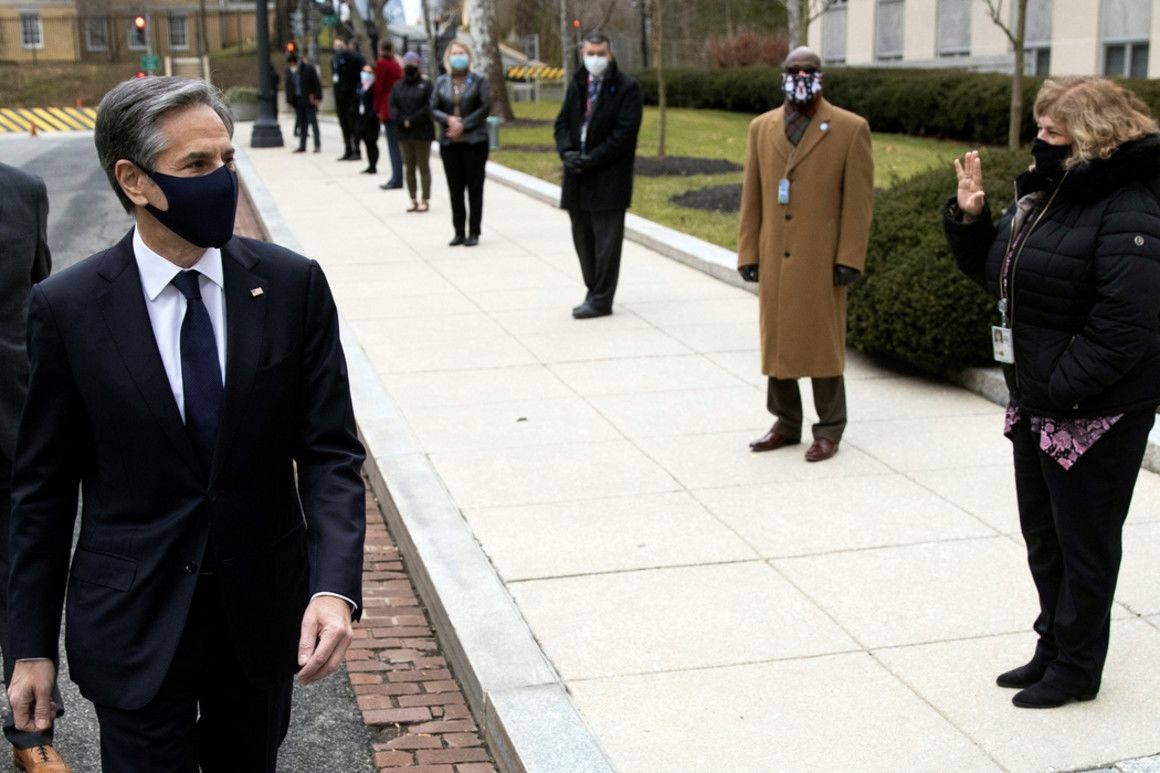 Secretary of State Antony Blinken is greeted by staff as he arrives at the State Department on Jan. 27.
Career staffers pledge to work for the government regardless of which party controls the White House and to implement the policies of whoever is in charge. Trump and many of his top aides, however, did not trust the career employees, casting them as a “deep state” bent on thwarting their agenda.
The State Department, fairly or not, was seen as a hotbed of Democrats. Several State Department career employees alleged they were mistreated by Trump’s political appointees. In some cases, independent watchdogs agreed.
Career diplomats want Blinken to make up for the turmoil they endured and to promote people from their ranks. Some note that they, after all, stoically stuck it out, whereas some of Blinken’s political appointees are former career staff members who quit to avoid dealing with Trump.
“Would I like to see more career staff joining the ranks who have a complete understanding of the past four years? Yes, absolutely. It sends a clear message to career staff,” one State Department employee said.
Blinken appears aware of these dynamics. In an email he sent to the department (subject line: “Let’s Get to Work”), he made sure to praise the “brilliant, talented, courageous women and men of the Foreign Service and Civil Service.” He also pledged to leave the State Department “stronger and more united.”
Moving on from his predecessors’ missteps
When Tillerson, the former chief executive of ExxonMobil, took over as Trump’s first secretary of State, many employees were hopeful about his plans to reform the department’s organization and appreciated his initial comments. But, almost immediately, Tillerson largely froze out the numerous career experts at State, relying heavily on a handful of primarily political aides to make decisions. By the time Trump fired him in early 2018, he was deeply disliked in Foggy Bottom.
Pompeo, who had been Trump’s first CIA chief, drew solid reviews in his early weeks. Diplomats were hopeful about Pompeo because, unlike Tillerson, he was close to Trump, and they thought that might translate into more policymaking influence for the State Department. Pompeo also reversed some of Tillerson’s decisions, such as a hiring freeze, and made sure to write punchy, positive messages to the staff, calling on them to have “swagger.”
Over time, however, many at State soured on Pompeo, in large part because he often did not stand up for their ranks against attacks from Trump or others.
In particular, U.S. diplomats were upset with Pompeo’s refusal to publicly support Marie Yovanovitch, the former U.S. ambassador to Ukraine caught up in Trump’s first impeachment inquiry. Pompeo also was perceived as overly partisan in a role whose past occupants have usually tried to stay out of the domestic political fray.
Pompeo has defended his tenure, including with a blizzard of tweets in his final days on the job, some of which focused on efforts to improve the lives of American diplomats. He said he was proud to work with the department’s men and women, calling them the “world’s finest diplomatic corps.”
“From culture, to people, to our physical infrastructure, the @StateDept is stronger today than ever before,” he wrote Jan. 18.
During his time at State, Pompeo and his wife, Susan, became the subjects of inspector general investigations into their use of government resources. One of those investigations determined that Susan Pompeo’s travels with her husband at times were not properly documented, but it sidestepped the question of whether the trips were an appropriate use of funds.
Pompeo has repeatedly said he and his wife did nothing wrong.
The Blinken-led State Department will be asked to weigh in on another, still-unfinished inspector general’s report about the Pompeos’ use of taxpayer-funded resources, a person familiar with the process said. The report may contain recommendations for policy changes that would fall to Blinken to implement.