

EU wants to train Ukraine’s army — eventually
EU officials want to up their training for Ukraine’s military as it embarks on a counteroffensive — but progress on the European level is proving slow.
While a number of European capitals are already providing military training to Ukrainian soldiers, discussions over forming an EU-level military training mission remain in their early stages.
The idea of an EU mission was discussed at an informal meeting of European defense ministers on Tuesday in Prague. And while the majority of ministers expressed support for the idea, there is still little clarity on the format and timeline for the project.
“There are many training initiatives underway, but the needs are enormous,” said the EU’s foreign policy chief, Josep Borrell, following the ministers’ discussion.
“We need to ensure the coherence of these efforts,” he said, “and I can say that all member states agree clearly on that — and on launching the work necessary to define the parameters for an EU military assistance mission for Ukraine.”
The EU’s tentative progress comes as Kyiv launches a critical counteroffensive, seeking to retake Russian-held land in southern Ukraine. Separately, officials are fretting over ongoing shelling around Ukraine’s Zaporizhzhia nuclear plant — the largest in Europe.
Noting that concrete decisions are not taken at informal meetings, Borrell said that the preparatory work for an EU military training mission now includes “contacts with Ukrainians” and looking at the “legal and operational parameters” to “define a crisis management concept that could lead to a decision on that.”
The added value of an EU mission, according to Borrell, is the ability to pool resources.
“It’s clear that some training activities that have been done by some member states are well done at the level of member states,” he said, adding that “if France provides certain type of guns, they provide [the] training. And they, better than anyone else, can provide this training because that’s their guns.”
Nevertheless, Borrell argued some of Ukraine’s needs could be addressed better by “pulling the capacities of the member states.” He cited several areas where EU training might help: logistics; military health; and providing protection against nuclear, chemical or biological weapons.
“That cannot be solved overnight, but we have to put the basis [for] an army who has to fight and will have to fight for quite a long time,” he said.
Portuguese Defense Minister Helena Carreiras, whose government has already offered Ukraine’s military training assistance, said the EU initiative is about coordination.
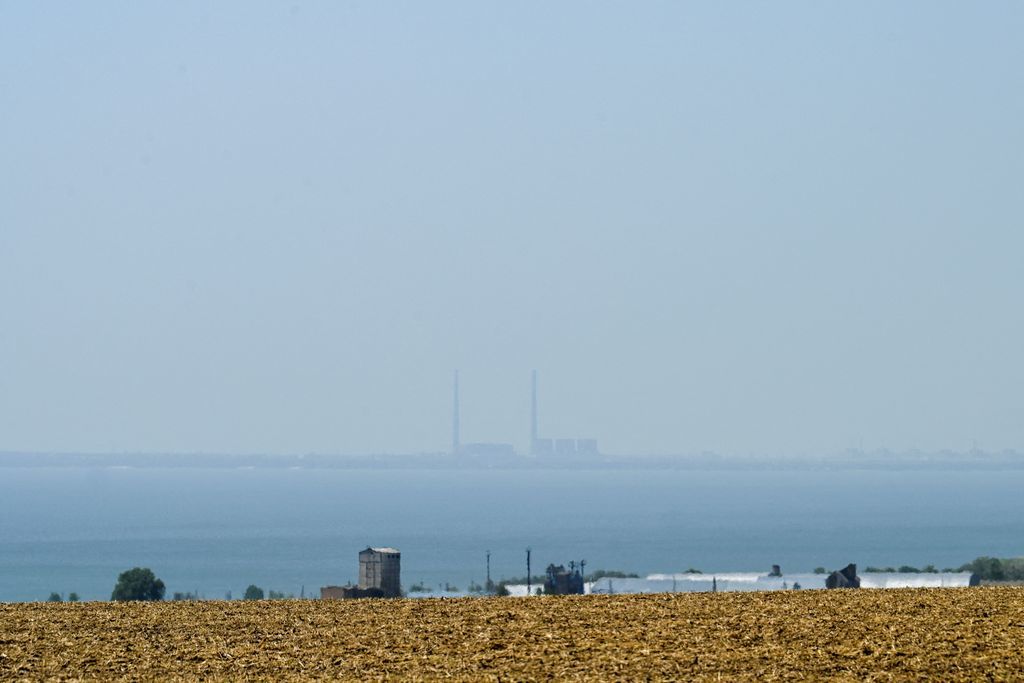 Officials are fretting over ongoing shelling around Ukraine’s Zaporizhzhia nuclear plant — the largest in Europe
“We do think it is a very good idea to promote training,” the minister said on Tuesday morning. “In a way, it’s being done already, we’re just trying to coordinate our efforts,” she added in response to a question from POLITICO.
Dutch Defense Minister Kajsa Ollongren, whose country is also involved in training the Ukrainian military, told reporters following the discussion that she supports an EU-led mission.
“I think we’re helping Ukraine by doing that,” she said, arguing it would allow the EU to “take over the coordination part, so the only thing they have to make very clear is their needs.”
But the Dutch minister also acknowledged that there are “practicalities that have to be worked upon” at this stage.
“We’re not going to wait for that,” she added. “So if we can start the training together with Germany on de-mining, we will simply start, and then later on it might be one of those EU missions.”
Some ministers underscored that they want to see the EU move faster on boosting support for Ukraine, including on training. Lithuanian Foreign Minister Gabrielius Landsbergis said the recent gap between the fulsome U.S. military offerings to Ukraine and more meager contributions from many EU countries “raises questions.”
An EU training mission, Landsbergis added in an interview, would show “we understand the responsibility” and “share the load” carried by transatlantic partners. A prolonged discussion, according to the Lithuanian minister, “fuels the notion that, you know, it’s too slow, too little, too late.”
Nevertheless, Estonia, another country already offering training, warned against duplication of efforts.
A new scheme “has to be designed so that there will be no overlaps,” Estonian Defense Minister Hanno Pevkur said in an interview, adding that it “has to be synchronized with the U.K., and also bilateral programs are in place already.”
One EU official said the aim is to make those EU countries currently less active in helping Ukraine play a bigger role. But it remains unclear whether, even if ultimately approved, the mission would involve all EU members.
Hungarian Foreign Minister Péter Szijjártó, whose country has declined to provide Kyiv with weapons, took a dismissive stance on the training discussion, arguing that each member state should make its own decision.
“This should be kept as a national competence,” he said in response to a question from POLITICO. “I think,” the Hungarian minister added, “that this should not be done at a European Union level.”

