London Daily

Focus on the big picture.
Thursday, Jan 22, 2026

Energy price cap rises to £4,279 - but Britons won't have to pay that much

Energy price cap rises to £4,279 - but Britons won't have to pay that much

The energy regulator reveals the price cap level that would have applied from January to March if households had not been shielded from the eye-watering hike by the energy price guarantee.

The amount energy companies can charge for electricity and gas will rise from January but households will be protected from the increase.

Ofgem, the energy regulator which limits the amount suppliers can charge for each unit of electricity and gas, increased its cap for the first three months of next year to 67 pence per kilowatt hour (p/kWh) for electricity and 17 pence p/kWh for gas.

This would usually see the typical household bill rise to £4,279 a year.
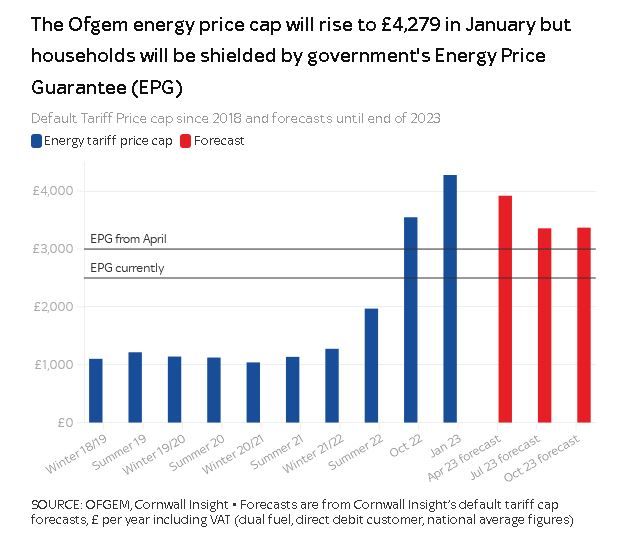


However, the government's energy price guarantee means households will be protected from the increase.

Introduced on 1 October, the guarantee limits how much the typical household pays for its wholesale energy, taking the average annual bill to £2,500.

This government cap will be in place until April next year, when the threshold is raised to £3,000.

Households will not have to pay the increase, so it may not be immediately obvious why the announcement made by Ofgem today matters.
It does because the energy price guarantee is a government subsidy, so taxpayers will still be picking up the bill, albeit indirectly.

And the cost is massive.

Along with a similar, albeit less generous scheme for business customers, the cost of the package could exceed £38bn over 18 months, according to the Institute for Fiscal Studies.

It is impossible to be precise because the actual cost depends on wholesale energy prices (fortunately for the government these have been coming down in recent months).

To put this in context, this is around half the £100bn that was spent on furlough support and the self-employee income support scheme cost over 18 months during the pandemic.

The cost would have been even higher - around £55bn - had the government not decided to taper the support from April next year. Liz Truss' government initially intended to maintain the support at an average of £2,500 for 2 years.

Economists have also warned that households could also end up paying the price through higher inflation.

The government's support has, so far, been untargeted and some people will need the money more than others. The support package represents a large stimulus to the economy at a time when inflation is running at a 41-year high.

Earlier this week the Organisation for Economic Co-operation and Development (OECD), the Paris-based thinktank, warned that the support would "increase pressures on already high inflation in the short term".

This will force the Bank of England to raise interest rates, it warned, pushing up borrowing costs across the economy.

Britain is not alone in this. France and Germany also risk falling into similar trouble, the OECD warned.

So, while the increase in the Ofgem price cap may not affect households immediately, the costs will ultimately be borne by all of us.


Newsletter

Related Articles

0:00
0:00
Close
Trump’s Board of Peace: Breakthrough Diplomacy or a Hostile Takeover of Global Order?
The Greenland Gambit: Economic Genius or Political Farce?
Will AI Finally Make Blue-Collar Workers Rich—or Is This Just Elite Tech Spin?
Prince William to Make Official Visit to Saudi Arabia in February
Prince Harry Breaks Down in London Court, Says UK Tabloids Have Made Meghan Markle’s Life ‘Absolute Misery’
Malin + Goetz UK Business Enters Administration, All Stores Close
EU and UK Reject Trump’s Greenland-Linked Tariff Threats and Pledge Unified Response
UK Deepfake Crackdown Puts Intense Pressure on Musk’s Grok AI After Surge in Non-Consensual Explicit Images
Prince Harry Becomes Emotional in London Court, Invokes Memory of Princess Diana in Testimony Against UK Tabloids
UK Inflation Rises Unexpectedly but Interest Rate Cuts Still Seen as Likely
AI vs Work: The Battle Over Who Controls the Future of Labor
Buying an Ally’s Territory: Strategic Genius or Geopolitical Breakdown?
AI Everywhere: Power, Money, War, and the Race to Control the Future
Trump vs the World Order: Disruption Genius or Global Arsonist?
Arctic Power Grab: Security Chessboard or Climate Crime Scene?
Starmer Steps Back from Trump’s ‘Board of Peace’ Amid Strained US–UK Relations
Prince Harry’s Lawyer Tells UK Court Daily Mail Was Complicit in Unlawful Privacy Invasions
UK Government Approves China’s ‘Mega Embassy’ in London Amid Debate Over Security and Diplomacy
Trump Cites UK’s Chagos Islands Sovereignty Shift as Justification for Pursuing Greenland Acquisition
UK Government Weighs Australia-Style Social Media Ban for Under-Sixteens Amid Rising Concern Over Online Harm
Trump Aides Say U.S. Has Discussed Offering Asylum to British Jews Amid Growing Antisemitism Concerns
UK Seeks Diplomatic De-escalation with Trump Over Greenland Tariff Threat
Prince Harry Returns to London as High Court Trial Begins Over Alleged Illegal Tabloid Snooping
High-Speed Train Collision in Southern Spain Kills at Least Twenty-One and Injures Scores
Meghan Markle May Return to the U.K. This Summer as Security Review Advances
Trump’s Greenland Tariff Threat Sparks EU Response and Risks Deep Transatlantic Rift
Prince Harry’s High Court Battle With Daily Mail Publisher Begins in London
Trump’s Tariff Escalation Presents Complex Challenges for the UK Economy
UK Prime Minister Starmer Rebukes Trump’s Greenland Tariff Strategy as Transatlantic Tensions Rise
Prince Harry’s Last Press Case in UK Court Signals Potential Turning Point in Media and Royal Relations
OpenAI to Begin Advertising in ChatGPT in Strategic Shift to New Revenue Model
GDP Growth Remains the Most Telling Barometer of Britain’s Economic Health
Prince William and Kate Middleton Stay Away as Prince Harry Visits London Amid Lingering Rift
Britain Braces for Colder Weather and Snow Risk as Temperatures Set to Plunge
Mass Protests Erupt as UK Nears Decision on China’s ‘Mega Embassy’ in London
Prince Harry to Return to UK to Testify in High-Profile Media Trial Against Associated Newspapers
Keir Starmer Rejects Trump’s Greenland Tariff Threat as ‘Completely Wrong’
Trump to hit Europe with 10% tariffs until Greenland deal is agreed
Prince Harry Returns to UK High Court as Final Privacy Trial Against Daily Mail Publisher Begins
Britain Confronts a Billion-Pound Wind Energy Paradox Amid Grid Constraints
The graduate 'jobpocalypse': Entry-level jobs are not shrinking. They are disappearing.
Cybercrime, Inc.: When Crime Becomes an Economy. How the World Accidentally Built a Twenty-Trillion-Dollar Criminal Economy
The Return of the Hands: Why the AI Age Is Rewriting the Meaning of “Real Work”
UK PM Kier Scammer Ridicules Tories With "Kamasutra"
×