

Covid-19 isolation gives Britain a taste of 'no-deal' Brexit chaos
Dozens of countries in Europe and around the world have halted flights from the United Kingdom, and the French government announced a 48-hour ban on truckers using ferry and rail routes from England to France after a potentially highly-infectious coronavirus mutation was blamed for a Christmas lockdown in London and the surrounding areas.
UK supermarkets and supply chain experts warned of potential shortages of some products if the French restrictions aren't eased soon. The UK government held a crisis meeting Monday.
One major supermarket chain, Sainsbury's (JSAIY), said it had stockpiled enough produce to prevent Brits going without their Christmas dinners but warned of shortages of some fresh fruit and vegetables if the situation doesn't improve soon.
"If nothing changes, we will will start to see gaps over the coming days on lettuce, salad leaves, cauliflowers, broccoli, citrus fruit — all of which are imported from EU at this time of year," Sainsbury's said in a statement. "We hope UK and French [governments] can come to a solution that prioritizes immediate passage of produce and food."
January could be difficult
Prime Minister Boris Johnson sought to assuage public fears in a press conference Monday, saying he had spoken with French President Emmanuel Macron and that both sides were working toward a quick resolution.
He stressed that British supermarket supply chains are "strong and robust," and that the "vast majority of food and medicine supplies are coming and going as normal."
The industry that operates frozen and chilled storage facilities and temperature-controlled vehicles said there was no reason for shoppers to panic, given the UK food supply chain was well stocked for the peak holiday period.
"As we learnt in March, the biggest cause of products running out on the shelves will be unnecessary and excessive buying," said Cold Chain Federation Chief
Executive Shane Brennan. "We urge everyone to play their part and buy only what they genuinely need."
But "urgent agreements" were needed between the United Kingdom and EU governments if problems were to be avoided in the new year. "An extended period of stopped movement now will cause significant problems for supply chains in January," Brennan added.
That sentiment was echoed by the British Retail Consortium, which represents over 170 major retailers plus thousands of smaller businesses.
"Retailers have stocked up on goods ahead of Christmas which should prevent immediate problems," said Andrew Opie, director of food and sustainability at the British Retail Consortium. "However, any prolonged closure of the French border would be a problem as the UK enters the final weeks before the [Brexit] transition ends on [Dec. 31]."
The Brexit factor
UK ports were already under serious strain before the new coronavirus variant sparked chaos at the border.
The United Kingdom left the European Union earlier this year but has continued to enjoy free trade with the EU market of 450 million people under transitional arrangements that expire on Dec. 31. Talks on a new agreement to avoid tariffs and quotas on about half of Britain's foreign trade remained deadlocked over the weekend, and the risk that Brexit will end without a trade deal remains high.
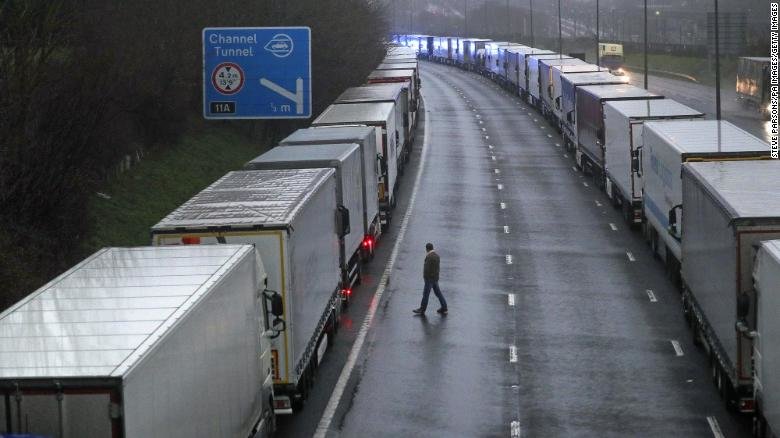
Stockpiling ahead of the end of the Brexit transition period and an increase in orders over the Christmas holiday created huge logjams in recent days. Last week, CNN journalists witnessed trucks backed up for more than 10 miles on the approach to the port of Dover, with truckers reporting waits of multiple hours.
Dover accounts for about 17% of UK goods trade. It handled 2.4 million trucks in 2019, and another 1.6 million passed through the nearby Eurotunnel under the Channel.
Businesses are increasingly worried that a Brexit deal won't materialize, and they have been racing to get goods into the country before year-end. New customs checks and paperwork will result in significant delays to shipments, while tariffs and quotas would pile on the pain in a "no-deal" scenario.
Earlier this month, Honda was forced to halt production at a major plant in England because parts deliveries were delayed, a sign of how quickly supply chain issues can cause disruptions. Honda said Monday it was monitoring the situation at UK ports, adding it currently did not anticipate any impact on production.
Toyota also said it has decided to shut its manufacturing plants in France and the United Kingdom earlier than planned for the winter break.
The company blamed UK traffic bans from a growing number of countries and the "uncertain nature of how long the borders will be closed for logistics activities."
France said Monday that it wants a new European-wide health protocol that would allow cross-border traffic to resume, while British traders are calling for truck drivers to be tested for Covid-19 in order to restore confidence.
"We have our drivers who do not want to go to the UK because of fear to not be able to come back as the borders are closed," said Vanessa Ibarlucea, a spokesperson for the French National Road Haulage Federation. "It is going to cause an issue regarding the flows which are likely to stop, and therefore cause a drying-up of supply across the Channel ahead of the Brexit day."

