London Daily

Focus on the big picture.
Tuesday, Jun 02, 2026

Calls Grow for Police Accountability in Hong Kong

Calls Grow for Police Accountability in Hong Kong

A Hong Kong court ruling has strengthened calls to establish an independent mechanism for complaints against the police amid intense outcry at home and abroad over alleged arbitrary arrests and excessive police use of force.

Once regarded as Asia’s finest, the city’s 30,000-strong police force has come under fire for actions during widespread anti-government protests that gripped Hong Kong last year. Tear gas, water cannons, pepper spray and batons were widely used by police to disperse unrelenting protesters.

On Nov. 29, the Court of First Instance ruled in favor of the Hong Kong Journalists Association, saying the existing system is inadequate for investigating complaints against the police violations of the city’s Bill of Rights on torture and cruel treatment. Also, the failure by the police to require anti-riot officers to display their numbered badges in the protests violated the Bill of Rights, the court said.

“If the government still respects the court, it should take the responsibility to rectify the problems,” Eric Cheung Tat-ming, principal lecturer and director of clinical legal education at the University of Hong Kong said.

“If the government loses its appeal case [in the Court of Appeal], it will have to take some time to come up with a new mechanism. If the officials ignore the judge's suggestions, it will be considered overturning the ruling,” he said.

Cheung reiterated calls for an independent body to process complaints and redress misconduct as well as any false accusations against police officers. Backers of the calls include pro-government legislators.

“By doing so, the government can restore public confidence in the police,” Cheung said. “By the same token, if the complaints against the police are invalid, it won’t be fair to them that the system is inadequate.”

He added that the government will have to come up with ways to address the two main issues the judge has raised in the verdict -- the absence of independent oversight in the existing police complaint mechanism and police officers’ failure to display their badges.
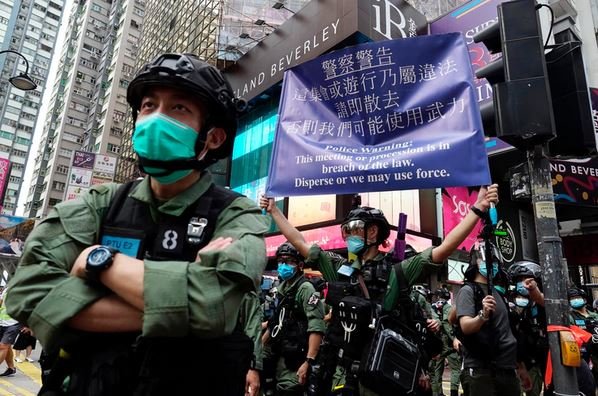

A police officer displays a warning banner on Oct. 1, 2020, China's National Day, in Causeway Bay, Hong Kong.


C.M. Chan, a lawyer and head of Centre for the Rule of Law of Hong Kong Policy Research Institute, an independent think tank, suggested that the Hong Kong government set up something similar to the Independent Police Complaints Commission in Britain, which he describes as a “tiger with teeth” as it has the authority to initiate investigations.

“From a good governance point of view, the government should listen to the court’s recommendations,” he said, adding that, "At present, you make a complaint against the police and the complaint goes to the police and the IPCC only monitors their investigations," he said, referring to Hong Kong’s Independent Police Complaints Council.

Under the current two-tier mechanism, the Complaints Against Police Office, a unit within the police force, refers reportable complaints to the IPCC, which is responsible for monitoring and reviewing reportable cases. However, it cannot overturn Complaints Against Police Office conclusions or initiate investigations.

Veteran Hong Kong-based China-watcher Johnny Lau Yui-siu has painted a less optimistic picture. He said, “The government may just indicate they respect the court’s ruling but brush aside any need to introduce reforms to the existing police complaint system.”

Nevertheless, he sees the court judgement as a step toward a long process in cracking the Chinese Communist Party’s grip on Hong Kong. “It will have a snowballing effect in pushing for changes,” he said, adding that Chinese President Xi Jinping’s purported “law-based governance” is a sign that Beijing cannot ignore the fact that authorities must act according to the law, even though they try to sugarcoat arbitrary policies.

Chan also said he has reservations about how willing Hong Kong authorities are to heed the court’s recommendations.

“We have to accept that the Hong Kong government operates within the parameters of the one-country-two-systems, we can’t draw complete parallels with most Western societies,” he said, referring to the arrangement under which Hong Kong retains its legal system and wider civil liberties than those in mainland China.
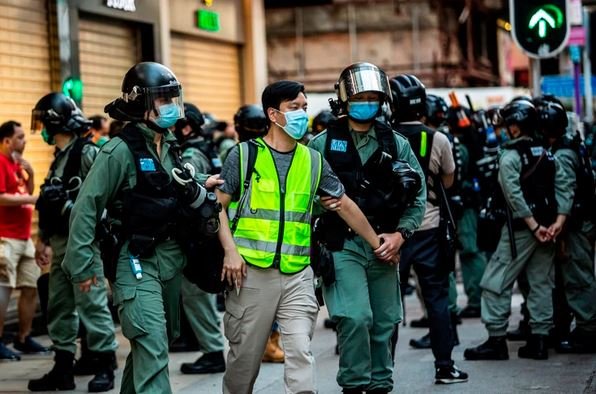

Police arrest a man and lead him to a nearby bus during a protest against China's planned national security law in Hong Kong on June 28, 2020.


As of August, the police complaints office had received 1,895 complaints, including 199 from the media that have been referred to the IPCC.

Last year, a panel of international experts appointed by the IPCC to probe allegations of excessive police force during the protests resigned collectively. The panel said in a statement that the IPCC lacked the powers necessary “to meet the standards citizens of Hong Kong would likely require” in a society that “values freedom and rights.”

In a report, Policing: A Journal of Policy and Practice, published last month, Clifford Stott, a British panel member who stepped down, said, “Hong Kong police played a pivotal role in radicalizing protests.”

Police Commissioner Chris Tang said the force will appeal the High Court's decision that officers' failure to show their identification numbers constituted a breach of the Bill of Rights.

Hong Kong’s Beijing-backed Chief Executive Carrie Lam has repeatedly said that the existing mechanism is sufficient to deal with complaints and there is no need to set up an independent system.

Newsletter

Related Articles

0:00
0:00
Close
Japanese Technology Firm Fujitsu Launches Advanced Artificial Intelligence Tool for Corporate Disclosures
South Africa Officially Launches Nationwide Campaign for Highly Contested Local Government Elections
United Kingdom Commits Additional Funding for Unexploded Ordnance Clearance in Laos
Singapore Announces Stringent New Greenhouse Gas Regulations for Commercial Cooling Systems
Cambodia and Thailand Hold High-Level Border Security Talks at United Nations Headquarters
Myanmar Military Government and China Sign Major Agreement to Upgrade Media and Cultural Cooperation
Knife Attack at Swiss Train Station Leaves Three Injured in Suspected Act of Domestic Terrorism
Transnational Extortion Gang Threatens Canadian Police With Army of One Thousand Armed Operatives
Australia Imposes Forty-Two-Day Quarantine on Cruise Ship Passengers Following Deadly Hantavirus Outbreak
International Monetary Fund Unlocks Seven Hundred Million United States Dollars for Sri Lanka Following Economic Reforms
Australia Launches Record One Point Four Billion Dollar Lawsuit Against Chemical Giant 3M Over Contamination
China and Canada Foreign Ministers Meet in Ottawa in Effort to Stabilize Strained Diplomatic Ties
Indonesia Demands Urgent United Nations Security Council Reform Amid Escalating Global Conflicts
Extreme Weather Patterns Trigger Severe Drought in Madagascar and Destructive Flooding in East Africa
Indian State of Karnataka Faces Political Upheaval as Chief Minister Siddaramaiah Abruptly Resigns
Philippines and Japan Reaffirm Defense Ties as Crucial for Indo-Pacific Regional Stability
Norway Joins French Nuclear Deterrence Initiative in Major Shift for European Security Architecture
Global Critical Mineral Alliances Expand as Western Nations Move to Counter Chinese Supply Dominance
United States Imposes Fifty Percent Tariffs on Mexican Steel and Aluminum Ahead of Trade Pact Review
European Union and China Head Toward Major Trade Conflict Over Clean Technology Exports
United States Economic Growth Severely Downgraded to One Point Six Percent as Stagflation Fears Mount
World Health Organization Warns Central African Ebola Epidemic is Outpacing Containment Efforts
United States Treasury Department Conditions Sanctions Relief on Reopening of the Strait of Hormuz
Iranian Air Defenses Intercept and Destroy United States Military Drone Over Bushehr Province
Iranian Armed Forces Launch Ballistic Missiles Toward Unspecified Targets Prompting Regional Condemnation
United Nations Secretary-General Warns Global Order Facing Highest Level of Conflict Since 1945
Israel Issues Sweeping Evacuation Orders in Southern Lebanon Amid Intensified Hezbollah Conflict
Russia Announces Systemic Military Strikes Targeting Ukrainian Defense and Energy Infrastructure
United States and Iranian Negotiators Reach Draft Agreement to Extend Ceasefire and Resume Nuclear Talks
United Nations Security Council Deeply Divided Over United States Capture of Venezuelan President
US and Iran Exchange Direct Military Strikes Amid Fragile Gulf Ceasefire
World Health Organization Warns of Catastrophic Ebola Outbreak in DR Congo
Russia Threatens New Wave of Strikes on Ukrainian Infrastructure and Embassies
Scientists Warn Atlantic Ocean Currents Could Collapse Faster Than Projected
Anthropic Reaches $900 Billion Valuation in Historic AI Funding Round
Washington Imposes Crippling Sanctions on Iranian Maritime Authority
Japan and the Philippines Initiate Strategic Intelligence-Sharing Pact
Microsoft Deploys Autonomous Computer-Using AI Agents to Global Markets
Anthropic Secures $45 Billion Compute Infrastructure Agreement With SpaceX
U.S. Director of National Intelligence Resigns Amid Administration Shakeup
Micron Technology Crosses Trillion-Dollar Valuation Amid Unprecedented Hardware Demand
Canada and Germany Finalize Historic Long-Term LNG Export Agreement
China Expands International Travel Restrictions on Domestic AI Researchers
Japan Approves Sweeping Overhaul of National Intelligence Apparatus
Global Airlines Scramble Logistics as Middle East Airspace Remains Fractured
Japan's Naphtha Imports Plunge 47 Percent Amid Strait of Hormuz Closure
Global Crude Prices Retreat Below $96 as Gulf Tensions Momentarily Ease
Generative AI Outperforms Human Baselines in Landmark Global Creativity Study
NASA Partners With Private Aerospace to Unveil Permanent Lunar Base Architecture
South Korean Equity Markets Surge on Next-Generation Memory Chip Frenzy
×