

Call for urgent review into exam results 'fiasco'
A union for education leaders, such as head teachers, says it will write to Gavin Williamson over the "fiasco".
Mr Williamson apologised to students after reversing how A-levels and GCSEs are graded, following heavy criticism.
Meanwhile, pupils will get GCSE results on Thursday as planned, the Joint Council for Qualifications (JCQ) said.
The confirmation comes following confusion over how results day would run after the government U-turn.
Julie McCulloch, director of policy at the Association of School and College Leaders (ASCL), said the JCQ's confirmation would be a "great relief" to all concerned.
The government decision to give A-level and GCSE students grades estimated by their teachers, rather than via an algorithm, means that tens of thousands of A-level students may now have the grades to trade up to their first-choice university offers.
It has prompted concerns about the number of available places, with top universities warning that students who now have higher grades could still be asked to defer if there is no space left on their chosen course.
And uncertainty continues for students as the admissions service, Ucas, and individual universities have yet to be given access to the upgraded results.
Alistair Jarvis, chief executive of Universities UK, which represents vice-chancellors, said problems could arise around issues of "capacity, staffing, placements and facilities - particularly with the social distance measures in place".
Universities minister Michelle Donelan said she wanted to ensure any students who had accepted a "different course" than planned, as a result of being downgraded last week, should be able to "change their mind and to reverse that decision".
She said No 10 was working with universities to help "boost the capacity available" in order to "minimise the amount of students that will be looking to defer."
Senior Tory MP Huw Merriman suggested students could be compensated with reduced tuition fees.
"For the cohort coming up to university, I think it's all about making it up to them and saying 'we understand that you have been messed around over last week'," he told the BBC's PM programme.
Analysis
By Hannah Richardson, BBC education reporter
There is still doubt as to whether the education system will do right by the Class of Covid.
Will their chosen universities be able to accommodate them? Or have they given their degree place away already? Will they have to come back next year and fight it out with students who have missed even more school?
And for the first time since this ageing education journalist can remember, exam boards are not holding their usual mind-boggling briefing on GCSE results.
So for some time at least, there will be no details of how the nation has done in their general school certificate examinations.
Roll on the start of term - although that's uncertain, too.
Hundreds of thousands of children in the UK have had their education disrupted by the pandemic after schools, colleges and nurseries were ordered to shut in March - resulting in the cancellation of all assessments and exams.
The ASCL - which is writing the letter to Mr Williamson - said a review was urgently needed into "what went wrong" with the grading system.
"This degree of transparency is necessary at a time when public confidence has been badly shaken," said ASCL general secretary Geoff Barton.
Mr Barton also called on No 10 and Ofqual to put in place a "robust contingency plan" for students sitting GCSEs and A-levels next summer in the event of further coronavirus-related disruption.
Student stories: Frances and Zainab
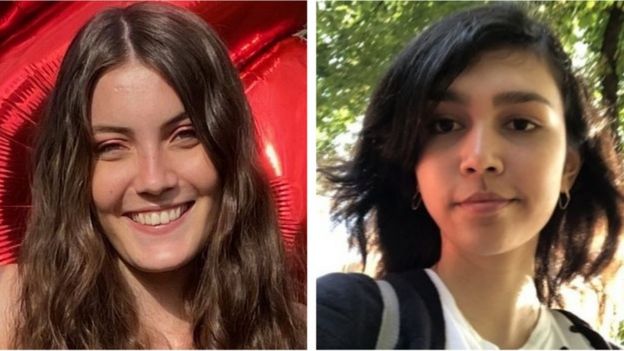
Frances Ramos, 18, from Towcester, Northamptonshire, said she was pleased to be given her predicted grades of ABB - up from the BCD she received last Thursday.
But she said the U-turn "does feel like it's a bit too late" and added: "I kind of wish the government had done this on Thursday." She is now waiting to hear if her first choice, the University of Liverpool, will accept her to study this year.
Zainab Ali, 18, from London, also thought the government should have acted sooner. "I think it's a shame. After the damage is done, that's when they will take action and I find it quite frustrating," she said.
The U-turn should now mean Zainab is able to attend Queen Mary University, London.
The University and College Union (UCU) and National Union of Students (NUS) have also written to the education secretary, urging No 10 to help students who have missed out on their first-choice courses and calling for financial support for the higher education sector.
UCU general secretary Jo Grady said staff were facing "unbearable workloads" due to the fallout over exam results.
She added that "substantial financial support" was needed "so universities can protect all jobs, safely welcome students and continue to provide world class teaching and research".
And Ms Grady criticised Mr Williamson's decision to suspend a cap on student numbers for universities - effectively allowing institutions to accept unlimited numbers this year - because she said it meant "certain universities can hoover up students, hitting the finances of other institutions".
Despite the cap being suspended, some universities have said numbers will have to remain limited, particularly on vocational courses such as medicine and dentistry.
Ucas was unable to say how many students had not been able to take up places due to their results being downgraded.
Earlier, Mr Williamson said he was "incredibly sorry for the distress" caused to pupils.
Mr Williamson said it had been the common view of the government, exams regulator Ofqual, and the devolved administrations in Wales and Northern Ireland - of different political parties - that the system in place was more robust and "significantly better" than that in Scotland, after an earlier U-turn in Scotland.
But after the release of A-level results on Thursday he said it had become "increasingly apparent that there were too many young people that quite simply hadn't got the grade they truly deserved".
Mr Williamson's critics had called for him to resign or be sacked, but there are several reasons why he hasn't yet received a ministerial P45, says BBC political correspondent Iain Watson.
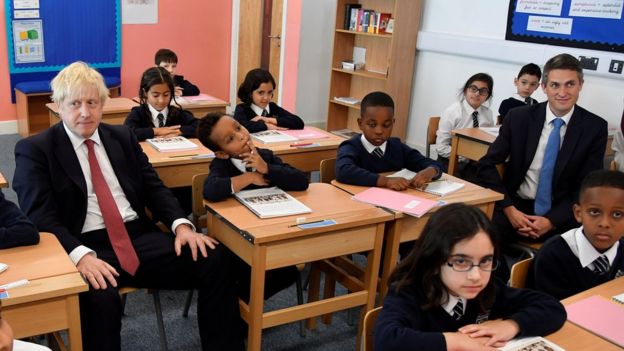
Ofqual's algorithm came under fire after data showed its downgrading of about 40% of A-level grades in England had affected state schools more than private institutions.
Ministers in England, Northern Ireland and Wales all decided on Monday - four days after A-level results were issued - to revert to teacher assessed grades rather than the algorithm.
The U-turn means teachers' assessments will also be used for all GCSE results - except for any students for whom the algorithm gives a higher grade.
Exam board Pearson, which awards BTecs, has said students' results that were adjusted downwards through the awarding process - only about 0.5% of the teachers' grades - will be reviewed on a "case-by-case basis" with their colleges.
A Pearson spokeswoman added it was aware of delays in some students getting their results and was working with schools and colleges to provide any that were outstanding as soon as possible.
Timeline: Government's changing position
* 11 August: Gavin Williamson announced A-level students would be able to use their results in mock tests to appeal if they are unhappy with the grades they are given, calling it a "safety net". Earlier in the day Scotland's government decided to switch to teachers' predicted grades
* 12 August: Nick Gibb, schools minister for England, acknowledged the government was "concerned" about what had happened in Scotland but insisted the system in England remained "robust"
* Thursday 13 August (results day): Mr Williamson ruled out following the Scottish government in reversing position, telling Sky News: "You've got to have a system that has checks and balances". Prime Minister Boris Johnson said the results were a "robust set of grades"
* Saturday: Mr Williamson told the Times there would be "no U-turn" on the grading system, saying Scotland had ended up with "a system where there aren't any controls" and had "rampant grade inflation"
* Sunday: Mr Williamson defended Ofqual's grading method in the Sunday Express, saying the calculated grade "makes certain that everyone can be confident that these qualifications carry the same weight as previous years"
* Monday: Mr Williamson announces a move to teacher-assessed grades for A-levels and GCSES saying "we now believe it is better"