

Brexit: NI will get medicine at same time as GB, EU proposes
The protocol means Northern Ireland is still inside the EU's pharmaceutical regulatory system.
However, it gets most of its medicines from Great Britain, which is not.
The EU says its new proposals mean medicines entering NI from GB will not need additional labelling or testing.
European Commission Vice-President Maroš Šefčovič said a commitment to ensure the supply of medicines into Northern Ireland was being turned into "a lasting solution".
He added that the protocol "has the flexibility to work on the ground".
The Northern Ireland Protocol is a mechanism designed as part of the Brexit talks to avoid a trade barrier on the island of Ireland.
It has, however, led to criticism from some unionists who argue it has caused disruption and placed a border in the Irish Sea with Great Britain, as it keeps Northern Ireland aligned with many EU rules.
Analysis: What is the EU proposing?
For generic drugs like paracetamol, the UK regulator can continue to approve drugs for NI.
Companies located in GB can continue to use the the same pack and leaflet for all parts of the UK.
There will be no need for NI-specific packaging.
All regulatory functions, like batch testing, will remain wherever they are now in the UK - no need to relocate any testing facilities from GB to NI.
For new medicines, like cancer drugs, any product authorised in the UK can be supplied to NI, until the relevant authorisation is also given in the EU.
The EU says this "bridging solution" is in addition to the existing compassionate and emergency use early access mechanisms under EU law.
For all types of medicines, no manufacturing authorisation or import licence will be required for bringing medicines into NI from the rest of the UK.
In addition, EU medicine unique identifiers won't have to be removed from products transiting through GB to NI and the reaffixed when entering NI.
However this derogation is only for three years, which the EU says will allow more time for industry to adapt.
On Friday, UK Brexit Minister Lord Frost said there had been progress on dealing with medicines and the EU proposals followed discussions between the two sides.
"They could constitute a constructive way forward, and we are willing to look at them positively but as we have not been able to scrutinise the texts in the necessary detail, we are not yet able to make that judgement with full confidence," he said.
However, Lord Frost added that talks on other issues, such as customs and on sanitary & phytosanitary (SPS) products are not "yet close to delivering outcomes which can genuinely solve the problems presented by the protocol".
He said a solution "needs to be found urgently early next year".
The minister suggested that plans presented by the EU in October "constituted a step forward", but "it is not possible to envisage an agreed solution which does not deliver significant change in this area".
Earlier, the UK government indicated the European Court of Justice could have a role in the protocol - a significant softening of its stance.
This could involve rulings on issues of EU law, but not having the final say in protocol disputes.
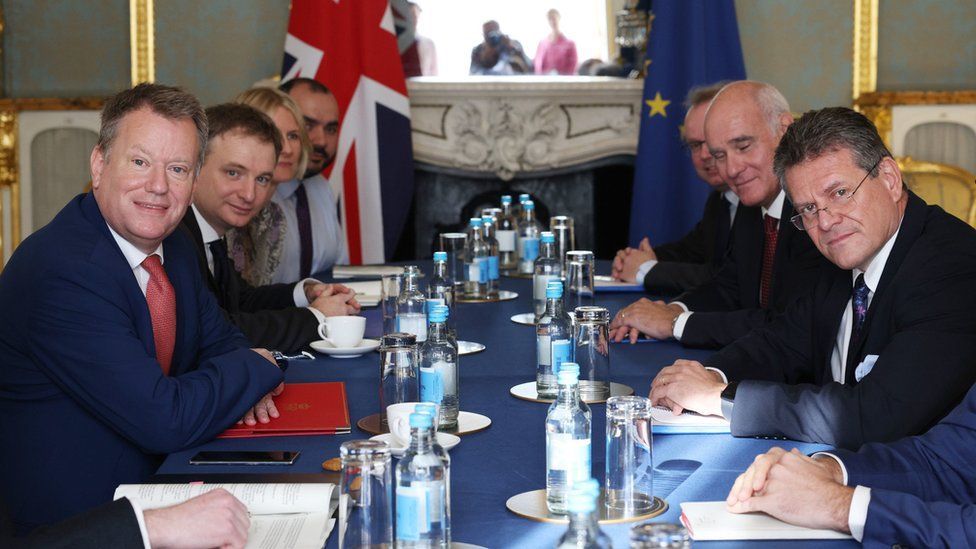 Brexit Minister Lord Frost and European Commission Vice-President Maroš Šefčovič are leading talks on the NI Protocol
But Mr Šefčovic said the EU was not ready to discuss the role of the ECJ in Northern Ireland Protocol negotiations.
What has the reaction been?
Irish Foreign Minister Simon Coveney said the proposals on medicines should "provide reassurance to people across the island that they will continue to have access to the medicines they need".
"I hope that this solution on medicines can act as a catalyst for solving the other protocol issues early in the new year," added Mr Coveney.
Mr Šefčovič said the issue of medicines "shows that the EU and the UK can work together" and he wanted to "carry this momentum into the other areas of discussion".
First Minister Michelle O'Neill, of Sinn Féin, who spoke to Lord Frost earlier on Friday, said the medicines development demonstrates that "when there is political will to do something that it can be achieved".
"I welcome the fact that we're not on a cliff-edge now on this crucial issue of medicines, but that good-will now needs to apply now to the other issues that need to be resolved," she said.
"The protocol is here to stay and for those that are going to be dishonest and say that it's going to be done away with, that's a falsehood.
Meanwhile, Democratic Unionist Party (DUP) leader Sir Jeffrey Donaldson said the EU should not have a role in how Northern Ireland has access to medicines.
"A foreign power should have no role in dictating to this part of the United Kingdom whether we can access medicines the same as the rest of the United Kingdom."
He also warned that he will remove his ministers from the executive if the government fails to act "immediately" to remove the Irish sea border.
"This cannot go on, it is not sustainable and if the UK government is not prepared to act decisively, then we will and I will follow through with what I said I would do."
Ulster Unionist Party leader Doug Beattie said that the "problem should not exist in the first place as medicines should not form part of the protocol".
'Put patients at ease'
Mr Beattie said they had been meeting with UK and EU representatives, including Lord Frost and Mr Šefčovič this week.
"We were told that the EU had reached their bottom line and any further changes to the protocol were impossible," he said.
"But we have demonstrated that this is not the case and we will continue to negotiate for further changes on trade, the role of the European Court of Justice and the democratic deficit faced by Northern Ireland."
Deputy leader of the Alliance Party Stephen Farry said this was a "very welcome development" but said that their party will need to "of course study the detail" of this development.
"Hopefully this now provides a sustainable solution to one of the particular challenges posed to NI by Brexit," the MP for North Down said.
Traditional Ulster Voice (TUV) leader Jim Allister has said the medicines dispute "merely highlights necessity of scrapping the protocol" and said the EU "has no interest in serious change".
Community Pharmacy NI chief executive Gerard Greene said the organisation would need to examine the proposals in more detail.
"The EU proposal should help to put patients at ease who were concerned about accessing key medicines at the end of the current grace period and going into 2022," he said.
"It is important that the respective UK and EU governments continue with their discussions and negotiations to ensure a long-term agreement is reached."