

‘Ambition greater than ability’: Liz Truss’s rise from teen Lib Dem to would-be PM
Liz Truss is tantalisingly close to acquiring the keys to No 10. But her constituency party members recall a meeting when the question of her entering parliament at all hung in the balance, after she was accused of failing to disclose an extramarital affair to activists.
It was 2009 – 12 years before she would be elevated to her current role as foreign secretary – and she was on the verge of finally becoming an MP after being selected to stand in the safe seat of South West Norfolk.
Dozens of hardline, rural Tory activists, dubbed the “Turnip Taliban”, had called an urgent meeting, angry that an 18-month affair with the Conservative MP Mark Field had not been disclosed when she was endorsed as a candidate. Some wanted her to stand down because they believed she was being parachuted in by unwanted moderates under David Cameron’s leadership.
Roy Brame, a self-declared member of the Turnip Taliban, had gone to the packed meeting convinced she should not stand in the safe seat at the next general election. But instead, he recalls Truss winning over a sceptical audience with a characteristic mix of charm and a thick skin.
He voted against her that evening, but Brame said he was impressed by her responses, telling reporters after the meeting: “We have just seen the new Thatcher.”
“People say that she’s not very good at presenting herself. But at that particular meeting, when well over 200 [people] were asking her some personal questions, and a lot about where she thought she wanted to go, she came over extremely well,” he said.
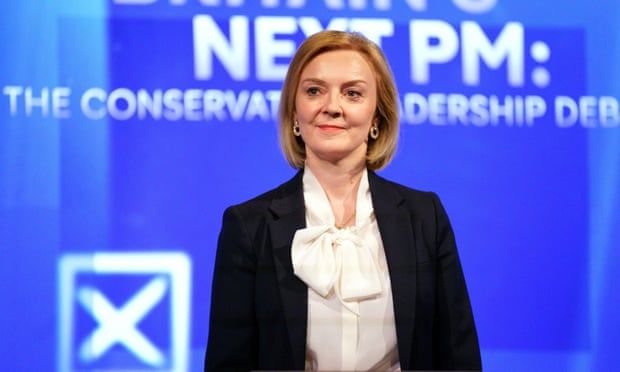 Liz Truss in a Margaret Thatcher-inspired pussybow blouse.
Truss survived the meeting – local websites claimed that the Turnips had been mashed – and won a vote supporting her as the candidate by 132 votes to 37.
Thirteen years later, Truss has now held six ministerial jobs under three different prime ministers – and in 2016 became the first female lord chancellor. Crucially, she appears to have currently won over a majority of the 160,000 Tory party members who will choose the next prime minister in September.
The comparison with Thatcher is one that has been pushed hard by her team. From wearing a pussybow blouse, to driving tanks and being photographed wearing a fur hat in Moscow’s Red Square, they claim Truss is ready to shake up the Tory establishment just as her hero did.
She was raised by Labour-supporting parents, was a Liberal Democrat, and went to what she describes as a “woke” comprehensive school in the north of England. All qualities she has been keen to promote against the Wykehamist, internationalist credentials of Sunak.
Her critics – and she has many within her own party – say she lacks many of Thatcher’s skills. She fails to display intellectual gravitas, they say, relying instead upon cheap slogans, and struggles to make convincing speeches, another facet of her character that could be quickly exposed under the intense scrutiny of Downing Street.
Dominic Cummings, Boris Johnson’s former chief adviser, told the online magazine UnHerd in May that Truss was “as close to properly crackers as anybody I have met in parliament” and would be an “even worse” prime minister than Johnson.
Others doubt if Truss really believes anything she says, and relies upon a gut instinct to fulfil her own ambitions. Anna Soubry, the former MP who served as a minister alongside Truss, said many had questioned whether she had the skills necessary to lead the UK.
“She was the most ambitious person many people had encountered. I honestly believe she was given jobs – ministerial promotions – just to shut her up. Her ambition is, undoubtedly, considerably greater than her ability,” said Soubry.
Mary Elizabeth Truss was born in Oxford on 26 July 1975, the eldest of four siblings and the only girl. Her left-leaning father, John Kenneth Truss, was a professor of pure mathematics at the University of Leeds. Her mother, Priscilla Mary, was a nurse, teacher and prominent member of the Campaign for Nuclear Disarmament.
They lived in Paisley for some of Truss’s childhood, before moving to Leeds. Truss has sought to portray her former senior school, Roundhay – which sent her and many others to Oxford University – as repeatedly letting children down with “low expectations, poor educational standards and lack of opportunity”. Too much talent, she declared, “went to waste”. She even claimed it was within a “red wall” seat.
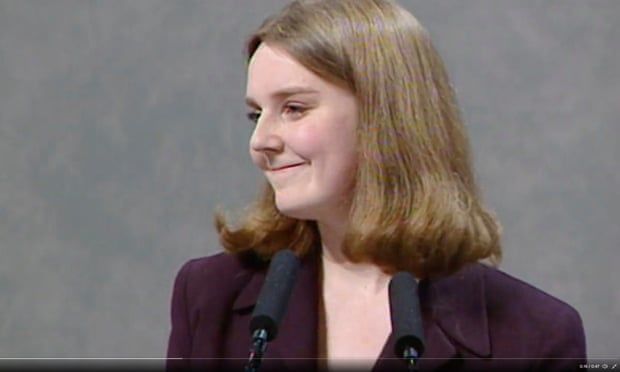 Liz Truss speaks at the 1994 Liberal Democrat conference, in which she discusses ‘abolishing the monarchy’.
Her claim seems to have surprised former fellow pupils. The school is part of Leeds North East, a constituency that had voted Conservative for almost half a century until 1997. It was a rugby union-playing ex-grammar set in 22 acres of grounds in a well-to-do part of the city. Alumni include a university vice-chancellor, judges, neuroscientists, an award-winning playwright, four current or former parliamentarians and a former editor of the Sunday Telegraph.
Lord Kirkhope of Harrogate, the Tory MP for Leeds North East when Truss was a pupil at Roundhay, said he knew the school well at that time and claimed Truss’s comments appear to be “patently untrue”.
He said: “I think she was suggesting she was the only person who went to any sort of university and all the others were poor, inner-city kids, which was certainly not the case for Roundhay ... Politicians in this sort of situation should be very cautious about what they say because they have a knock-on effect to the staff and former pupils.”
Truss read PPE at Merton College, Oxford, and became a leading member of the Liberal Democrats. At the party conference at the age of 19, she called for the abolition of the monarchy. “We do not believe people are born to rule,” she said.
Fellow former Lib Dem members said the intervention angered the late leader Paddy Ashdown, who had been assured she would remit the motion and avoid a vote. But the vote took place, drawing unwanted publicity for the party leader. “Paddy was not forgiving of those responsible for hijacking the conference,” said Lord Rennard, then a senior party figure.
At one freshers’ week, Lib Dem members including Alan Renwick, a friend of Truss who is now an academic on constitutional affairs, were decorating a stall and Truss, then a believer in cannabis legalisation, had a particular vision of how it should look. “She wanted the whole stall to be covered with these posters saying: ‘Free the Weed’, so I was scurrying around after Liz, trying to take these down again and put up a variety of different messages rather than just having this one message all over the stall,” Renwick told BBC Radio 4. She was putting them up again just as quickly.
Truss was an enthusiastic participant in Oxford’s Hayek society, which celebrated the work of the Austrian political philosopher best known for his defence of classical liberalism. The same group included other Lib Dems who went on to become Tories.
“She was incredibly difficult to work with,” recalled Neil Fawcett, now a Lib Dem councillor, who campaigned alongside her in the 90s. “On a personal level, I could never really work out what she actually believed because she always seemed to be playing to the gallery, rather than putting forward a genuine belief.”
Truss joined the Conservatives in 1996 when the party was being torn apart by factionalism under John Major’s leadership. The following year she met her future husband, Hugh O’Leary, an accountant, at Conservative party conference, and they married in 2000.
At 25, she made her first steps towards parliamentary politics, taking on the dispiriting task of carrying the Tory message into a northern seat in the Labour heartlands. In 2001, she contested Hemsworth, in West Yorkshire, and secured a 4% swing from Labour to Conservative, which brought the Labour majority down from nearly 24,000 to less than 16,000.
To improve her chances of securing a more winnable seat next time, she was assigned Field, the MP for Cities of London and Westminster, as a mentor and soon after their relationship began. His marriage of 12 years ended in divorce, while hers survived.
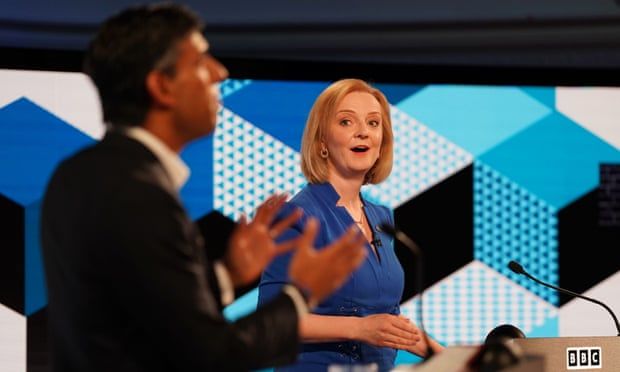 Liz Truss, right, and Rishi Sunak take part in the BBC Conservative party leadership debate in Stoke-on-Trent.
After David Cameron became the Conservative leader, Truss was placed on the “A-list” of parliamentary candidates, and was tipped to be the next MP for the Tory seat of Bromley and Chislehurst, through a byelection after the death of the local MP. But after the Daily Mail broke the story of her relationship with Field, Truss was informed she would not be the candidate.
After finally winning over the executive of the South West Norfolk Conservative party in 2009, Truss was elected to parliament the following year with a 13,140 majority. Once in parliament, she founded the Free Enterprise Group of MPs, championing deregulation and lower taxes. She co-authored Britannia Unchained, a pamphlet that described the British as “among the worst idlers in the world”.
After a junior education role, Truss was appointed as environment secretary in 2014 for two years, during which she became a meme after a cringeworthy speech at Conservative party conference. “Britain imports two-thirds of its cheese,” she said cheerily, before quickly changing her expression to one of dark foreboding. “That. Is. A. Disgrace.”
Her supporters insist Truss really is one of the people – she does not enjoy public speaking and prefers a closed meeting or a party. Knowing that her staccato delivery is regularly mocked, she has attempted to take the sting out of the criticism by saying she knows she is not the most polished of performers.
During the EU referendum, she argued for remain, signing a cross-party declaration with Ed Miliband, Ed Davey and Caroline Lucas which described leave campaigners as “extreme and outdated”. After the referendum, she performed a 180-degree turn and is now one of the most vociferous supporters of leave.
Under Theresa May, Truss was appointed justice secretary, a job that quickly ran into trouble. She initially failed to defend the judiciary after they were branded “enemies of the people” by the Daily Mail because they ruled parliament had to be given a vote on triggering Brexit. Truss later issued a statement supporting the judges but this was seen as too little, too late.
Her actions drew unprecedented criticism from Lord Thomas, the lord chief justice, who told MPs she had been “completely and absolutely wrong”.
She was demoted to become chief secretary to the Treasury, but she embraced the change. In fact she became increasingly mischievous, reprimanding the then environment secretary Michael Gove publicly in one speech. “Too often we’re hearing about not drinking too much … eating too many doughnuts … or enjoying the warm glow of our wood-burning Goves … I mean stoves,” she said. “I can see their point: there’s enough hot air and smoke at the environment department already.”
Her office has gained an unwanted reputation among cabinet colleagues for leaking stories. It was often assumed that the leaks came direct from Truss, but her friends have denied this.
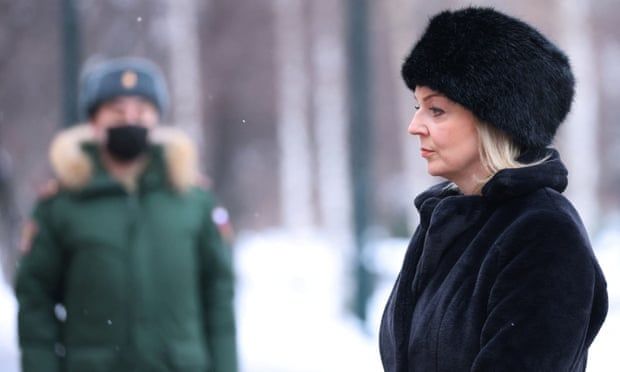 Liz Truss in Moscow in February. As foreign secretary, Truss has documented her jet-setting diplomatic trips on social media.
After May’s resignation, Truss became one of the first cabinet ministers to support Johnson’s bid to lead the party. She was appointed international trade secretary and for two years signed trade deals across the world.
As foreign secretary Truss has become increasingly active on social media, exhaustively documenting her jet-setting diplomatic trips around the world.
Her condemnation of Vladimir Putin’s actions in Ukraine – which saw Russian officials explicitly cite comments she made in a BBC interview as the reason for its decision to place the country’s military on high alert – has led to a rise in popularity within the Tories.
Her solution to the impasse over the Northern Ireland protocol was to scrap large parts of that agreement. Critics said she risked a trade war with the EU and had damaged the UK’s reputation for adhering to international law.
Her supporters say that her creative thinking also meant that she secured the release of Nazanin Zaghari-Ratcliffe, a task that had eluded three previous foreign secretaries. She enlisted Oman as an intermediary and paid a historical debt to Tehran.
For many of the MPs who are backing Sunak, she is also the “Johnson continuity candidate”. They are fuming that she appears to have won over the party.
“If she wins, you will see pretty much the same groups of people – the same Crosby Textor [global consultants] types and the same donors. Liz is certainly very determined to get there, but the people won’t change that much and no one really knows what she might do if she gets there,” an MP said.
Truss has been approached for comment.