

Almost 124,000 patients waiting more than three months for NHS tests in England
NHS patients are waiting more than three months for tests including MRIs, colonoscopies and heart scans, with overall waiting lists doubling in some parts of England.
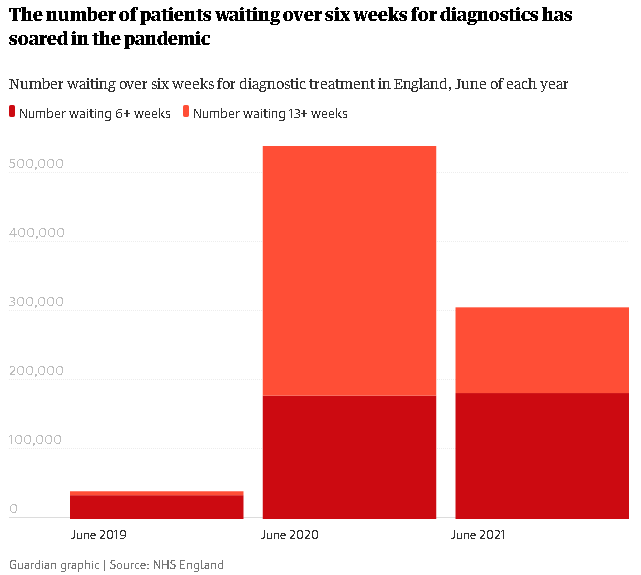
The number of people waiting more than three months for tests was 22 times that in 2019 as the health system continues to tackle the Covid pandemic backlog. Almost 124,000 people were kept waiting more than three months in 2021, compared with 5,675 in 2019. It is a slight fall from the May 2021 figure, which stood at just over 127,000.
People referred to hospital for tests are supposed to be treated within six weeks, according to NHS England’s constitution. But more than 306,000 people were waiting more than six weeks for a range of diagnostic tests. This is 7.6 times the equivalent figure in the same month in 2019, but lower than in June 2020 – by which time services had been massively disrupted by the pandemic and lockdown – when 539,433 people were waiting six weeks or more.
The overall waiting list for tests in June was 1.4 million patients, an increase of 28% compared with June 2019.
Dr Richard Vautrey, the chair of the British Medical Association’s GP committee, described the waiting lists for diagnostic tests as “incredibly concerning”.
He said: “GPs do not refer patients for diagnostic testing unless absolutely necessary in order to make a formal diagnosis. So, when we put this into perspective, such a drastic estimated increase in the diagnostic waiting list represents a healthcare crisis. Behind these figures are patients who are left waiting far too long for a diagnosis and therefore treatment.
“Evidence tells us that for conditions such as cancers, early diagnosis and subsequent treatment can have a significant impact on a patient’s chance of survival. As such, the BMA can’t stress enough how important it is that the government urgently develops a credible strategy to tackle waiting lists, ensuring that there are adequate facilities for patients to be referred into.”
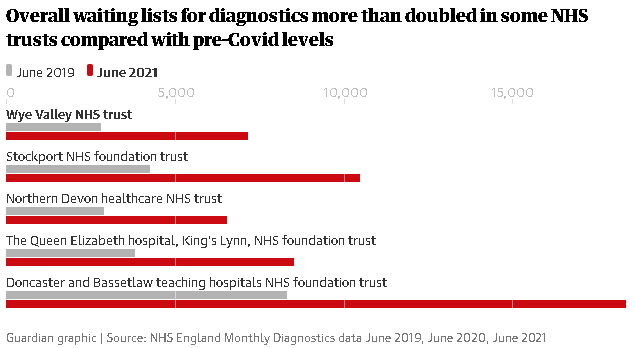
A total of 10 acute trusts reported that their diagnostic waiting lists had more than doubled when compared with the same month in 2019, with some waiting lists rising far more dramatically.
These included Wye Valley NHS trust, which had just over 2,800 patients in June 2019, rising to 7,160 in the same month this year, and Stockport NHS foundation trust, which went from 4,260 patients on waiting lists to 10,467 in 2020.
A spokesperson for Wye Valley NHS trust said it had put measures in place – including the recent addition of extra scanners on the hospital site – to increase diagnostic capacity and reduce the number of patients waiting for investigations.
A Greater Manchester health and social care partnership said Stockport and other trusts had a range of measures in place to see patients waiting for a diagnostic test as quickly as possible, including clinically prioritising urgent cases and running weekend clinics.
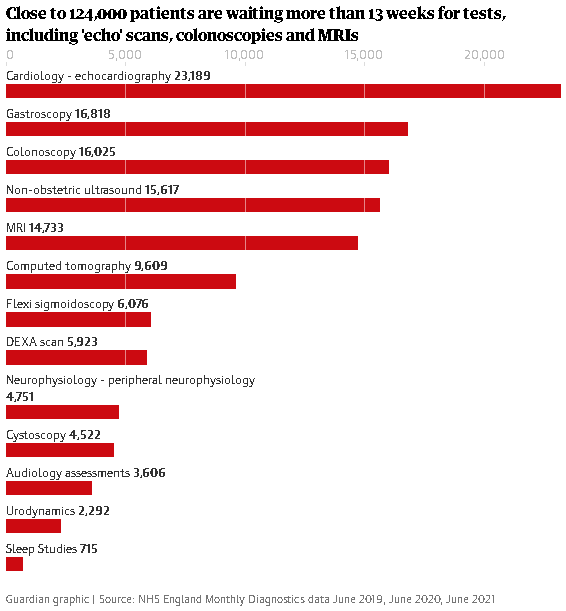
More than half of all patients waiting more than six weeks across England require one of three tests: non-pregnancy related ultrasounds, “echo” scans – used to detect potential heart failure and congenital heart disease – or MRIs.
Rachel Power, the chief executive of the Patients Association, said it was clear that the pandemic had “disrupted every aspect of the delivery of healthcare”.
“To reduce waiting lists the NHS needs to deliver care at a faster rate than patients are presenting with new need, or needs they’ve been keeping to themselves throughout successive lockdowns. To be able to do that it needs strong leadership and more resources – human and financial.”
Nuffield Trust’s deputy director of research, Dr Sarah Scobie, said: “The waiting list for these critical tests has now swelled well above normal levels, compounded by the impact of the pandemic.”
However, she pointed to a recovery in diagnostic activity, adding that NHS trusts had worked hard to ensure the number of scans and other tests did not dip to the level recorded during the first wave, despite the extreme pressure on services.
“But there are still too many people waiting for tests,” Scobie said. “These delays can slow down treatment decisions and risk worsening health needs if serious conditions aren’t identified quickly.”
A spokesperson for NHS England said treating more than 400,000 seriously ill Covid patients had inevitably had an impact on other parts of the health service, but the system was “showing strong signs of recovery in areas including diagnostics”.
“Latest figures also show that average waiting time for a diagnostic test has fallen to less than three weeks, and the number of patients waiting six weeks or more has dropped by more than a third since this time last year, so the NHS continues to encourage anyone with health concerns or symptoms to come forward so we can help you.”